34 Province Project: Zhejiang 浙江

Zhejiang is another one of those Chinese provinces most people may have vaguely heard of, but likely know little about. On the coast just south of Shanghai, its capital Hangzhou lies at the mouth of the Zhe River, or Zhèjiāng in Chinese, hence the name. During its Song dynasty heyday in the 1200s, it was likely the world’s largest city and, if you trust Marco Polo, “the finest and noblest city in the world”, making it, if you trust Wikipedia, “synonymous with luxury and opulence in Chinese culture” ever since. Today it’s best known for its scenic spot the West Lake and the HQ of tech conglomerate Alibaba.

Befitting Hangzhou’s reputation for luxurious living, Zhejiang cuisine (浙菜 Zhè cài) is one of the Eight Great Traditions, but at first glance it’s hard to differentiate from the fare eaten in nearby Shanghai and Jiangsu. (Bonus confusion point: the famed Zhenjiang vinegar, with an extra “n”, comes from the town of that name in Jiangsu, not Zhejiang.)

In Singapore, as far as I can tell, there are no dedicated Zhejiang restaurants, although there’s a place called West Lake that serves mighty fine Fujian food. Instead, the whole broad area tends to get lumped together as Jiangnan, meaning “South of the Yangtze”, and even that is a bit rare on the ground, with flag bearer Jiang-Nan Chun at the swanky Four Seasons hotel upholding the aforementioned reputation by charging a cool $248++ a whack for their apparently less than traditional haute cuisine interpretation.

Possibly the most iconic Hangzhou dish is Dongpo pork (东坡肉 dōngpōròu), which I sampled at local chain Dian Xiao Er (店小二), the modestly self-proclaimed “Best Chinese Restaurant in Singapore”. This is basically a thick slice of pork belly, first pan-fried and then slowly stewed in soy sauce, a technique called hóngshāo (紅燒) or “red braising” in Chinese, and according to legend invented by or at least named after Song-era poet Su Dongpo. Versions of this are eaten across Asia, including the Japanese kakuni (角煮), and Dian Xiao Er’s version delivered in spades, being meltingly soft and even the layer of fat infused with flavor.

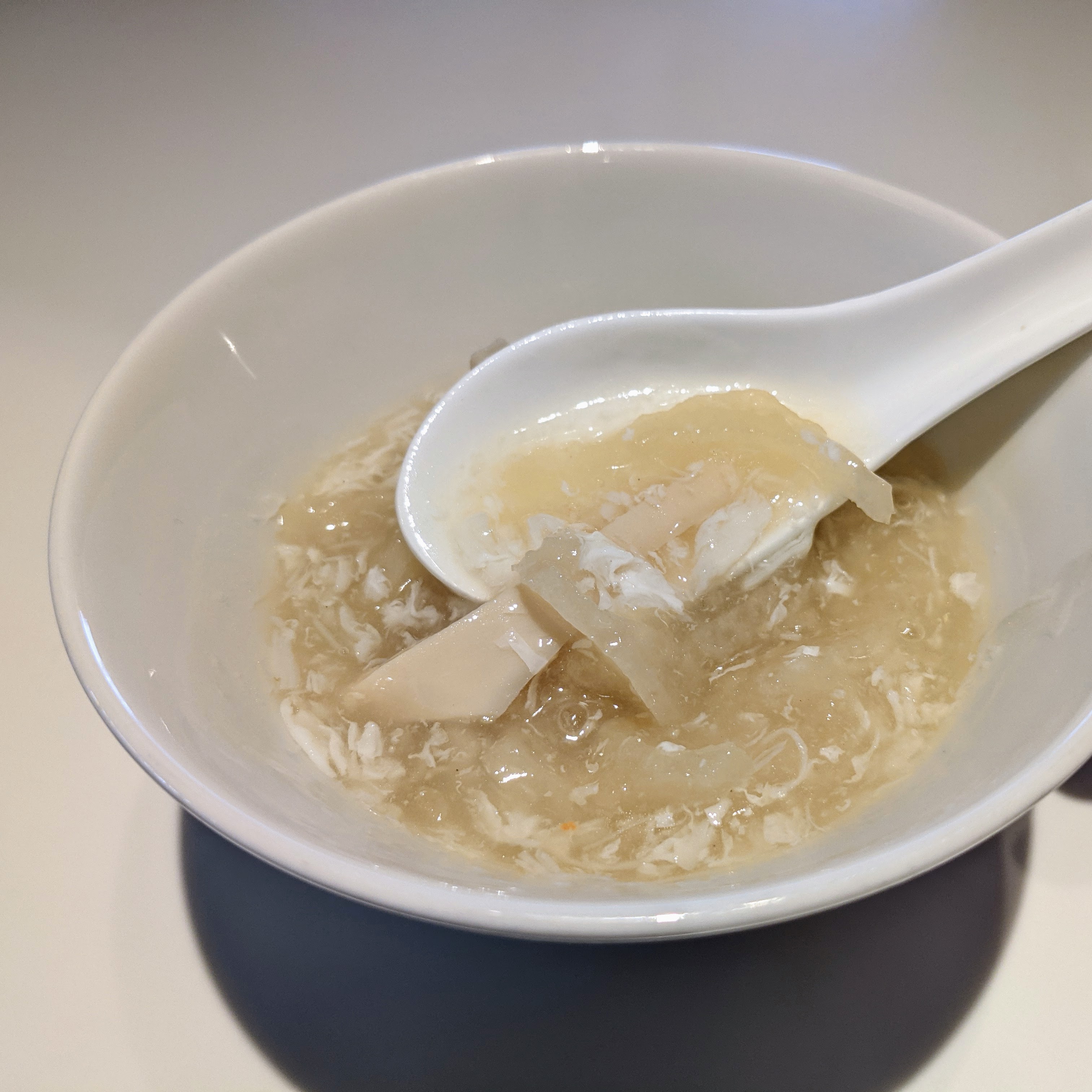
Dian Xiao Er makes no pretension to being a Zhejiang or even Jiangnan restaurant, but we ordered a few other things that seemed to point in the right general direction. The Fish Maw Thick Soup with Seafood (海鲜鱼鳔羹) was a nice example of the thickened soups called geng (羹), which are particularly prominent to the south in Fujian, served here with springy if essentially tasteless fish maw (swim bladder), slices of abalone and shreds of crab meat. This, I’m afraid, was one of those Chinese dishes that dispense with taste in favor of texture, which has always been a concept my barbarian palate struggles with.

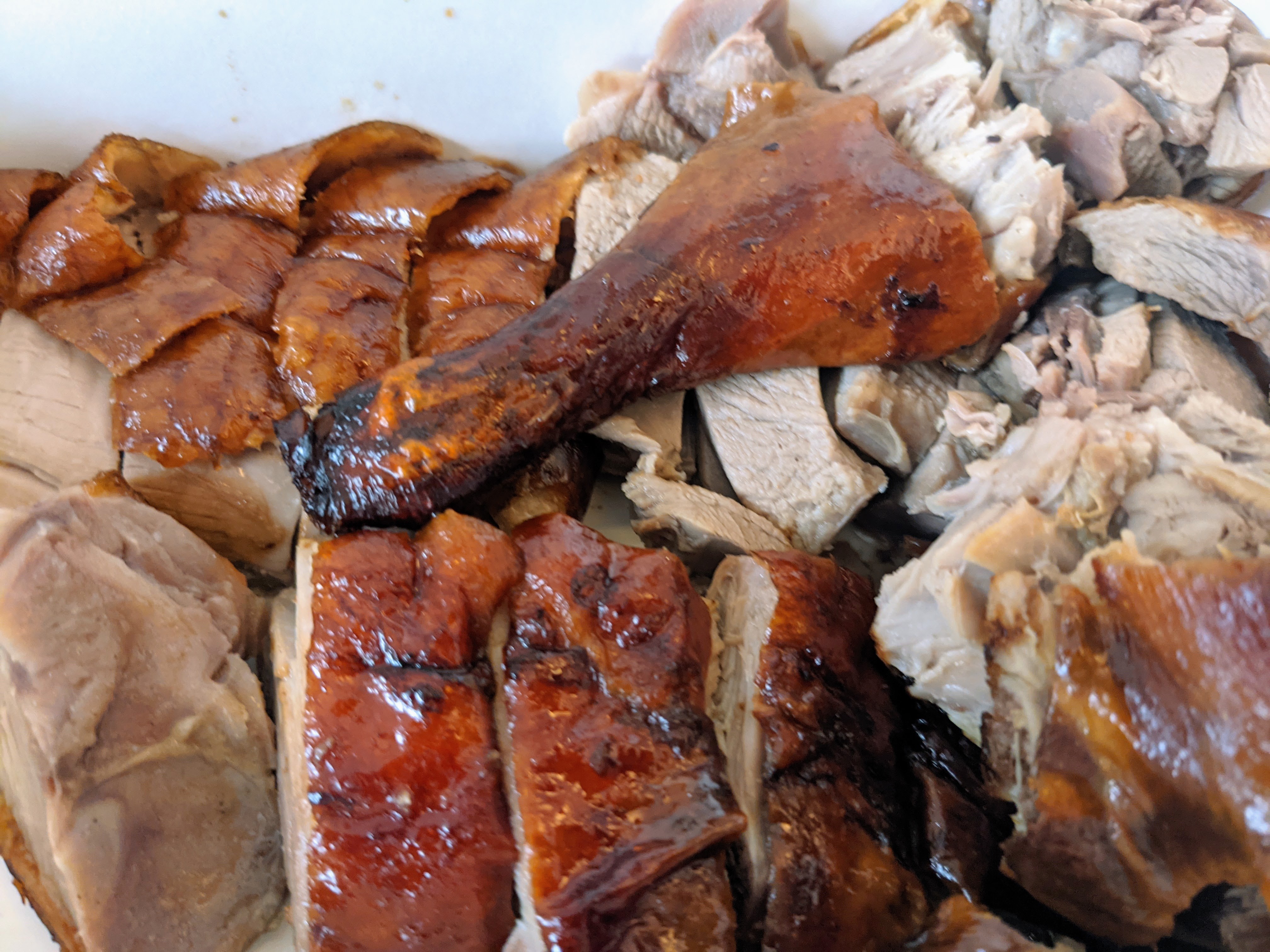
Last but not least, Dian Xiao Er’s signature dish is the Duck Roasted with Ten Wonder Herbs (十全药材烤鸭), not to be confused with KFC’s Chicken Fried with 11 Secret Herbs and Spices. The roast duck were was competent if unspectacular, but the dark, runny sauce on the side was something else, with a bouquet that the Western nose can only describe as mulled wine: ginger, star anise, cinnamon? Delish, if not particularly Zhejiang; Hangzhou has a mildly famous soy sauce duck as well, but I doubt it has much if anything in common with this one.

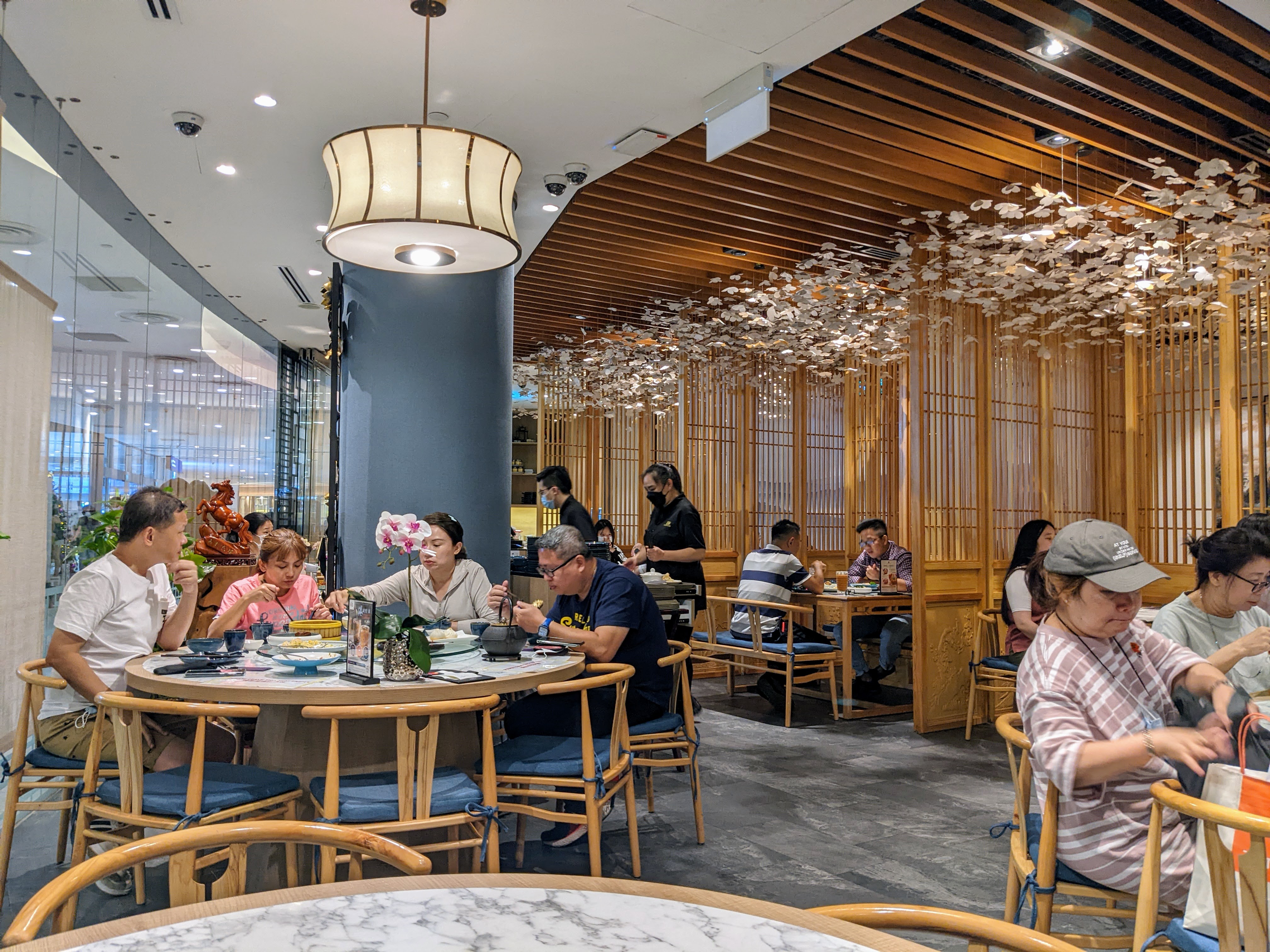
Next stop was Crystal Jade Jiang Nan (翡翠江南) in Vivocity, a themed outlet of the ubiquitous Singaporean chain. The restaurant is pretty dapper for a shopping mall, with the latticed wood booths topped by hundreds of fluttering flower cutouts particularly appealing. The menu is “inspired by” (always a dangerous phrase) “the Jiangnan and Sichuan regions”, but we steered clear of the Mala Crispy Chicken and the Mochi Cheese Balls (shudder). The Three Delicacies Platter (巧手三拼) had the Nanjing Salted Duck we already met in Jiangsu, a rather tasty take on Jiangsu Smoked Fish (江苏熏鱼) that we sample later in the Shanghai episode, and Spinach with Sesame Sauce (麻酱波菜鲜百合) that tasted an awful lot like the classic Japanese cold dish of hōrensō no goma-ae. A quick Google was inconclusive, but given that spinach is a reasonably recent import to Japan (1800s?), the two dishes may well be related.

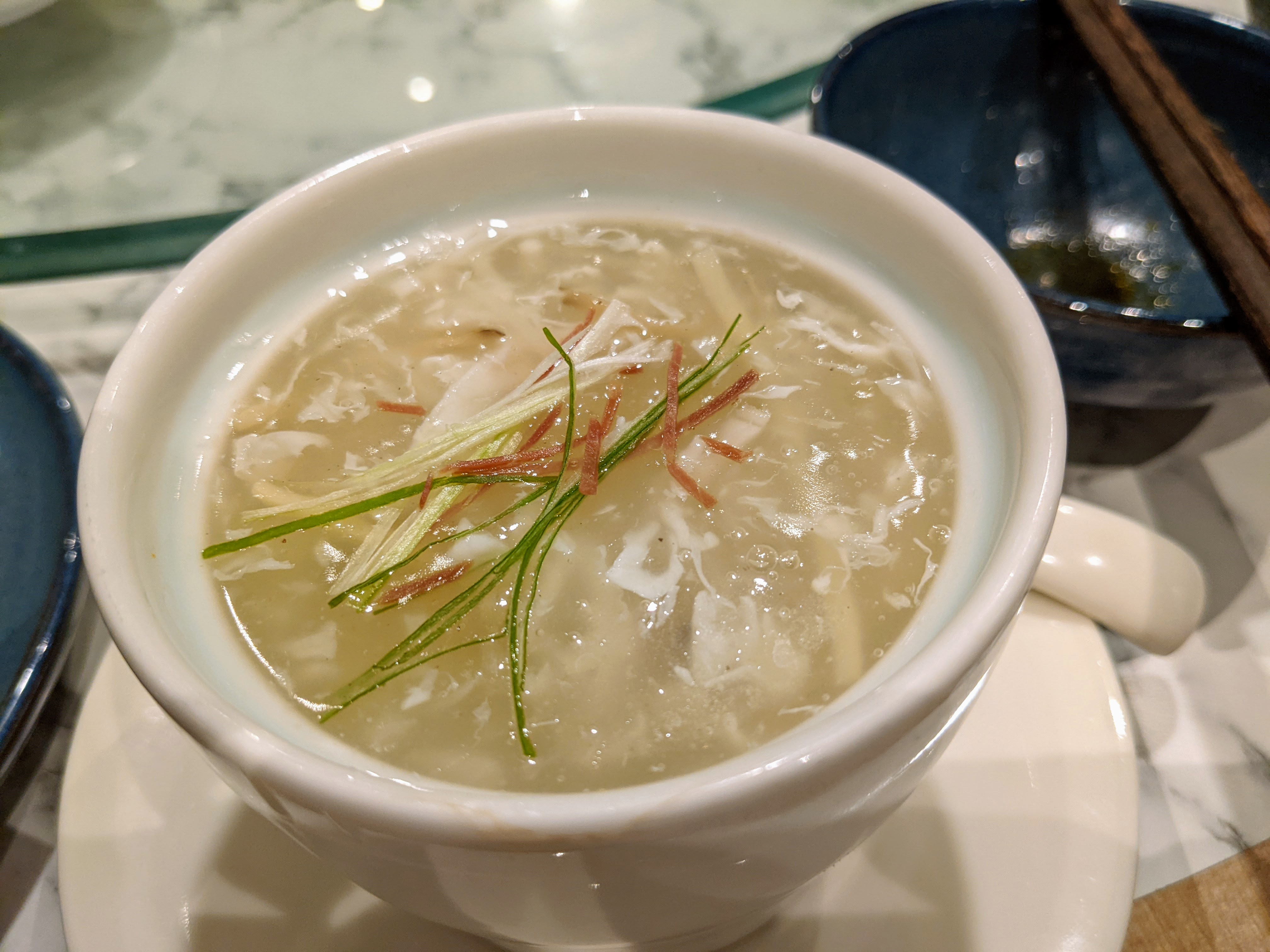
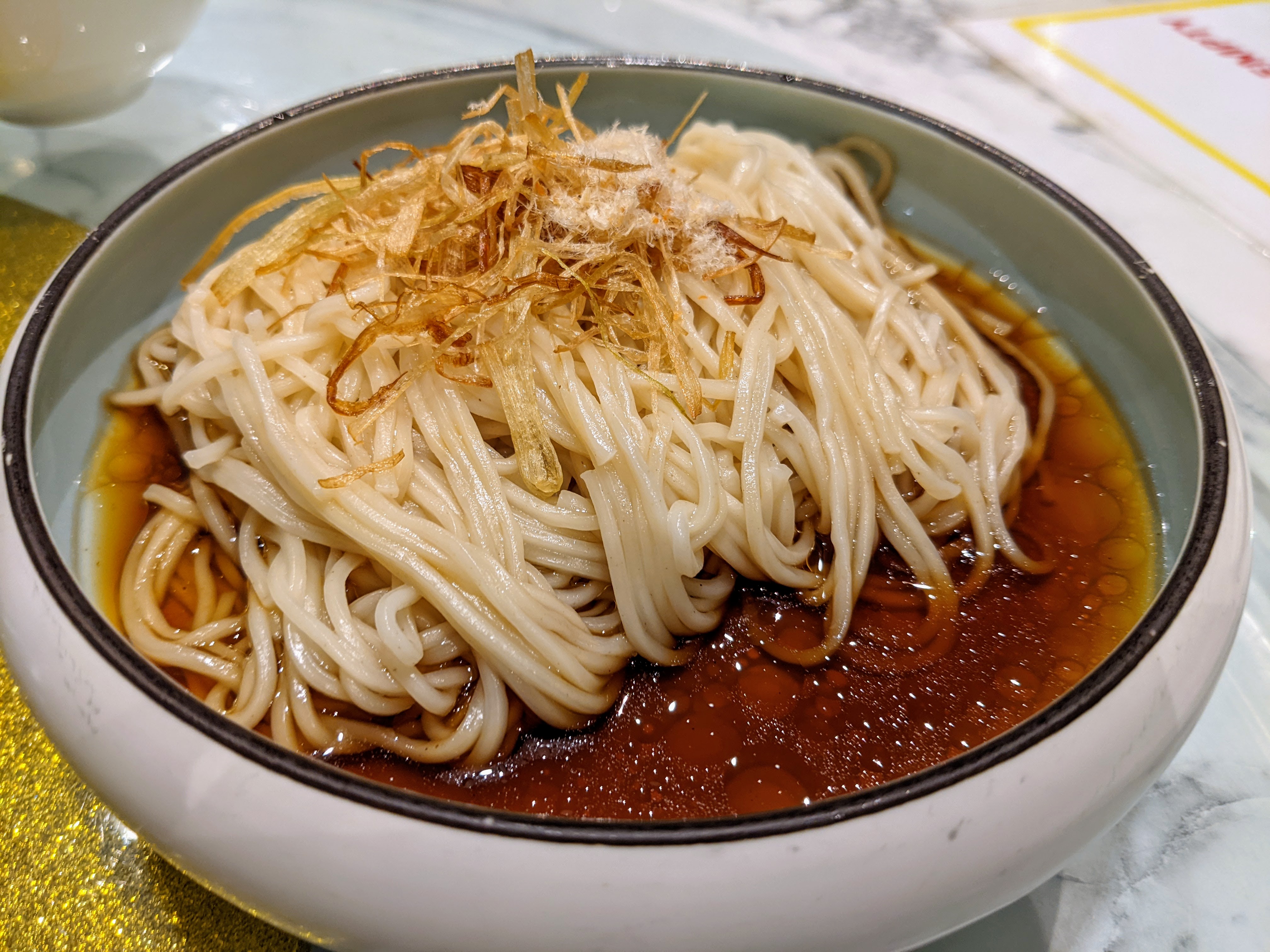
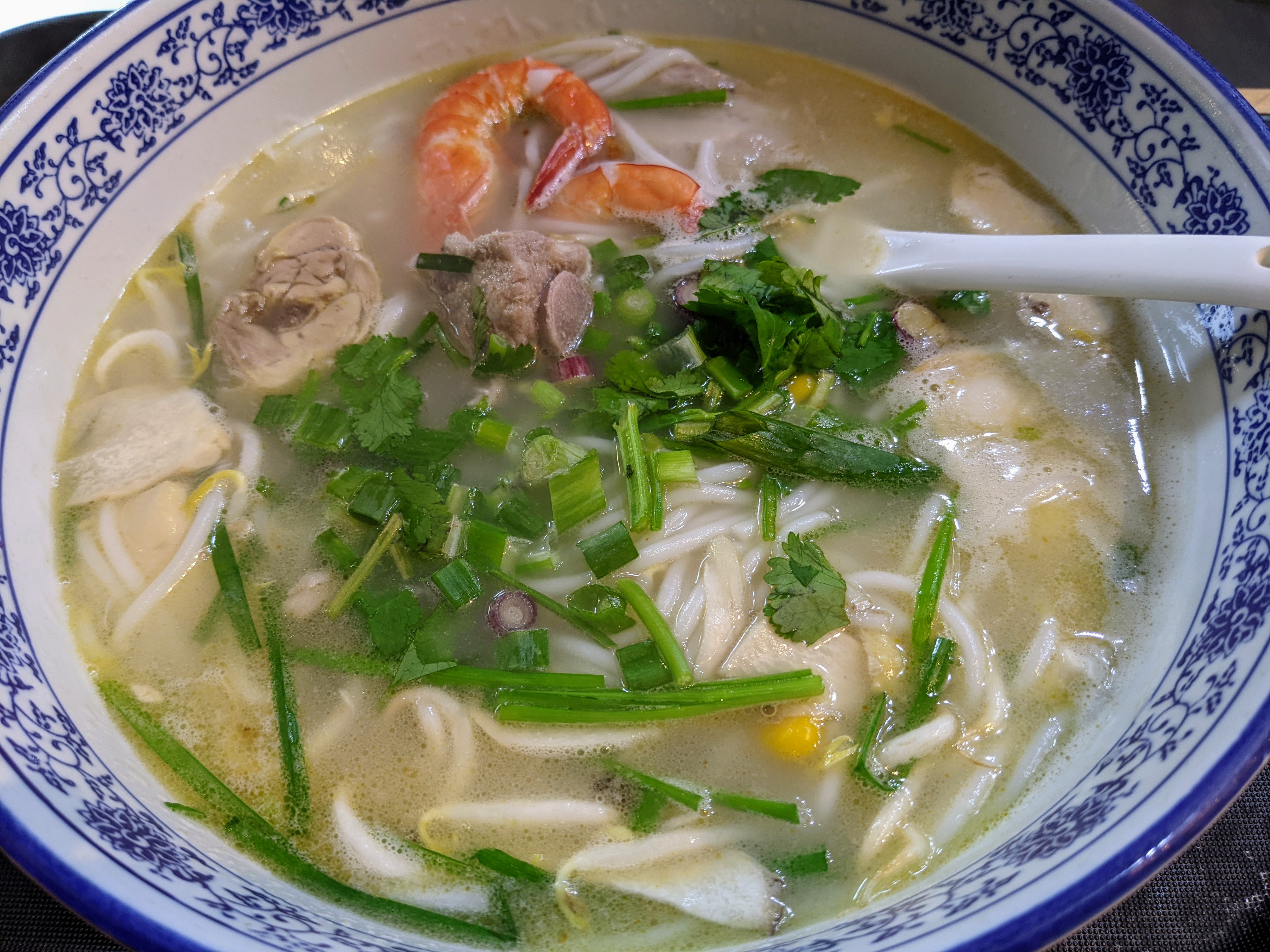
The one indubitably Zhejiang dish on the menu was Sister Song’s Thick Fish Soup (宋嫂鱼羮). Per legend, in 1197 Emperor Gaozong was out for a spin on Hangzhou’s West Lake when he felt a bit peckish and ordered some fish soup from a lady called Song Wusao, and the rest is history. It’s a deceptively simple-looking starchy soup that hides a light but complex flavour: shreds of white fish and egg white, julienned bamboo shoot, ginger and ham, a touch of vinegar, quite a bit of white pepper and a touch of Shaoxing wine (绍兴酒), commonly used as cooking wine in countless Chinese dishes but originating from Shaoxing, Zhejiang. Very moreish. Less Zhejiang but an unexpected hit with the kids was the Scallion Oil Noodles (葱油面), an even simpler Shanghai dish: hand-pull lamian noodles, fry slivered scallion in oil, combine and enjoy. And we rounded things out with Crystal Jade’s signature xiao long bao dumplings, another tasty Shanghai dish, and pan-fried shengjianbao, which unfortunately were soupless and sad. (More about both in the Shanghai episode.)

The one unforgivable crime of the restaurant, though, was that the tea menu did not feature what is probably China’s and certainly Zhejiang’s most famous tea, namely Dragon Well (龙井 lóngjǐng) from Hangzhou. Instead I had to drown my sorrows in a pot of Precious Eyebrows (珍眉 zhēnméi), variously credited to Anhui and Jiangxi but quite possibly grown in Zhejiang, and the kids were bribed with complimentary pig-shaped red bean buns courtesy of the Vivo Kids Club. Total damage for 3 came to $88, which is actually kinda ex given that we were still a little hungry afterwards.

And that brings us to the end of the Zhe River. The final Zhejiang-in-Singapore dish I wanted to tick off my list is West Lake Beef Soup (西湖牛肉羹), but this is conceptually pretty similar to Sister Song’s fish version, usually served as an appetizer or side dish, and mostly served at barbecue places that don’t even pretend to have anything to do with Zhejiang. So with two gengs down, it’s time to hit the closing gong and move onto our next province.

<<< Hong Kong | Index | Hainan >>>

34 Province Project: Hong Kong 香港

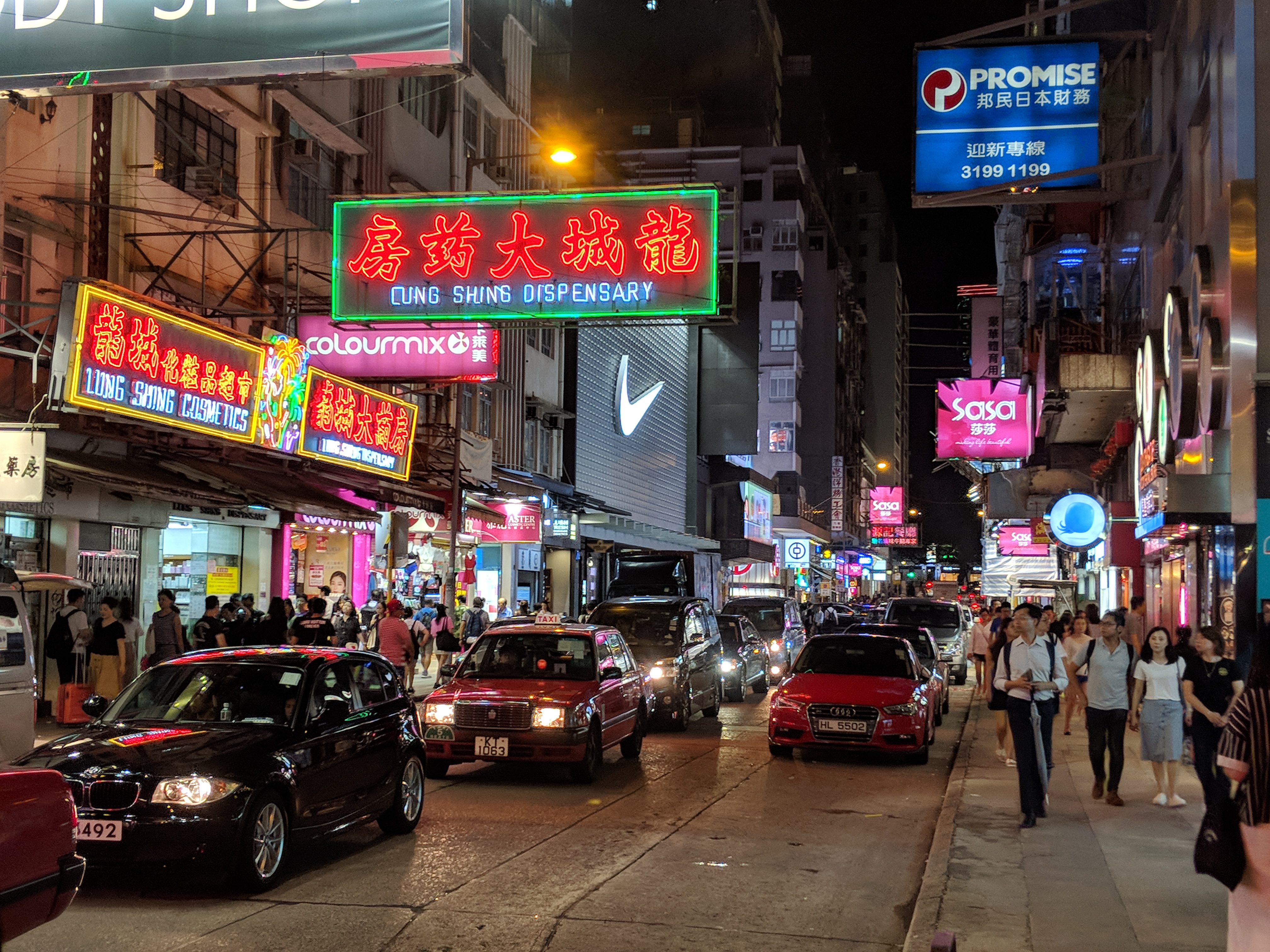
Hong Kong! Former British colony and financial powerhouse, the “Fragrant Harbour” (Heunggong in Cantonese, Xiānggǎng in Mandarin) of the South China Sea is one Chinese province Special Administrative Region that needs little introduction.

Language nerd alert: Hong Kong uses traditional characters and Cantonese, but many of these dishes are common in Singapore too and thus have local names. If you see tone marks, it’s Mandarin/simplified, if you don’t, it’s Cantonese/traditional. This, too, is unfair since Cantonese is actually even more tonal than Mandarin, people just can’t seem to agree on how to write all 9. 對唔住。

I’ve been to Hong Kong more times than I can count, including at the tail end of the Siberia to Lhasa trip, and have had the chance to explore a fair bit of the city, the mountains and the islands. In terms of classical Chinese cuisine, Hong Kong falls squarely in the Cantonese corner (粤菜 Yuè cài), but what makes eating there so interesting is the cosmopolitan nature of the city. Not only can you get excellent food from every corner of the globe, from French to Indian to Japanese, but 150 years of British colonisation left a deep mark on the city, resulting in its own unique Hong Kong cuisine. So for this episode, I’m going to try to find the essence of Hong Kong in Singapore, and leave “standard” Cantonese cuisine for the Guangdong episode.

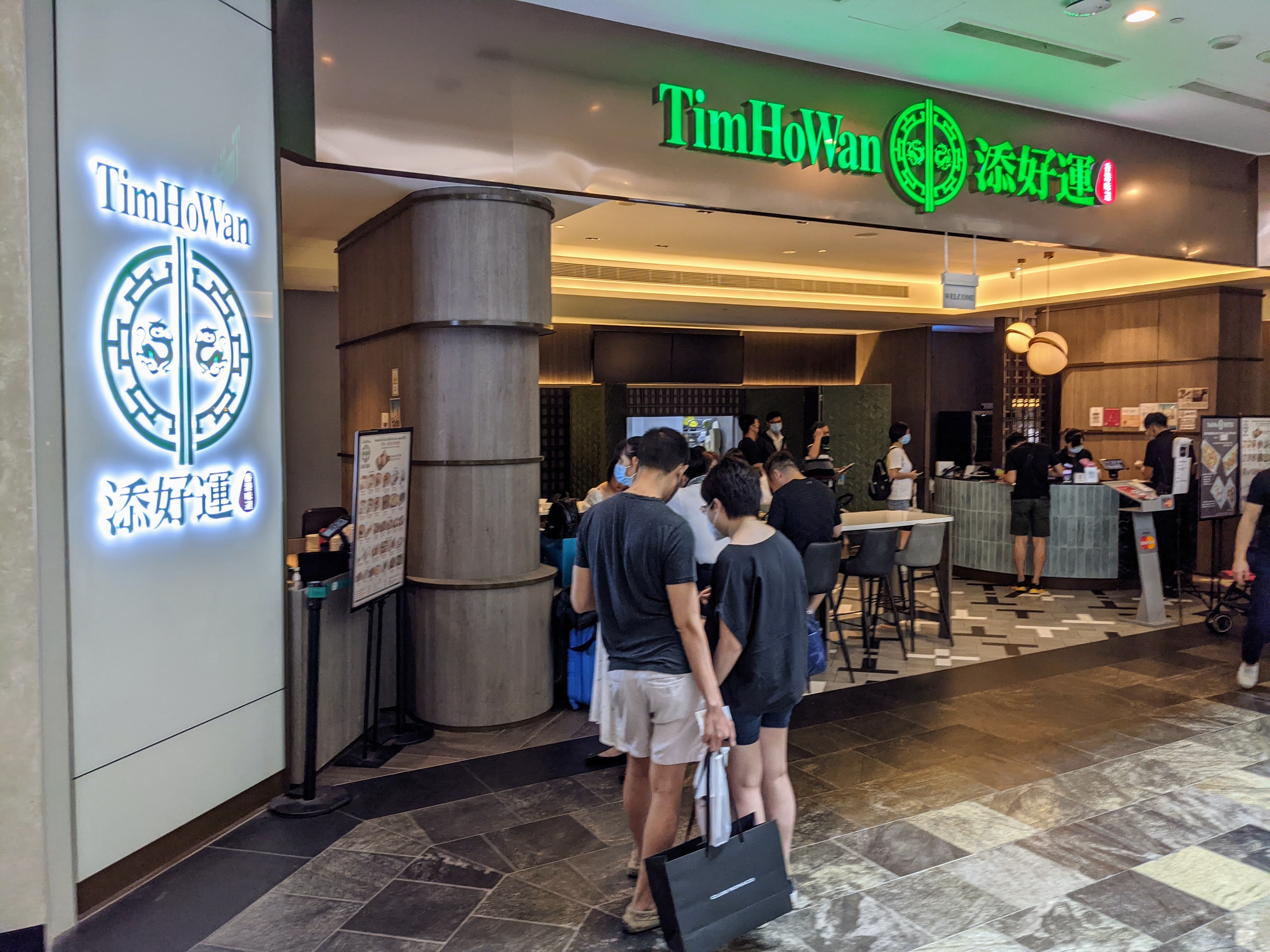
Finding food that claims to be from Hong Kong in Singapore is easy, but weeding out the pale imitations and choosing the most representative options is harder. But you can’t cover Hong Kong without dim sum (点心), that justly renowned Cantonese tradition of stuffing your face with an endless series of small bites washed down with tea, so the first pick was easy: Tim Ho Wan (添好運), the “world’s cheapest Michelin star restaurant”, and now a multinational dim sum franchise owned by the Philippines’ answer to McDonalds, Jollibee. I’ve been to Tim Ho Wan once before in Sydney, and I remember being distinctly disappointed, apparently a widely shared feeling since the Australian operation went bankrupt shortly afterwards. But the Singapore operation had a better rep, so we queued up for lunch one day at Marina Bay Sands to check it out.

First cab off the rank was their famous Baked Bun with BBQ Pork (酥皮焗叉烧包), a Tim Ho Wan only invention which takes dim sum staple char siew bau (BBQ pork buns) and gives it a sweet, crunchy crust not unlike a Japanese melon pan (which contains no actual melon, it’s named for the appearance). The kids liked it, but both adults found it just too sugary.

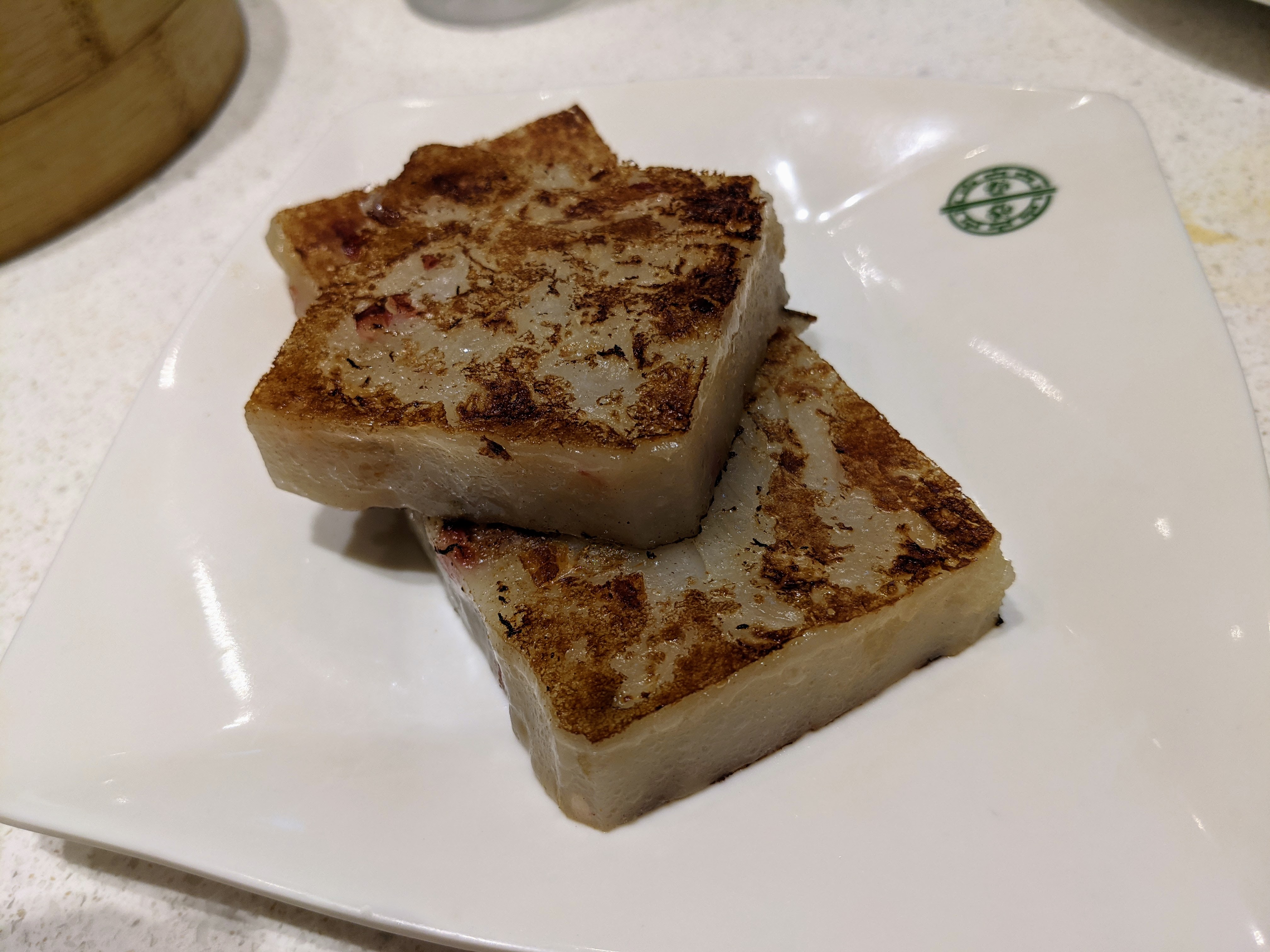
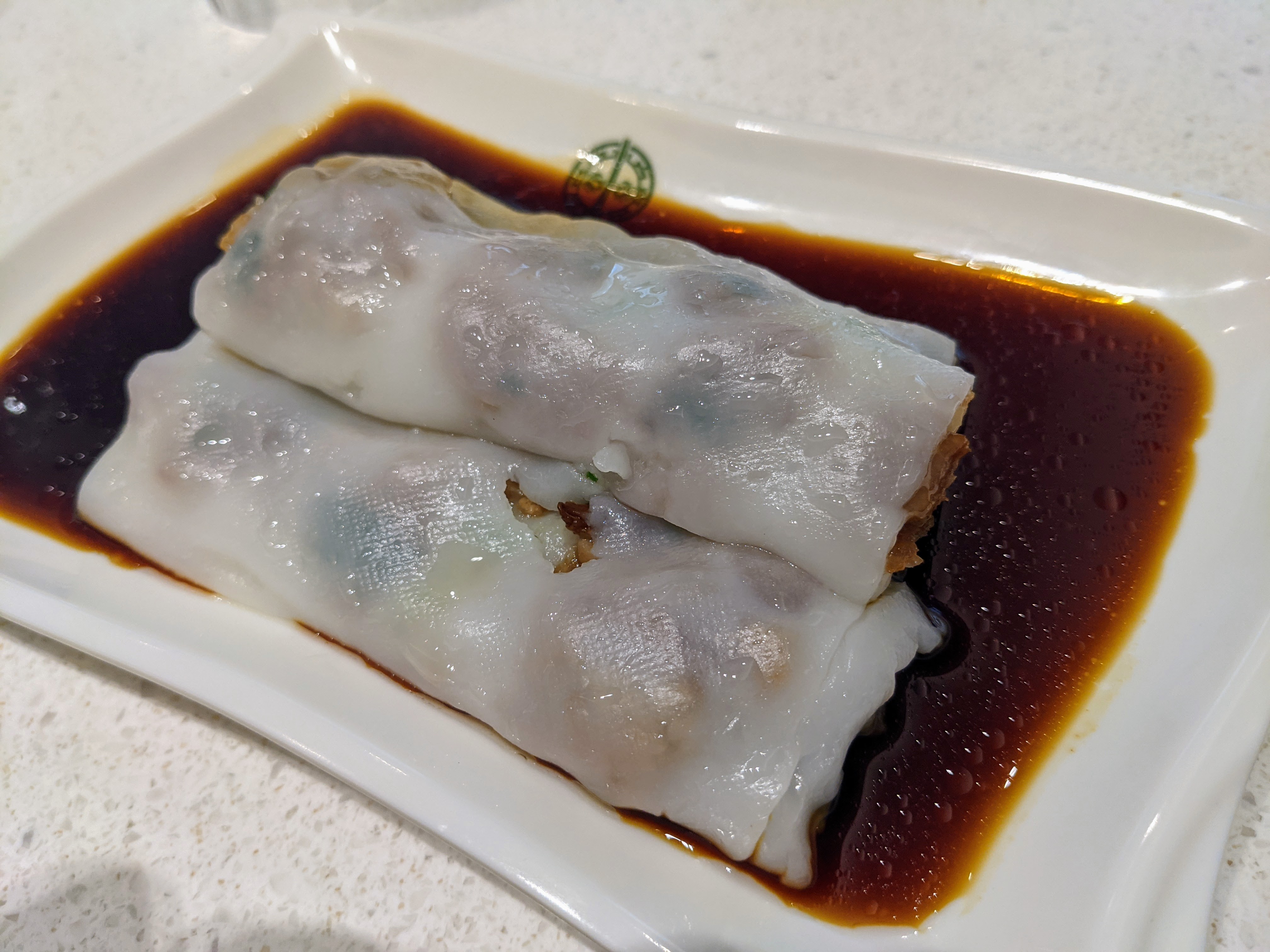
The other three dishes in Tim Ho Wan’s pantheon of Four Heavenly Kings of Dim Sum (四大天王点心) are Pan Fried Carrot Cake (香煎萝卜糕), Steamed Egg Cake (香滑马来糕) and Vermicelli Roll with Pig’s Liver (黄沙猪润肠). This carrot cake has nothing to do with the Western dish: it’s a Singaporean mistranslation of white radish (daikon) cake, since carrots are called “red radish” (红萝卜) in Hokkien. This can be gloopy and greasy, but the ones here were quite nice, freshly made with bits of bacon and just enough radish taste. The Steamed Egg Cake, literally a “Malay cake” in Chinese, was a new acquaintance akin to a moist sponge cake, very light and airy with a distinct but not overpowering cane sugar kick. Pig’s liver was, regrettably, off the menu so we got the char siew version instead, which was OK, but not really different to the chee cheong fun at any Singaporean hawker center. We rounded things off with a few siew mai dumplings (OK), tofu skin wraps both fried (excellent) and steamed (mediocre), a lor mai kai glutinous chicken rice (good), and finally some osmanthus jelly with goji berries for dessert. Total damage: $90 for 4.

Now my expectations for ambience and service are usually pretty low, but we couldn’t help but compare this to our usual Michelin-starred chain standby Din Tai Fung, whose prices are in the same ballpark but which manages to feel like a restaurant instead of a food court. At DTF, tea is served in a pot instead of plastic cups, portions are more generous, and everything just tastes fresher and better. Alternatively, at our local hawker, Tai Heng Handmade Dim Sum does dim sum of an (IMHO) equal if not superior quality for less than half the price. I don’t think we’ll be back.

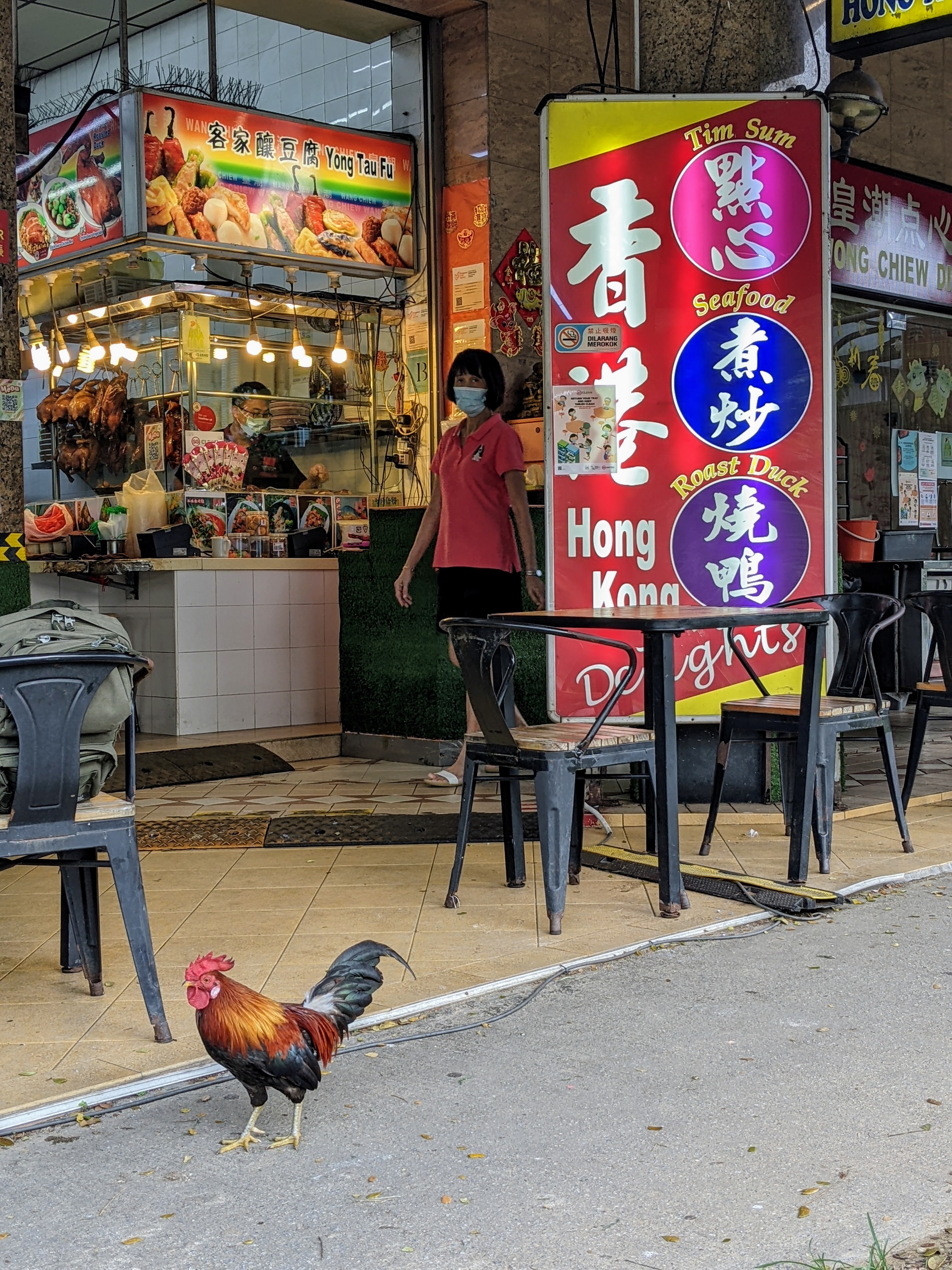
After that Michelin star disappointment, it was time to visit a distinctly non-famous Hong Kong joint, namely Wong Chiew (皇潮, “Imperial Teochew”) off Sembawang Rd near Springleaf. Neh’mind the atas name, this casual eating house is so ulu it always has red junglefowl, Singapore’s wild ancestral chickens, running through it, and I suspect army boys from the nearby bases come here more for the $8.50-for-3 Tigers beer promos than the food: as you can see, even the letters on their signboard are drunk. They used to open 24 hours until COVID spiked that, but they’re still open 6 AM to 1 AM, perfect for the tail end of my long Mandai Rd bike runs past the zoo.

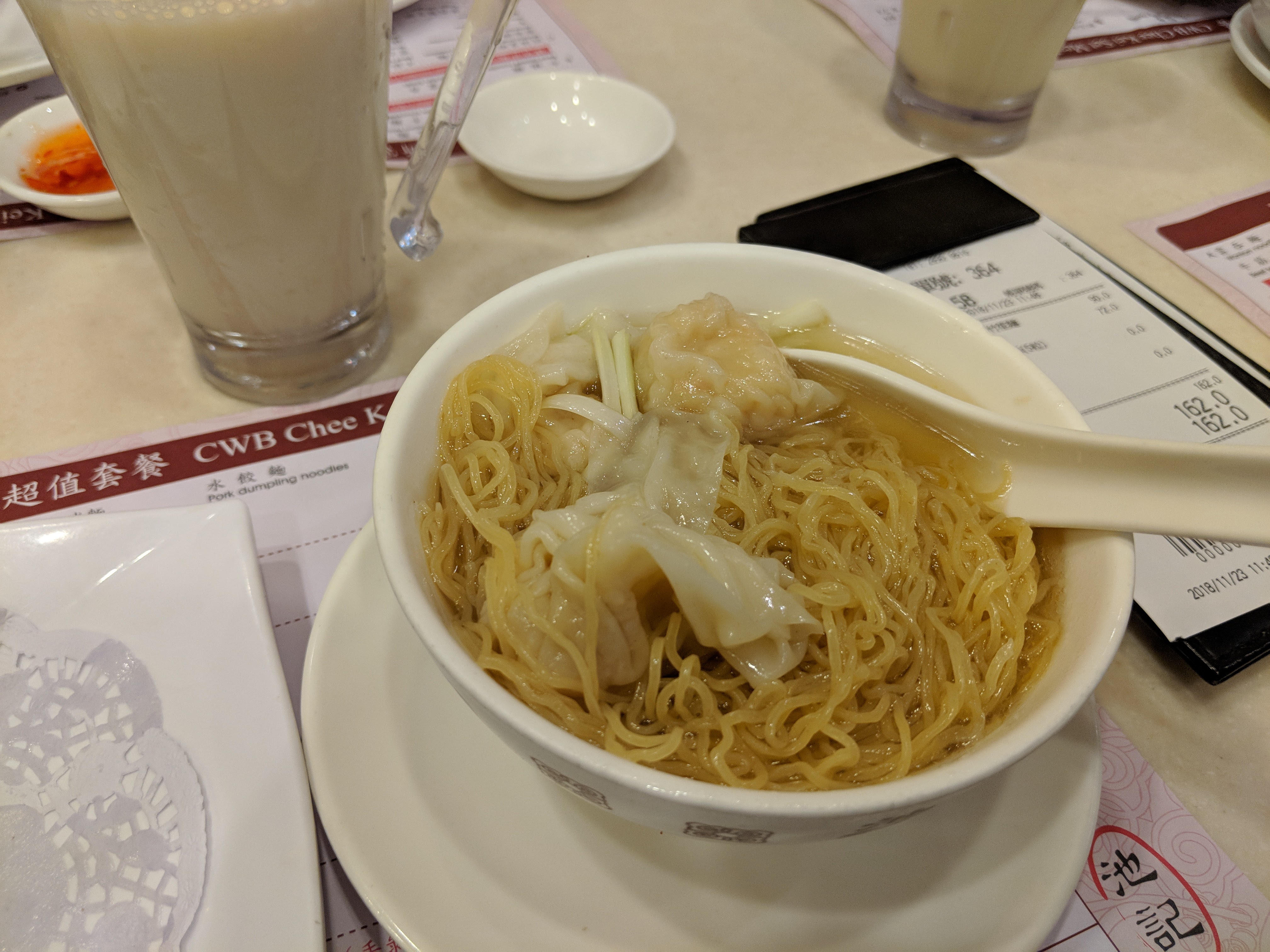
The menu is enormous and has Hakka yong tau foo, rice porridge (congee/juk), roast meats, lots of seafood, zi char (family-style eating) favorites and much more. My default breakfast, though, is the dry wonton mee (雲吞麵, “swallowing clouds noodles”), served here with plump house-made wonton dumplings, delicious fatty chunks of char siu (叉烧) barbecued pork cooked in the big oven in the back, and a bowl of chicken stock with a big ol’ chunk of daikon radish. It’s hard to cook the thin, eggy yòumiàn (幼面) noodles just right, al dente but not too chewy, and in Singapore the noodles tend to get overpowered by chilli to boot, but here the sauce is mild and generous and instead of sambal belacan you get sweet, vinegary green pickled chillies served on the side like God intended. The handmade dim sum here is also on point, and I have a particular soft spot for their siu mai (燒賣), made from coarsely chopped pork, a generous whole shrimp in each dumpling, and a sprinkling of fish roe on top. If you want something even more substantial, get the Char Siew Roast Meat Rice, which pairs up the char siu with siu yuk (燒肉) pork belly that reminds me of proper Finnish Christmas salted ham, with a crispy skin and salt soaked into the fatty meat. Add in a drink and you’ll still escape for less than $10, under half the price of Tim Ho Wan, and it even feels like Hong Kong because the service is borderline-rude brusque yet efficient. Authentically HK? Eh, probably not. Delicious? Oh yes. Oi Michelin, give that star to someone who deserves it!

The second uniquely Hong Kong institution I wanted to explore is the cha chaan teng (茶餐厅), serving a uniquely Hong Kong mishmash of Western and Chinese food that would have frou-frou fusion places recoil in horror. Typical dishes include macaroni soup with Spam, Coca-Cola boiled with ginger, and unusual riffs on toast.

Now back in Hong Kong, these are essentially greasy-spoon diners that open late and serve food that’s fast, easy and cheap like your mom, but a few have grown famous enough to branch overseas. One of these, Tsui Wah (翠華, “Emerald Brilliance”), now has four branches across Singapore, so on a random Saturday I dropped into their rather swish riverfront Clarke Quay outlet for a midmorning snack. Eight minutes after opening at 10:30 AM, there was already a queue — how were they going to tiptoe the awkward line of going upmarket without losing what made them famous in the first place?

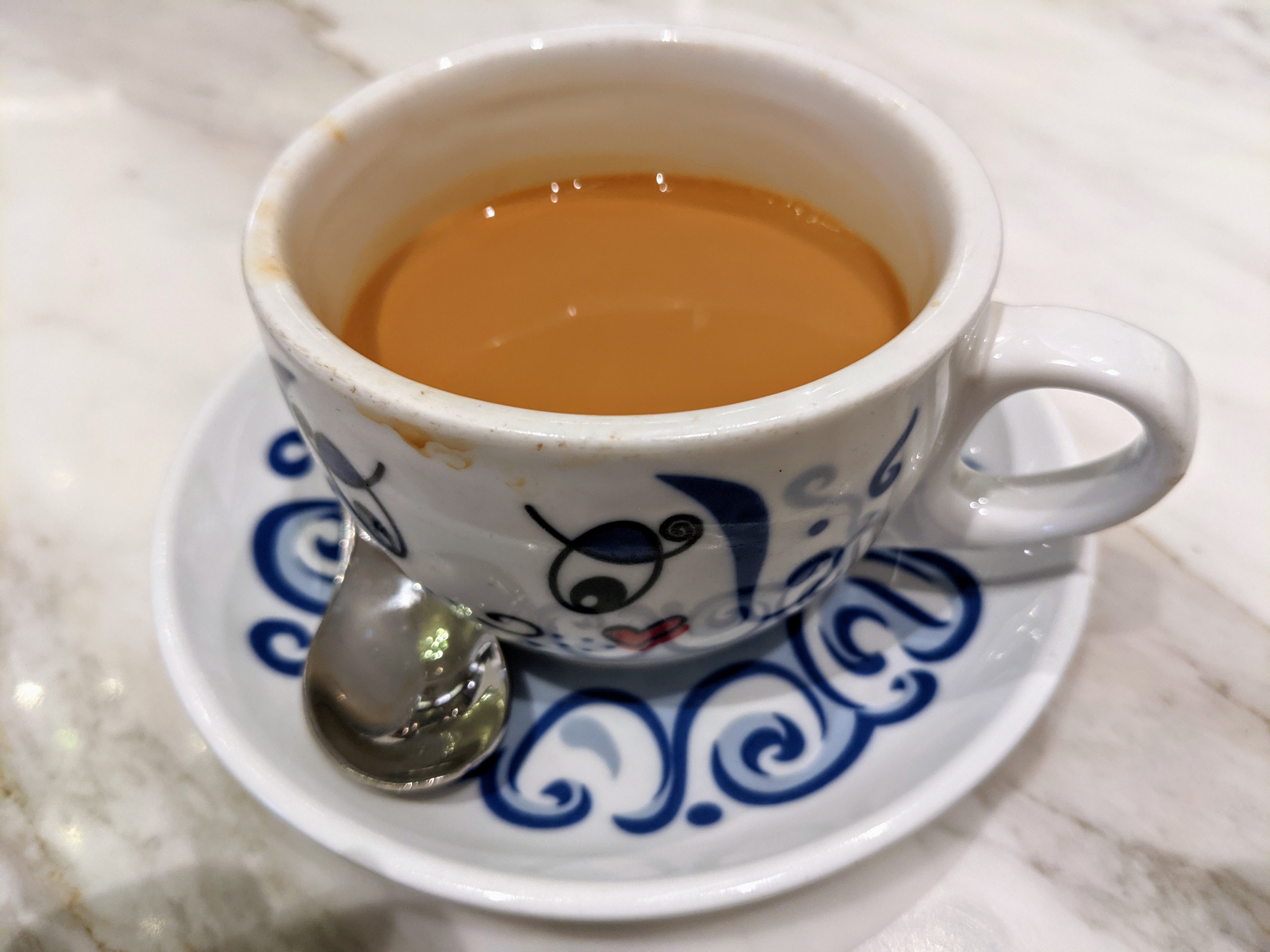
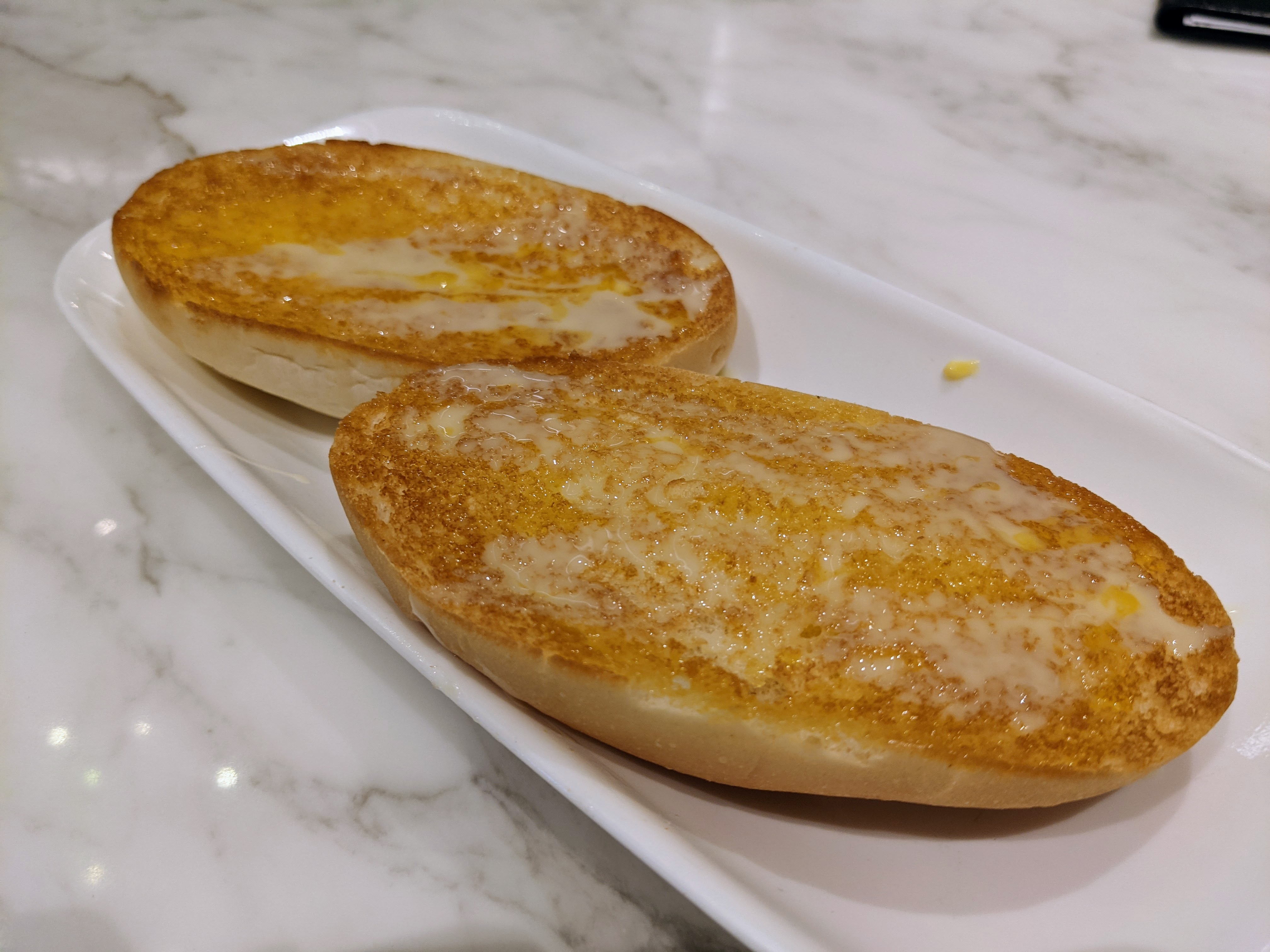
The canonical drink at a cha chaan teng is milk tea (奶茶), brewed to teeth-shattering strength (3 teaspoons per cup, brewed for 6 minutes is not uncommon), topped off with evaporated milk, and served with sugar on the side. (Add tapioca balls and ice, and you get Taiwanese bubble tea.) The end result is essentially the same as my standard Singaporean coffeeshop order of teh C kosong, meaning tasty enough, but $3.50++ instead of the usual $1 and change. To go with it I tried their famous Crispy Bun With Condensed Milk ($4), which is pretty much just that: a baked bun slathered with butter and sweet condensed milk, perfectly designed to shred and burn the roof of your mouth if you’re a greedy pig like me who attempts to eat it without letting it cool down a bit first.

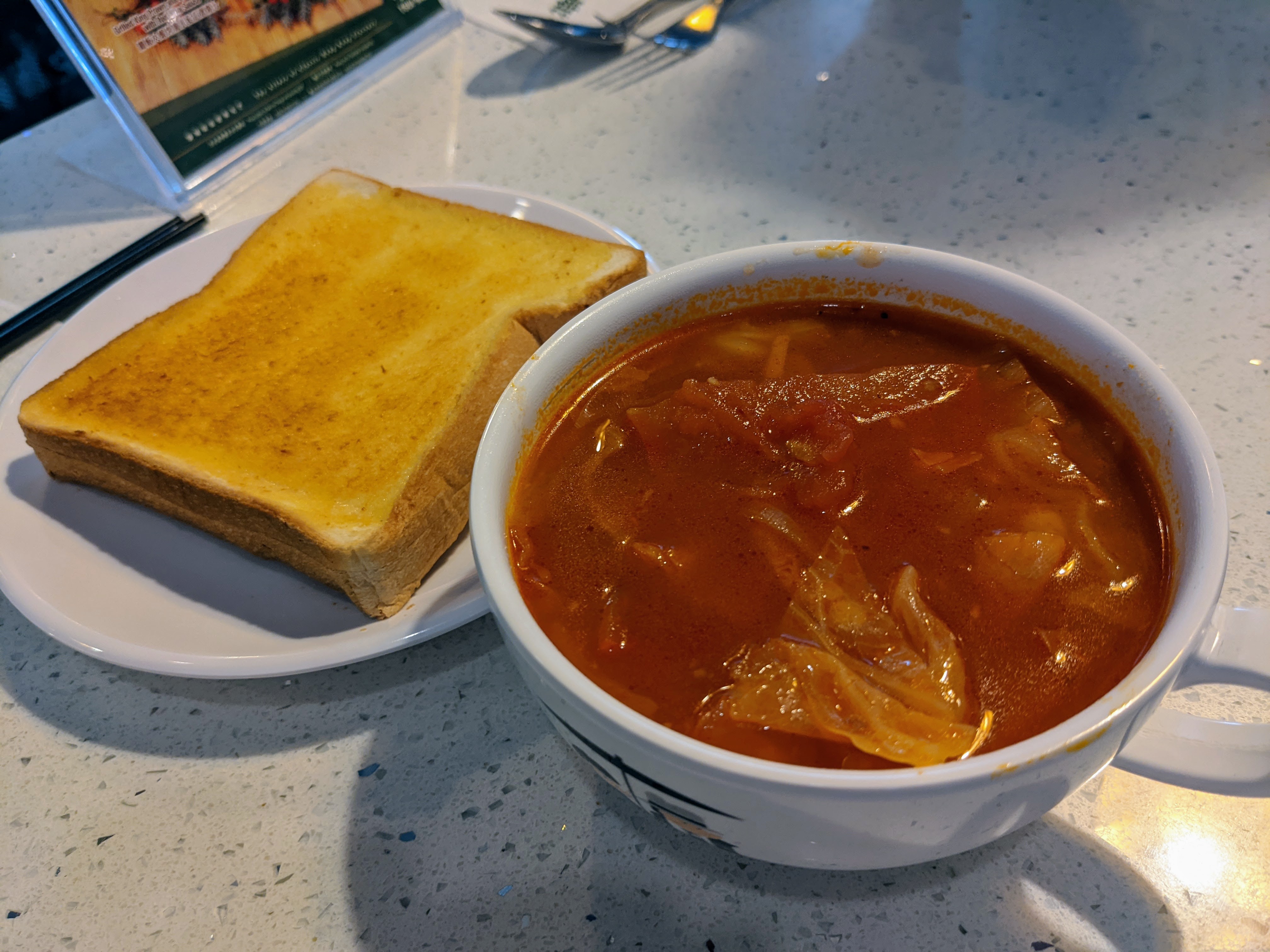
Appetite whetted, I returned with reinforcements for a more substantial meal at their Orchard branch, somewhat bizarrely hidden inside the multistory Courts household appliance emporium at Heeren, and ordered a random selection off their Signature Dishes menu. Borscht (羅宋湯) Hong Kong style mutates this pan-Slavic beetfest into a cabbage and tomato soup with a touch of chilli, served with a thick slice of buttered toast, both of which got the thumbs up from the jury. Tsui Wah’s Jumbo Hot Dogs come with a big old wiener, ketchup, mustard, lettuce and tomato in an un-American crusty bun. Somewhat disturbingly, unlike (say) the Japanese hotto doggu, hot dogs are rendered literally into Chinese as 熱狗, which is doubly incongruous since 狗 (gǒu) is commonly used as an insult, as in the “running dogs” (走狗 zǒugǒu) of imperialism etc. 资本主义的热狗万岁! May the hot dogs of capitalism live ten thousand years!

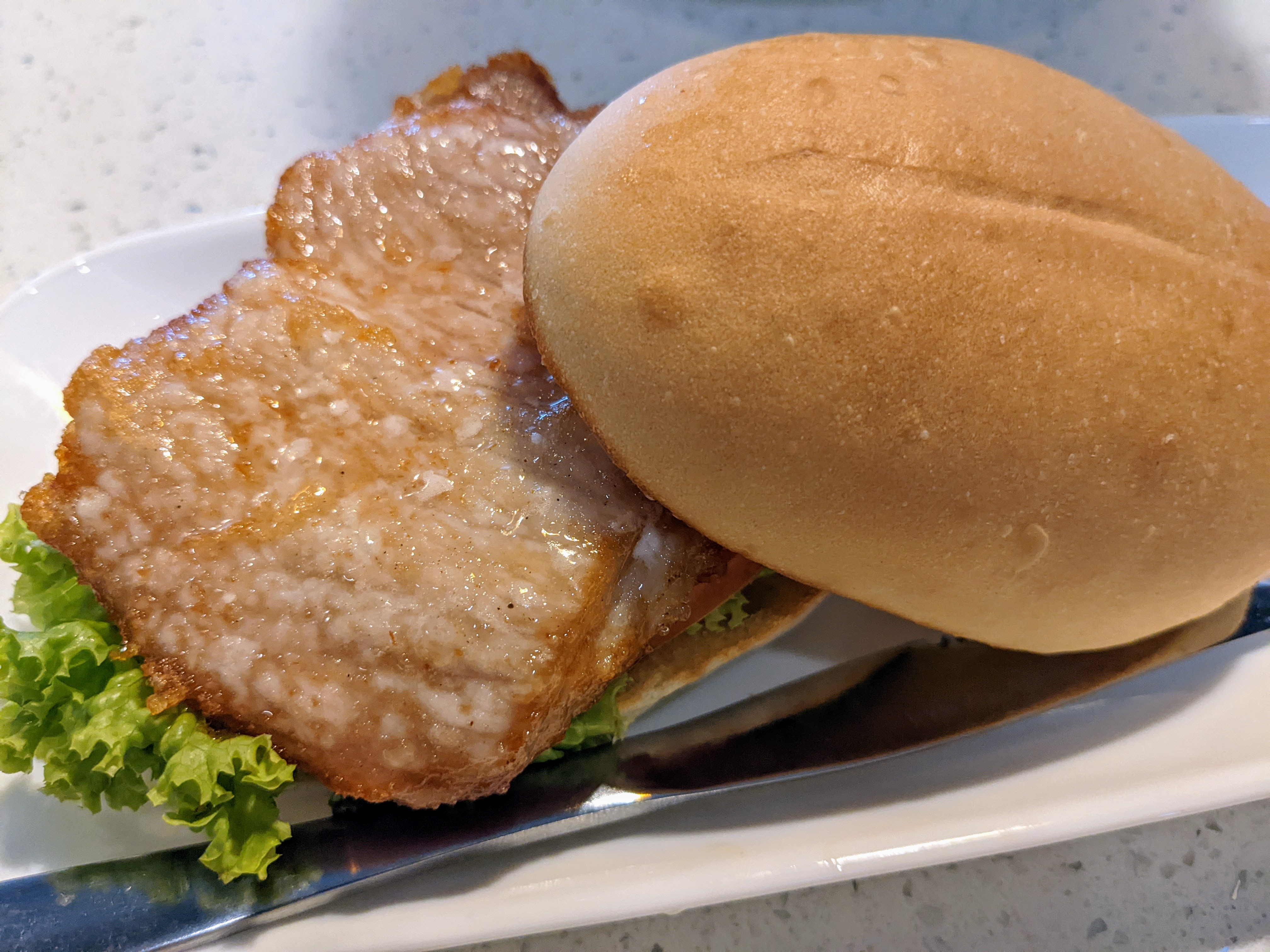
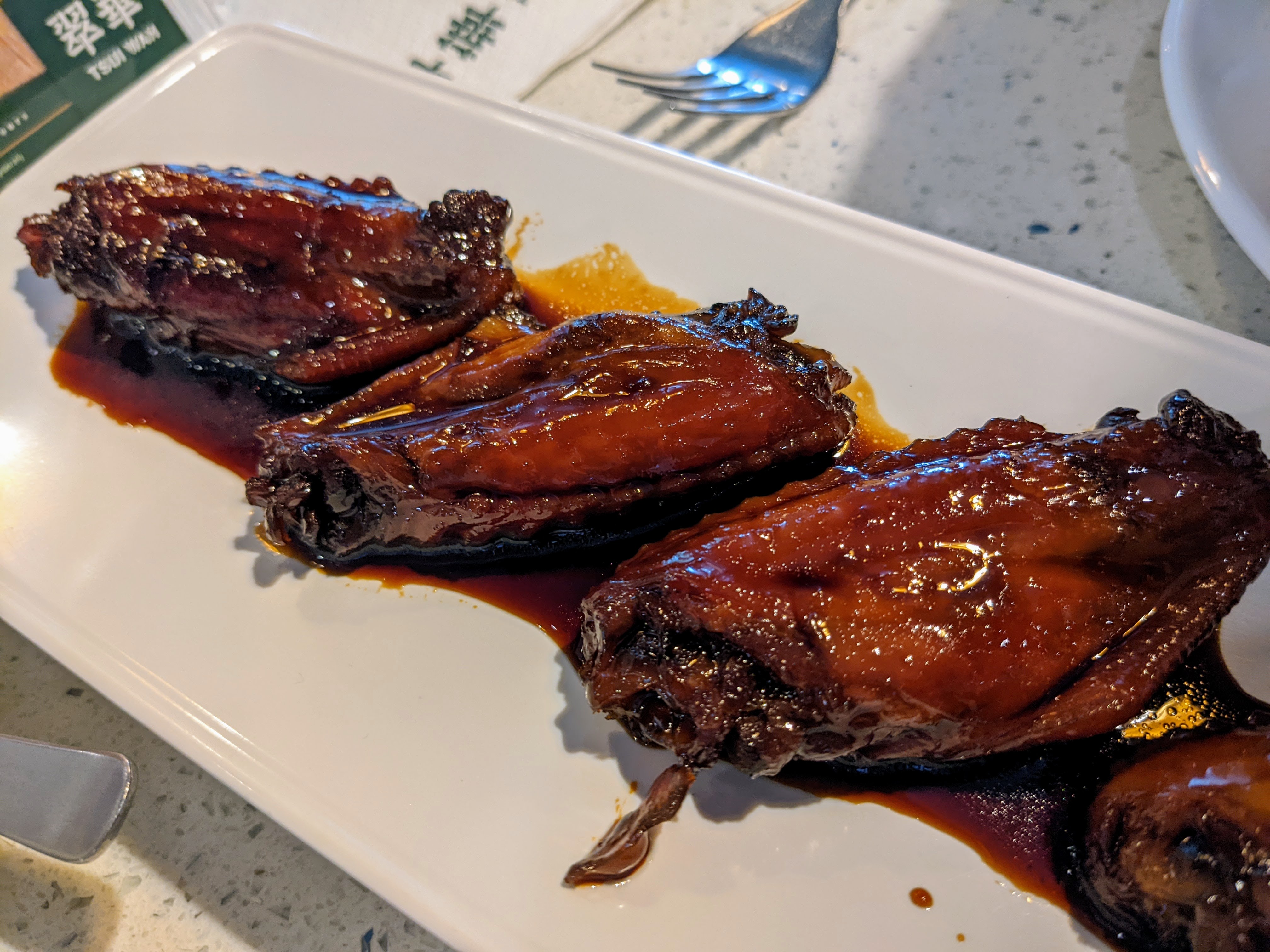
More food arrived. I expected the Signature Pork Chop Bun (豬扒包) to be breaded and fried schnitzel-style, but no, we got a pretty dry slab of lean grilled pork with lettuce and pickles in another crusty-dry bun, sauced with what to me tasted exactly like American-style Thousand Island salad dressing: “weird”, was the judgement of culinary youth panel. Last and least, the Swiss Chicken Wings (瑞士鸡翼), an iconic HK dish slathered in sweet soy and of no known connection to Switzerland — if anything, they were the only identifiably Chinese-tasting in my entire order today — were cold and kinda chewy.

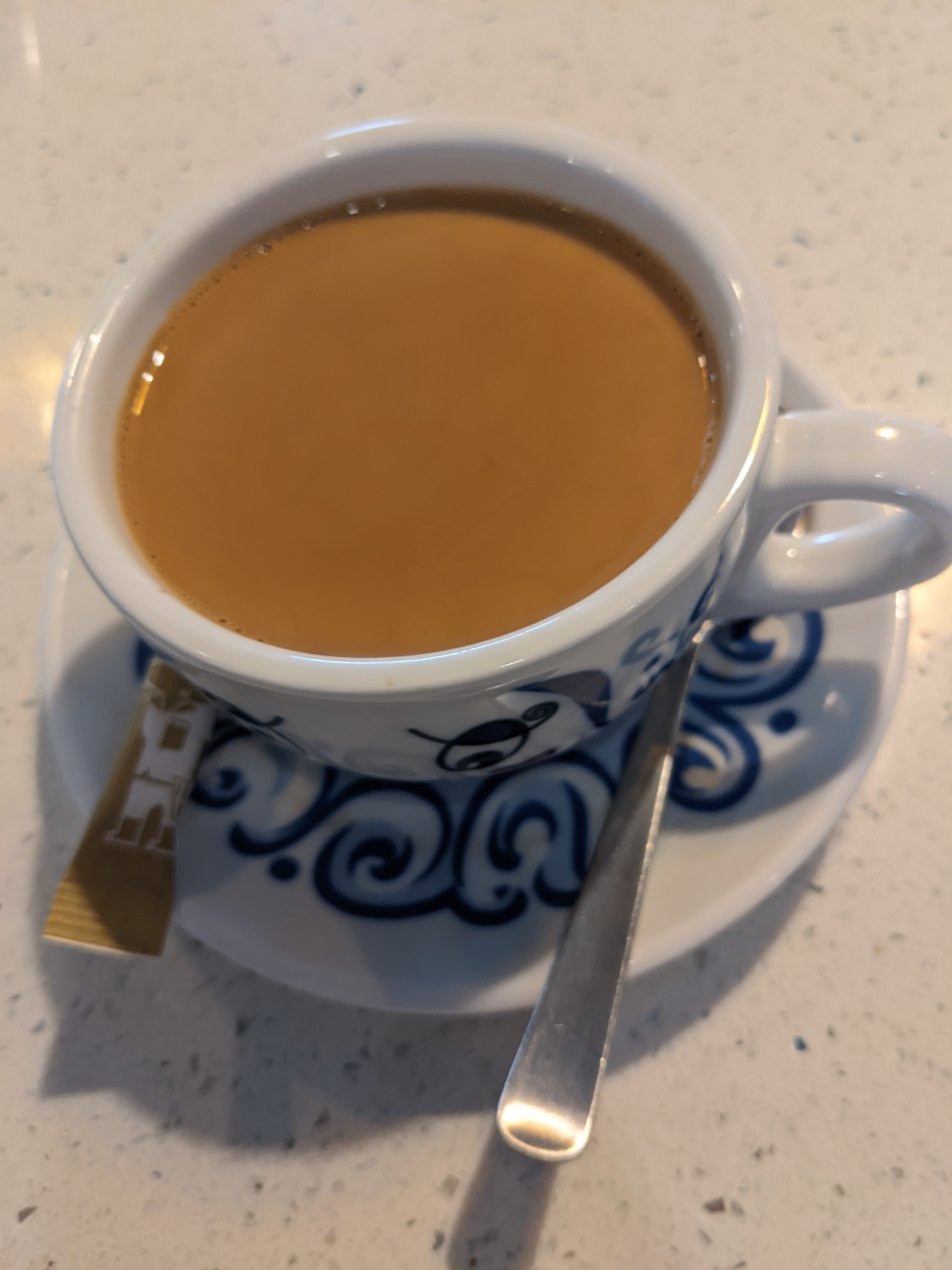
The most interesting new acquaintance, though, was yuenyeung (鸳鸯), an only-in-HK mix of milky coffee and tea which I must shamefully confess to never trying before. I’d also always thought this was the Cantonese reading of yin-yang (阴阳), but no, the name actually means “mandarin ducks”, famed in Chinese legend because the multicolored, flashy males look so different from the drab grey females, but the two go so well together that they mate for life. Now I’m not much of a coffee drinker, but this was downright delish, a complex interplay of notes of both that tasted better than the sum of its parts. I’m a convert. They may have taken heed of the random review complaining about the brew being too weak, though, since the cuppa I had was brewed so strong my hands were still shaking hours later, which also reminded me why I’m not a coffee drinker.

Last but not least, I wanted to sample some Hong Kong street food. Singapore has no real street food, since all hawkers were corralled into centres years ago, but the franchise behind Tim Ho Wan has also decided to concoct a new brand, Joy Luck Teahouse (歡樂冰室), to bring HK street food into the air-conditioned basements of Singaporean shopping malls. “Teahouse” here is bing sutt (冰室), literally “ice room”, which are supposed to be the now largely extinct small cafes that were direct predecessors to cha chaan tengs, but Joy Lucks don’t even have seating, it’s takeaway only. One outlet lurks in the psychedelic food pit four levels under ground at Ion Orchard, so in the mood for a snack, I dialed up some curry fishballs (咖哩魚蛋) franchised from Kowloon brand Tak Hing (德興). $4.80 gets you a coffee cup with 6 fishballs slathered with a mild, Japanese-curry-ish sauce, and while I was kinda skeptical these were actually pretty nice, especially when eaten while piping hot. Singaporeans love fishballs and they love curry, so why isn’t this sold everywhere yet?

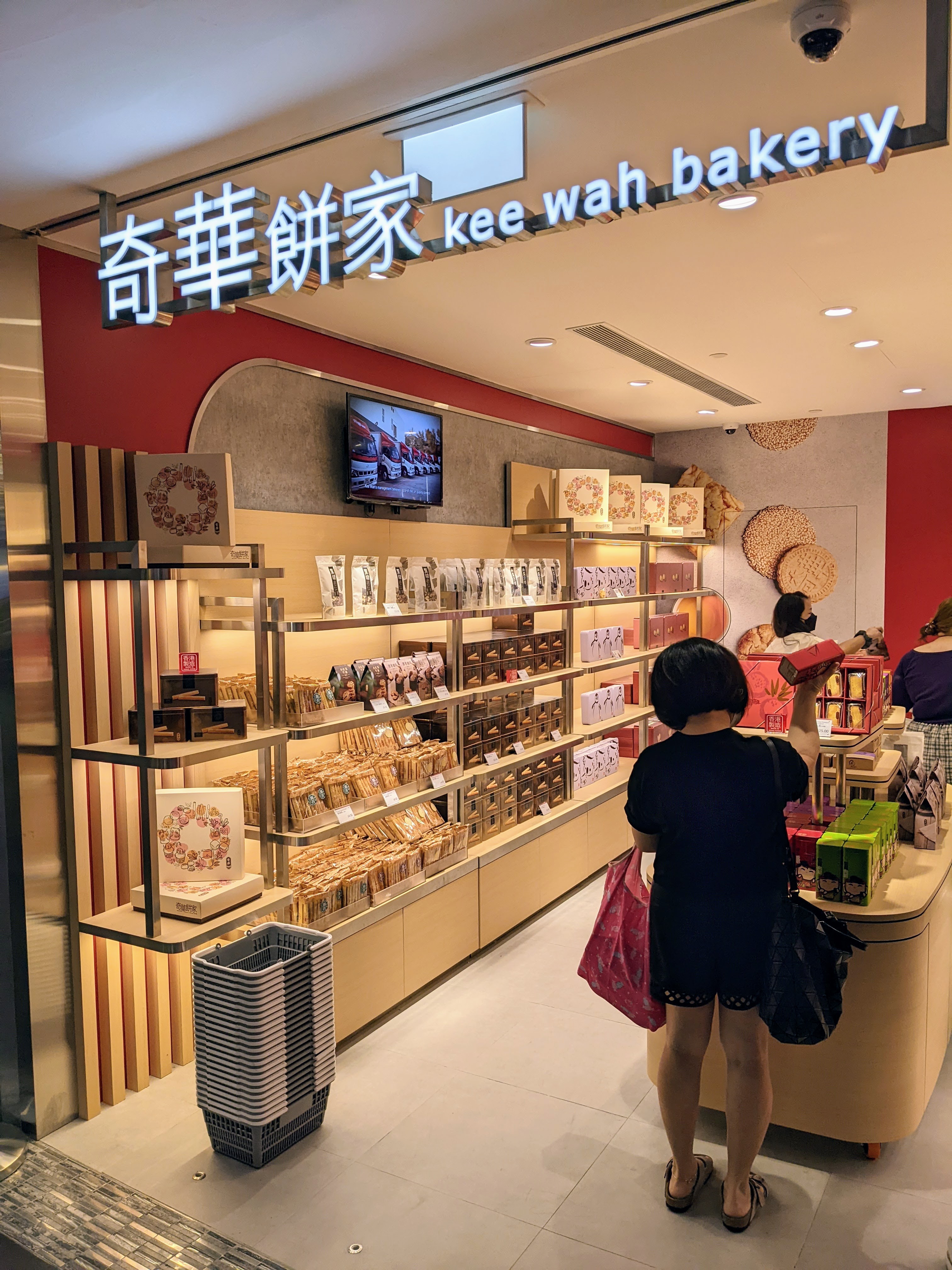
Other offerings include milk tea, egg tarts (see Macau for more on that topic), and pineapple buns, the last of these being Hong Kong’s twist on the Japanese melon pan, both named after the appearance of the crust and neither actually containing any fruit. If that’s not enough, you can literally turn around and walk into the flagships of Hong Kong cookie makers Kee Wah or lao po bing masters Hang Heung, offering crusty pastries stuffed with winter melon paste. And then there’s the fabulously cheesy fake HK-by-night neon show of Legendary Hong Kong (Mongkok Street) at Jurong Point, various purveyors of baked cheese rice (pour one out for Malaysian chain Hong Kong Kim Gary), egg waffles that looks like delicious giant bubble wrap and more. Crikey! At this point, all I can do is channel Chris Patten and admit defeat, send this telegram, and sail off into the sunset. God save the Queen.

<<< Guangxi | Index | Zhejiang >>>

34 Province Project: Guangxi 广西

Guangxi (West Guang), formally the Guangxi Zhuang Autonomous Region, lies at the west end of the same plain as its much better known sibling Guangdong (East Guang, aka Canton). Rubbing up against Vietnam, the mountainous western parts are considered the wild and woolly end of China and it has the highest percentage of minorities in China, including the eponymous if rather obscure Zhuang people, who in fact are China’s largest minority group, 18 million strong. The Zhuangs have their own religion, delightfully named Mo; their own language, which is much closer to Thai than Chinese; their own writing system, which riffs off Chinese characters but is still quite different; and their own delightfully off-the-wall romanization system that takes a leaf from the late, unlamented Gwoyeu Romatzyh to encode tones with bonus letters, so that the UN Declaration of Human Rights starts off like this: Boux boux ma daengz lajmbwn couh miz cwyouz, cinhyenz caeuq genzli bouxboux bingzdaengj.

On the culinary front, Guangxi cuisine is a bit of an ill-defined mix. Spicy, but less spicy than Sichuan; sour, but less sour than Hunan; light, but less light than Guangdong, says one verdict. Rice noodles feature heavily, as do fish and snails from the Li River, and bordering Yunnan and South-East Asia, it’s not too hard to pick up similarities to both. More infamously, Guangxi is the site of the Yulin Lychee and Dog Meat Festival, controversial even within China, and formerly the stage of the worst ritual cannibalism during the Cultural Revolution.

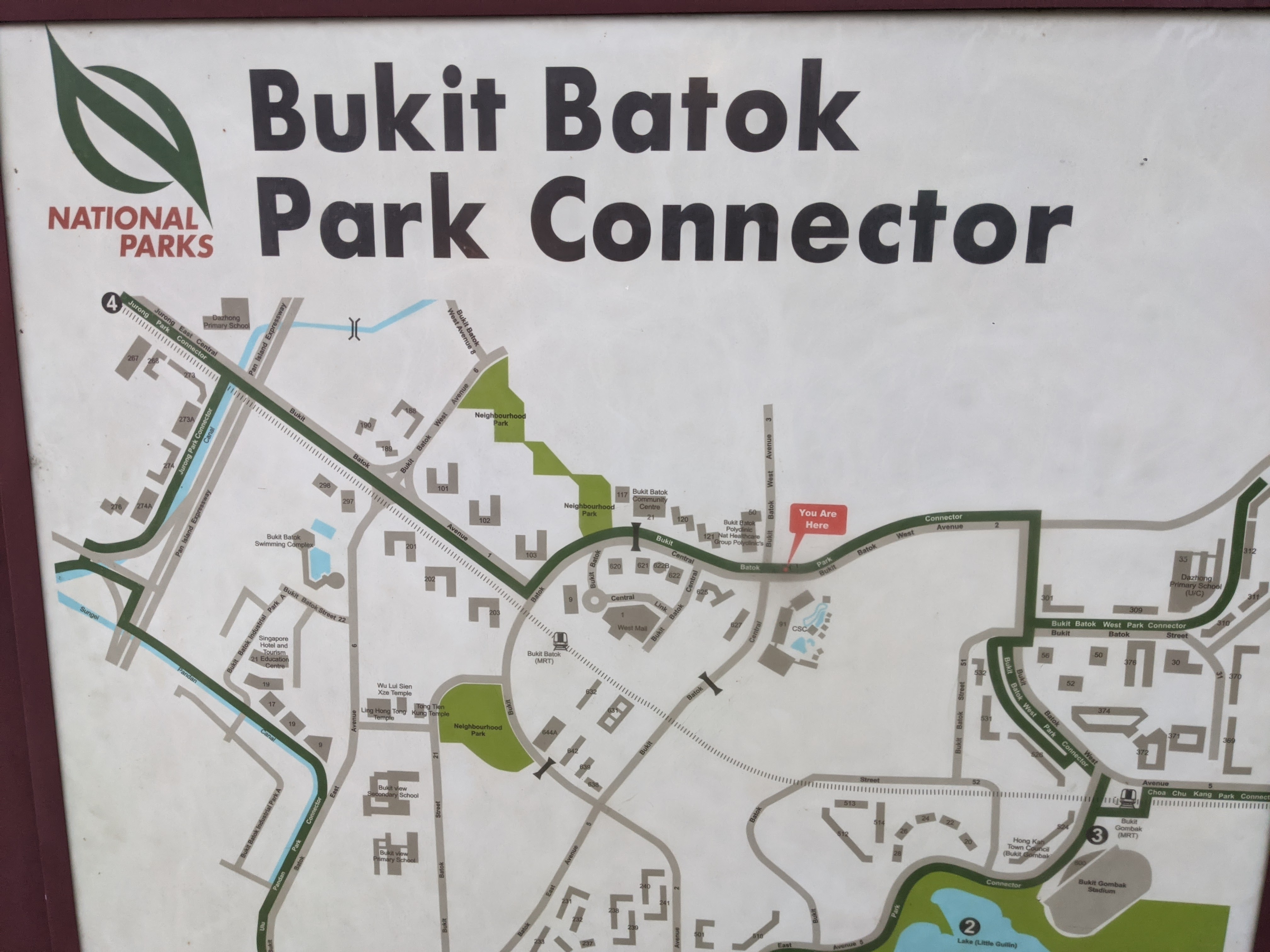
Here in Singapore, Bukit Batok has a Little Guilin Park, thus named for the craggy limestone cliffs left over from an old quarry, and a Gui Lin Food Stall, serving up not-so-Guangxi dishes like the Malay coconut rice nasi lemak. The one dedicated Guangxi restaurant chain in Singapore, Number 1 Guilin Rice Noodle (壹号桂林米粉), threw in the towel a couple of years ago, and it turns out the (parenthetically named) Wulin Shan Zhuang (Feng Bo Zhuang) 武林山庄 (风波庄) is the wrong zhuang (庄 “village”, not 壮 “strong”), the sole outpost of a chain from Sichuan, and gave up the ghost some time in early 2021.

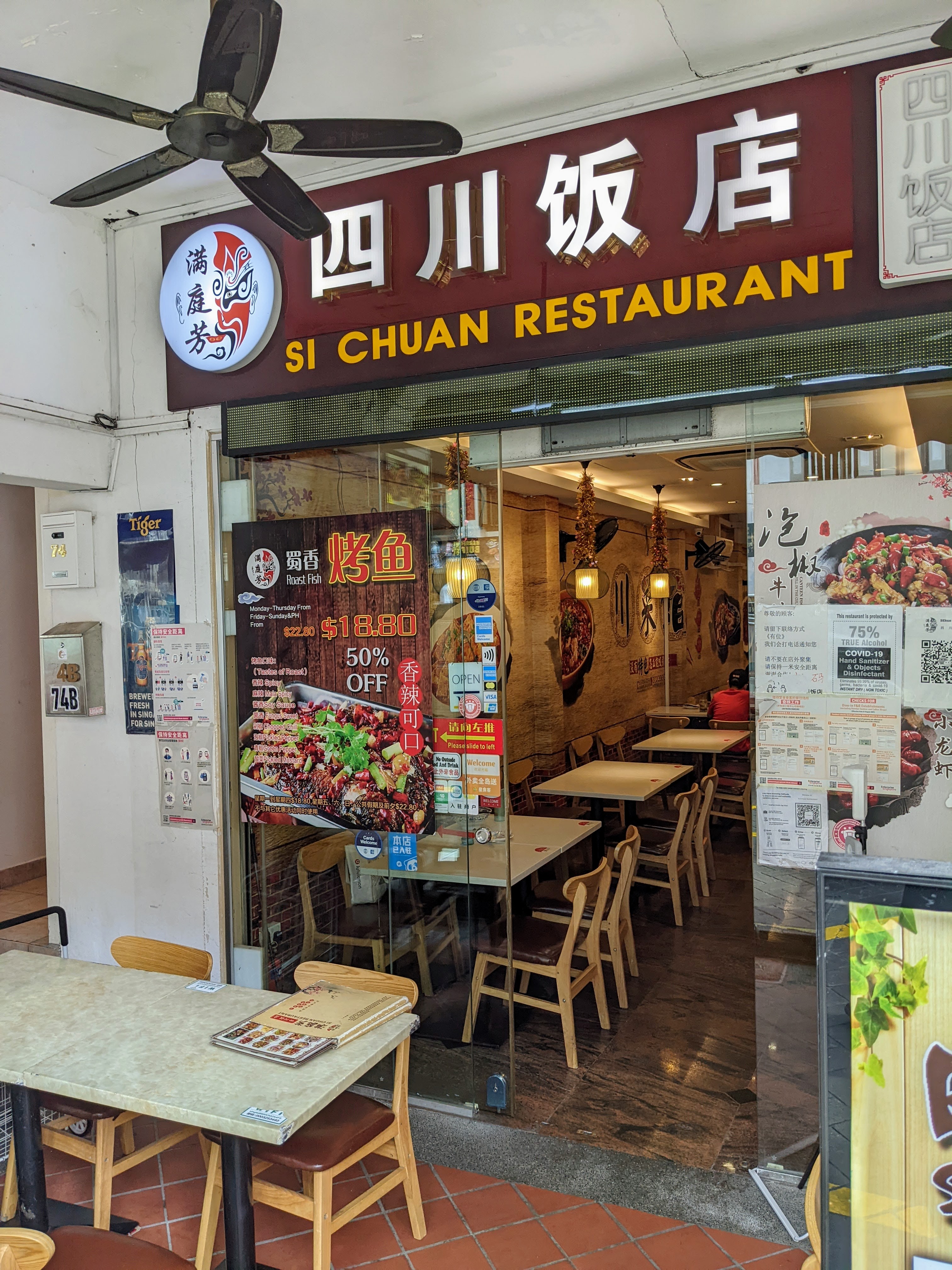
That leaves, as far as I can tell, exactly one place in Singapore that claims to serve up any Guangxi dishes at all, namely Guilin rice noodles (桂林米粉 Guìlín mǐfěn) at Sichuan Restaurant (四川饭店) in Chinatown. It’s buried way at the back of the menu, and it took a couple of round trips to the kitchen to confirm that they actually had it. “Chilli?” “Can.” A few minutes passed, and the kitchen must have had its doubts because the waitress came back to confirm. “Very spicy!” “OK.” A few more minutes, and another doleful warning arrived: “Not only spicy. Mala.” Surely Sichuan’s signature spicy-numbing sensation is too much for the laowai? I doubled down: “Mala is OK.”

What eventually appeared was a bowl of slippery rice noodles, much closer to what Singaporeans would call “laksa noodles” than the usual thin bee hoon, with some minced meat, a couple of token veggies, swimming in a broth dominated by Sichuan-style mala flavor. The worried waitress came by once more: “Is OK?” “OK!” I mean, sure, it was spicy, but nowhere near Yunnan’s rattan pepper noodles. What disappointed me more was that, as far as I could tell, this was identical to Chongqing xiaomian, only with the wheat noodles swapped out for rice noodles. Oh well, serves me right for ordering this in a place that’s literally called Sichuan Restaurant.

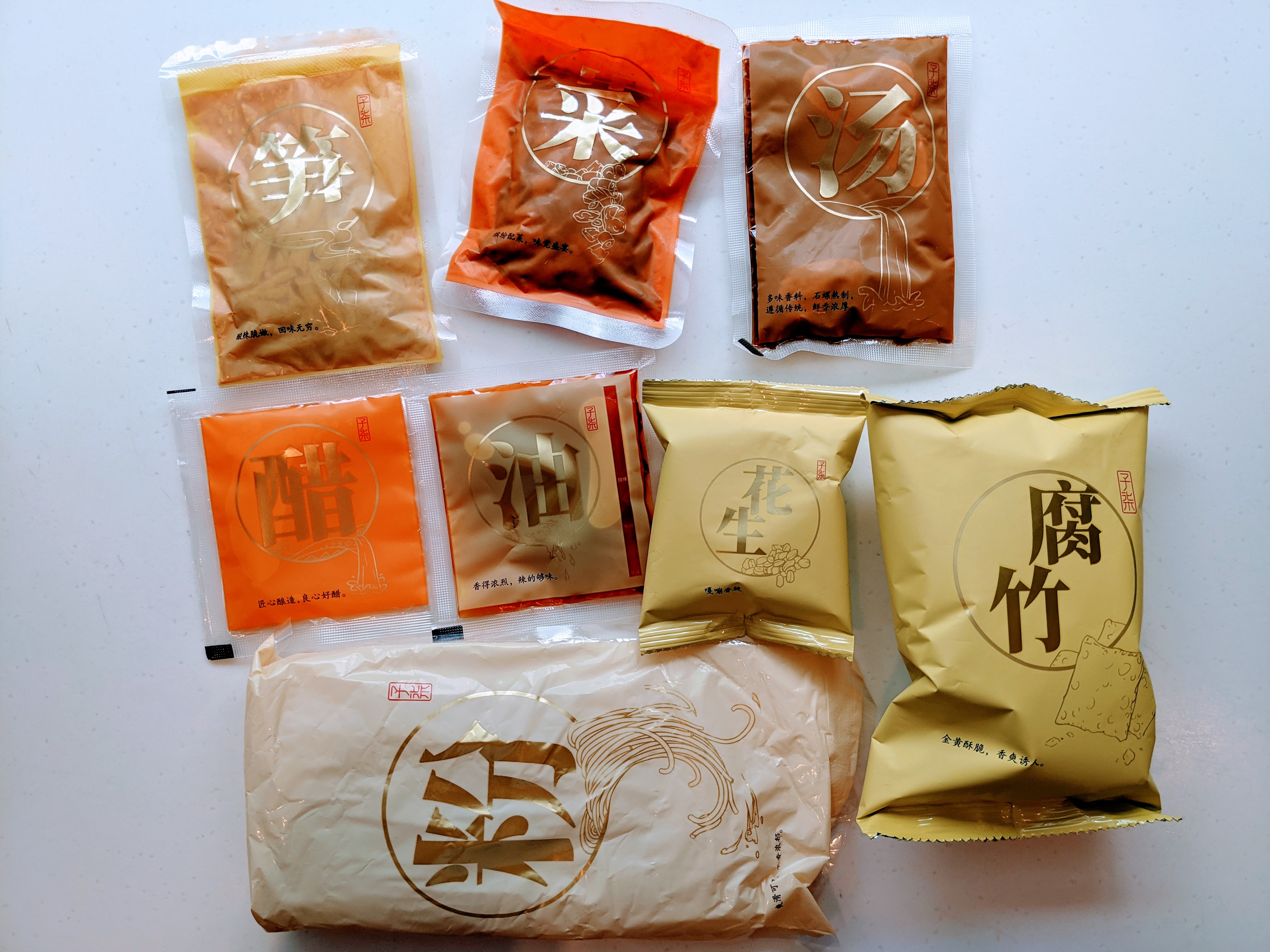
Hands down the most famous Guangxi dish, though, is river snail noodles (螺螄粉 luósīfěn), hailing from the city of Liuzhou and recently massively trendy throughout China despite smelling famously funky. Failing to find any fresh providers of the stuff, I hopped on the internets and ordered a deluxe instant version, specifically the one branded by Chinese video personality Li Ziqi (李子柒), who built a following of millions by filming idyllic depictions of life in rural China without mod cons like electricity, and whom you can see photogenically squelching barefoot through the mud to collect river snails just for you her grandma. The enormous pouch (Singapore dollar coin for scale) comes with no less than 8 baggies of ingredients inside: noodles, soup stock, fermented bamboo shoots, pickled vegetables, vinegar, chilli oil, peanuts and tofu skin, and this video with English subtitles will take you through how to make it. One key point: you need to first boil the noodles starting from cold water, strain, then mix the rest of the wet ingredients and bring to a boil again.

So how was it? In a word, meh. Internet hyperbole often compares those bamboo shoots to durian, but I know durian, durian is a friend of mine, and fermented bamboo shoot, you’re no durian. They’re a bit funky, a bit sour, but not objectionably so and I’ve had curries etc made with them in Thailand and Laos as well; in fact, the menma pickled bamboo shoots commonly used as a Japanese ramen topping are essentially the same thing. Most of the other flavors, snail and otherwise, were obliterated by the combo of chilli oil and vinegar, and the end result bore a considerable resemblance to that old Chinese standby, hot and sour soup. Edible, sure, but hardly worth the hassle of preparation or the $5 it cost.

Overall, the Guangxi experience in Singapore was distinctly unsatisfying, I’m pretty sure neither of these could hold up a candle to the real thing. But until the day comes when Guilin and Yangshuo are back on the tourist map, it’s time to say Boux boux ma daengz (I think I need to make this my new email signoff) and move on to our next province.

<<< Yunnan | Hong Kong >>>

34 Province Project: Yunnan 云南

Yunnan, “South of the Clouds”, is the closest China gets to Southeast Asia in both culture and cuisine. 25 of China’s official 58 minority groups can be found here, many of them merrily straddling the border, with groups like the Miao (Hmong), Hani (Akha), Lisu and Tai also found in Laos, Thailand, Cambodia and Myanmar.

I’ve never had to chance to visit Yunnan proper, but I have been just on the other side of the border a couple of times, sampling Tai Dam cuisine in Luang Namtha, Laos and trekking with Lisu hill tribes in Chiang Dao National Park, Thailand. The most interesting almost-Yunnan trip, though, was a visit to Mae Salong, founded in northern Thailand by Yunnanese remnants of the Chinese Nationalist (Kuomintang) Army fleeing across the border to escape the Communists in the 1950s. Being in the notorious Golden Triangle, for decades they made a living in the opium trade working with equally notorious Burmese warlord Khun Sa, but in the eighties they laid down their poppies and AK-47s and switched to cultivating oolong tea and backpackers, with a sideline in Yunnanese noodles.

Given the variety of people living there, Yunnanese cuisine (滇菜 Diān cài) defies easy categorization, but the province is best known for slippery mĭxiàn (米线) rice noodles, the liberal use of chillies, a vast array of mushrooms, and pǔ’ěr (普洱) tea, a type of fermented, aged tea with a funky, earthy scent and taste.

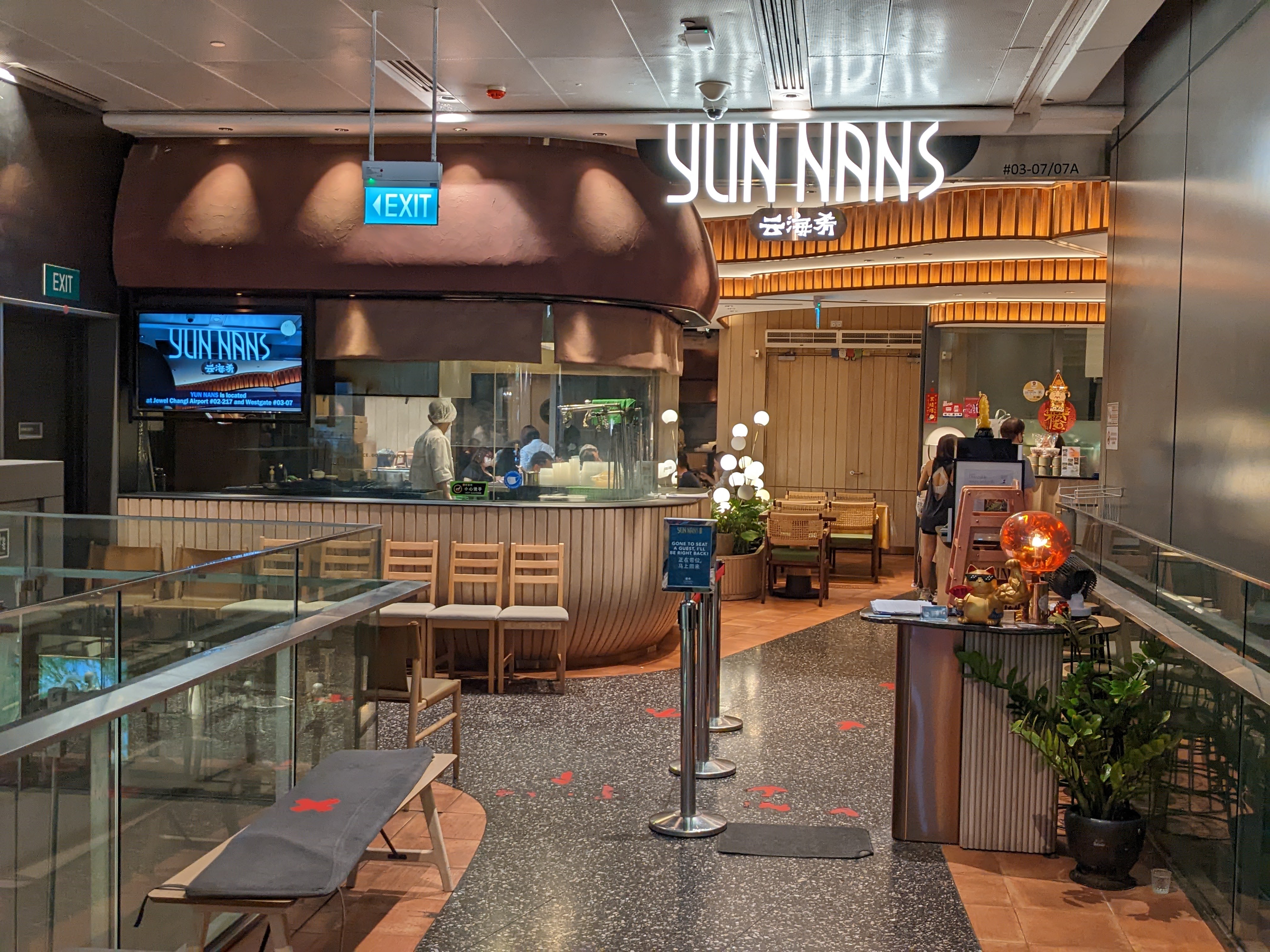
I kicked off my exploration of Yunnan at the eponymous Yun Nans (云海肴 Yúnhǎiyáo, “Sea of Clouds Dishes”), a large Chinese chain with three Singapore outlets. The chain was actually founded by a bunch of Beijing hipsters in 2009, who in 2017 moved their HQ to Yunnan’s capital Kunming and opened a couple of outlets there to maximise their street cred. Only when writing this entry did I connect the dots, since it turns out the Yunnanese meal I’d eaten at a hip eatery in Beijing’s tarted up hutong district of Shichahai back in 2018 was an outlet of the same chain!

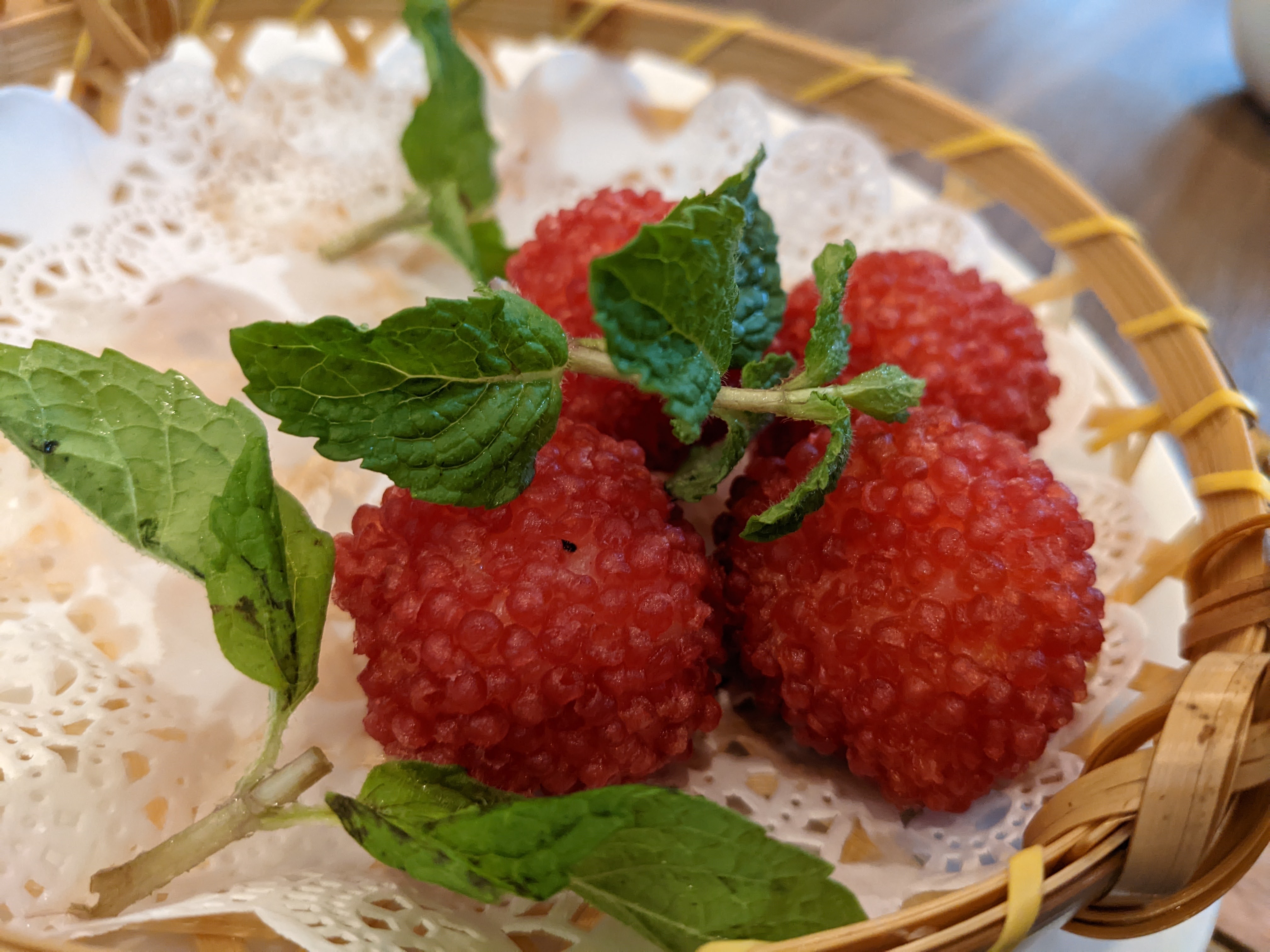
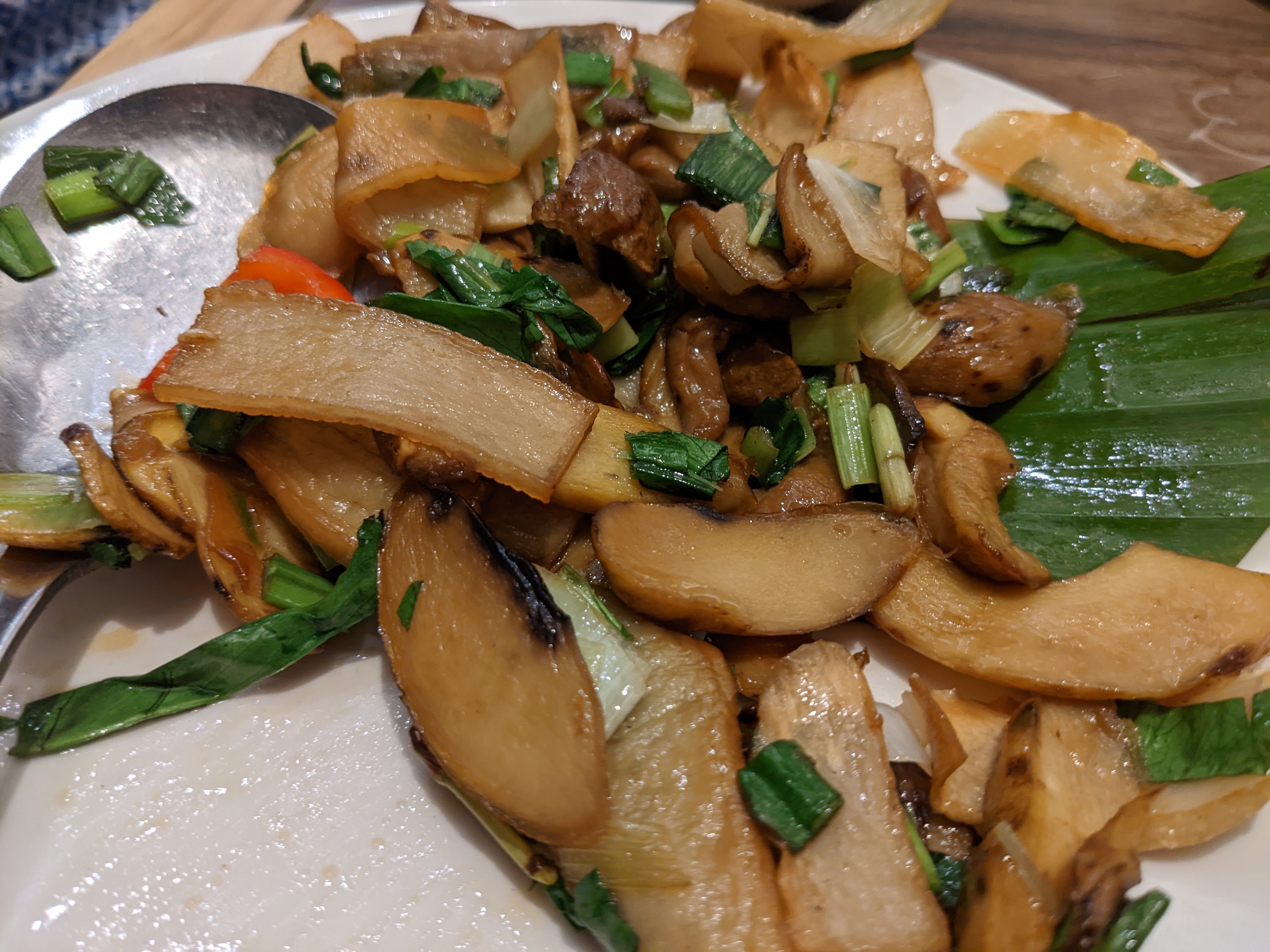
I actually visited twice: once during COVID, when we ordered a Signature Set (云南精选) for delivery, and once in person at the Westgate outlet for a large conference dinner. The conference food was preordered, but the starter Lychee Prawn Balls (荔枝虾球) were perhaps the most striking-looking Chinese dish I’ve seen, looking exactly like giant raspberries complete with a sprig of mint for camouflage — although on the inside it was just a large, slightly sweet deep-fried prawn. The Braised Wild Porcini Mushrooms (包烧牛肝菌) were also delicious, this could have been straight out of a Finnish forest!

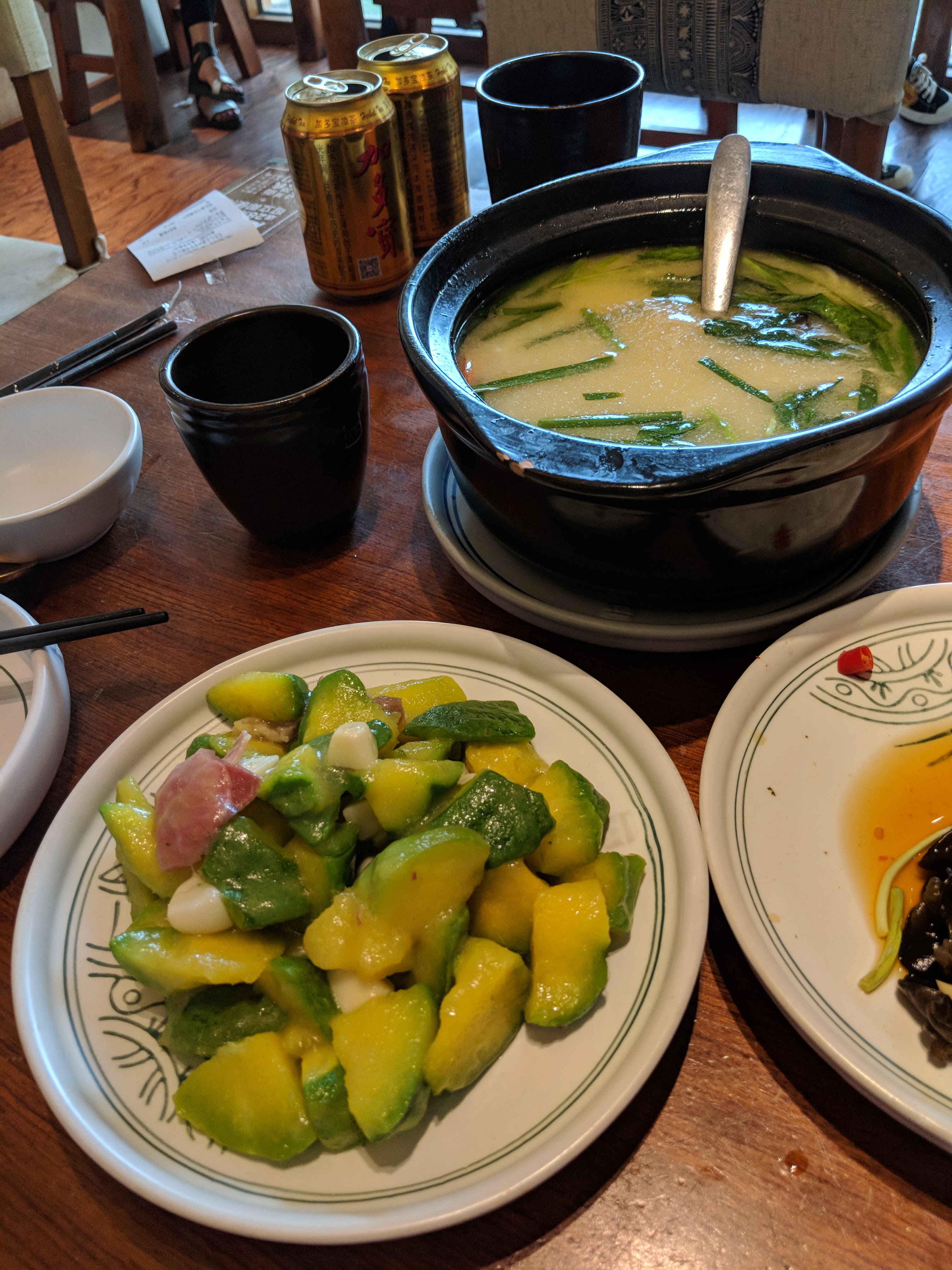
For the delivery set, First up was Poached Pork Collar with Pickled Chillies (腌菜松板肉), easily the most unusual dish of the lot: somewhere between a soup, a curry and a bowl of noodles, the flavour of the striking orange broth was complex but primarily sour thanks to the pickles, with a sharp chilli note and a few Sichuan peppers for that extra zing. Under the soft sliced pork lurked a few crinkle-cut potatoes, slices of an unidentifiable gourd and some slippery glass noodles. Everybody’s favorite, though, was the Crispy Duck with Dried Chillies (香酥鸭), Yunnan’s take on the Sichuan classic dried chilli chicken laziji, which looks murderously spicy but actually isn’t, with battered and deep-fried slivers of duck jostling with shredded dry chillies, some onions and a whole lotta garlic.

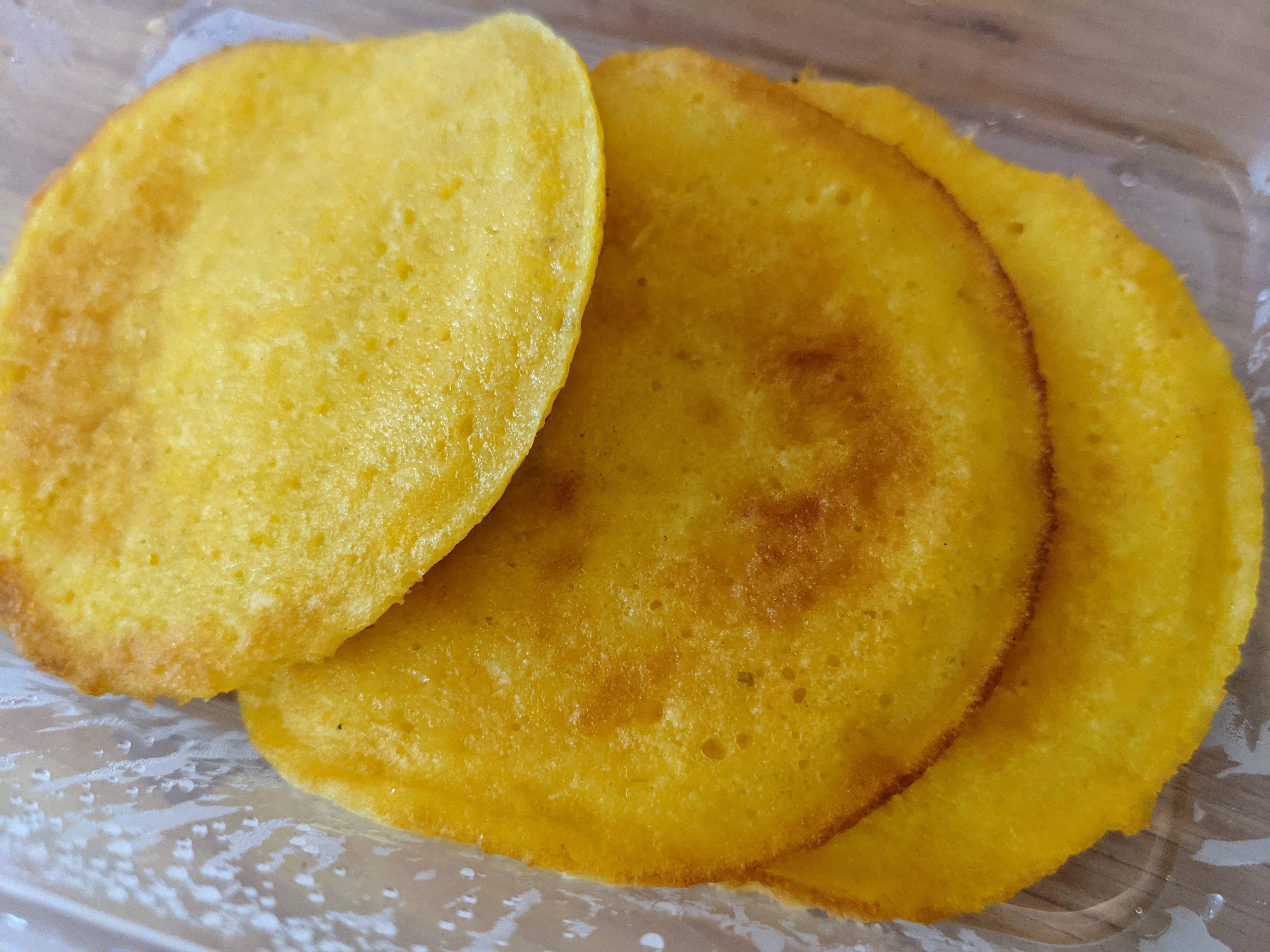
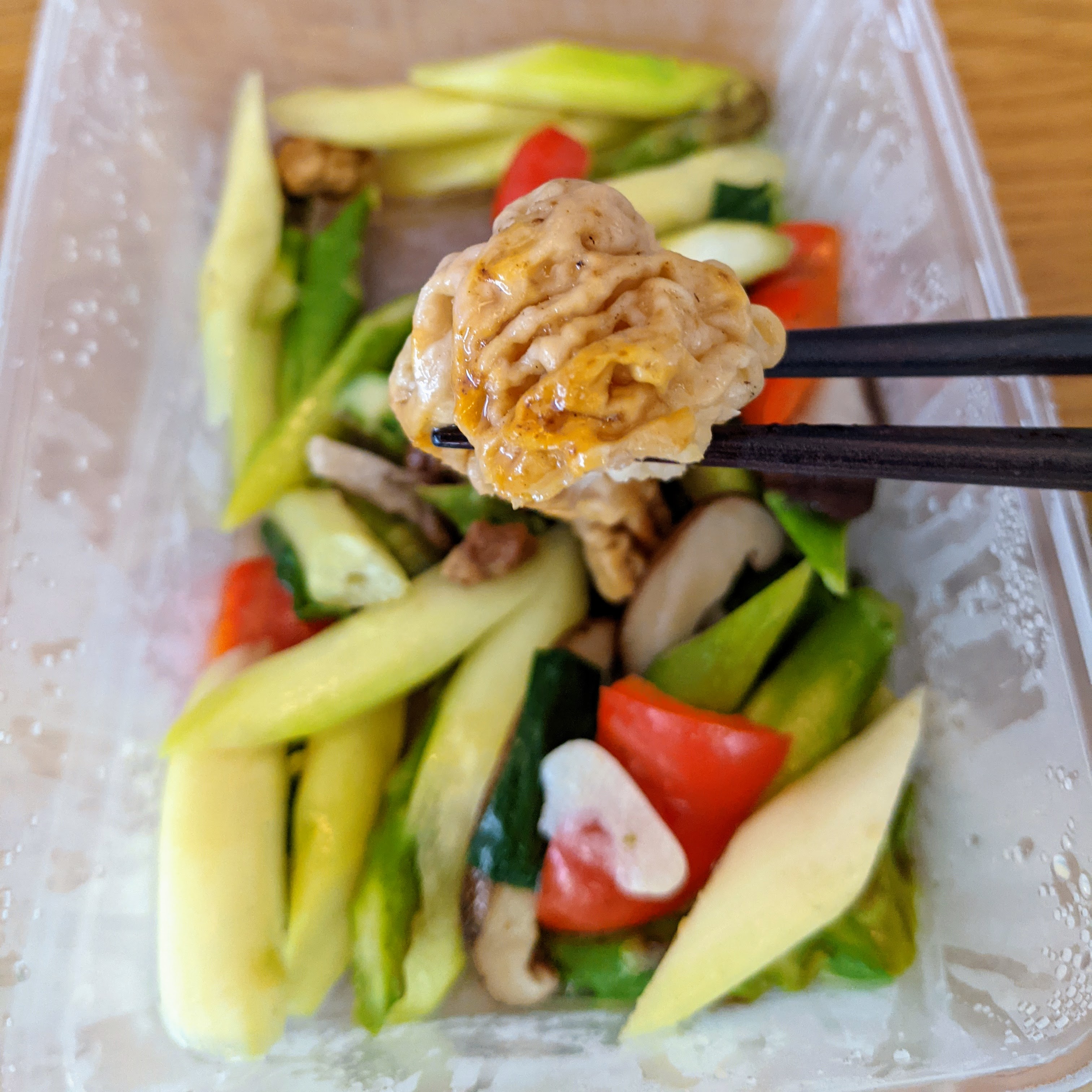
The most unusual ingredient of the day was in the Sauteed Asparagus with Golden Fungus and Mushrooms (金耳花菇炒芦笋), where the “Golden Fungus” is Tremella aurantialba, a jelly fungus so obscure it doesn’t even have a picture on Wikipedia. Called golden ear (金耳 jīn’ěr) in Chinese, it’s a relative of the much more common snow fungus aka silver ear (银耳 yín’ěr). But whereas the snow fungus is thin, crunchy and ethereal, this looks disturbingly brain-like, has a spongy texture and tastes like nothing much. The still crispy asparagus was nice though. To wash it all down we had a bowl of Steampot Chicken Soup (汽锅鸡), apparently the chain’s signature dish and a Yunnanese classic but, I’m sorry to say, quite indistinguishable from the herbal chicken soup sold at your neighbourhood hawker centre, a few bony chunks of chicken in nondescript sweetish soup with a token wolfberry for colour. For dessert we had some Corn Cakes (玉米粑粑 yùmǐ bābā), supposedly a type of Naxi baba bread, which looked and tasted like sweet pancakes with corn chowder added to the batter. All in all, even making allowances for delivery, it was a pretty mixed bag at best.

The most famous Yunnanese dish, though, is crossing the bridge noodles (过桥米线 guòqiáo mĭxiàn), which come with a lovely if implausible story of a wife making soup for her husband studying on a little island. She brought the ingredients across separately to keep them warm, mixed the ingredients on arrival, and ta-dah, the soup was born, despite the anguished cries of physics students noting that maximising surface area will increase heat loss, not decrease it. Honguo (红锅 Hóngguō, “Red Pot”) is one of several small chains specialising in this in Singapore, and I tried out the Signature 12-Item Soup ($10.20) at their Bugis Junction outlet. The presentation is striking, and the Pot is indeed Red, but the taste was a little anticlimactic, the ingredients a frankly odd mishmash of pork, fish, shrimp etc and the chicken soup rather nondescript, salty and, fatally, only lukewarm. Not very impressed.

Undeterred, I crossed the bridge again at the wonderfully named Mademoiselle Tang Noodle (唐大小姐 Táng dàxiǎojiě), a hip little joint in Novena, packed at lunchtime on a random Friday. Here the menu also promises a DIY bento-box experience for the soup, but it actually came premixed. What you lose in the presentation is more than made up for in taste though, this was much tastier and $12.90 gets you a couple of generously sized prawns as well. Two thumbs up from my wife.

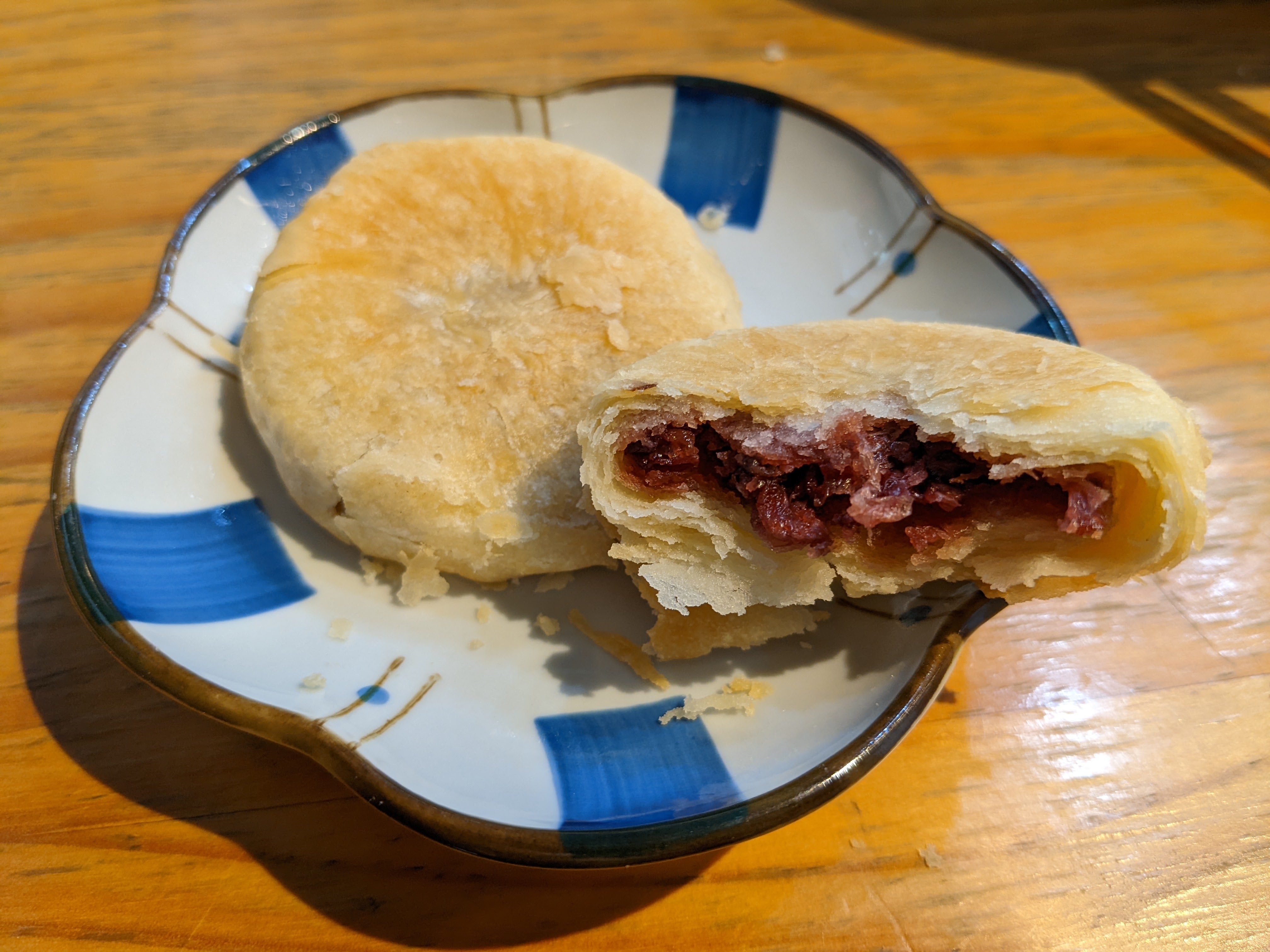
There are a couple of other interesting Yunnanese dishes on the menu, and after some deliberation I landed on the Rattan Pepper Chicken Rice Noodle (藤椒鸡米线 téngjiāo jī mǐxiàn), despite being warned no less than three times that “It’s spicy! Very spicy!” Rattan pepper here refers to Zanthoxylum armatum, known as green Sichuan pepper (麻椒 májiāo) in its typical dried spice form, but in Yunnan the fresh pods, téngjiāo (藤椒), are eaten as is. The pods look like tiny capers and have very little taste, but they crack open with a crunch and release a pop of the numbing má (麻) sensation Sichuan cuisine is famous for. And you’ll need all the numbing you can get, since those innocuous reddish-orange bits in the soup are fresh bird’s eye chillis aka chilli padi, the tiny little torpedoes of pain that spice up authentic Thai food. The spice was not completely overwhelming though, and the chicken, garlic chives, bean sprouts and other bits in the soup stood up to the pounding. Afterwards, I could still feel the slow burn in my stomach and a nice endorphin high kicked in, the way it used to when eating Thai food in Bangkok with my Thai colleagues. Ah, nostalgia. A final Middle Eastern exclamation mark was added by the Flower Cake (鲜花饼 xiānhuā bǐng), crumbly biscuits flavoured with a sweet, fragrant paste of glutinous rice and dark purple rose syrup, reminiscent of Turkish delight (lokum).

All in all, Mademoiselle Tang was easily my favourite of the three places we sampled, and I’m looking forward to visiting again. The Specialty Chicken Rice (瓦香鸡饭 Wǎxiāng jīfàn), apparently a classic Naxi dish, looks particularly intriguing — but we’ll cross that bridge when we get to it.

<<< Shanxi | Index | Guangxi >>>

34 Province Project: Shanxi 山西

Shanxi, “West of the Mountains”, has the misfortune of being a backwater stuck between two provinces of similar name and far more prominence, namely Shaanxi to the west and Shandong to the east. The high point in its history was around 500 BC during the Spring and Autumn Period, when the state of Jin (晋) briefly ruled the area only to be crushed by the megalomanical Qin rulers of Shaanxi by 221 BC, and it was all downhill from there. A dry highland plateau largely cut off from trade, the largest industry today is coal mining.

Shanxi cuisine (晋菜 Jìn cài) is thus not particularly famous even in China, but the area has made two notable contributions to the country’s culinary history. Shanxi aged vinegar (老陈醋 lǎo chén cù) is China’s spiritual equivalent to Italy’s balsamic vinegar and looks the part, being deep black and funky.

The other dish comes to us from Datong, technically the only place in Shanxi I’ve been to, since my train from Mongolia to Beijing made a brief unexpected detour through there. Rail buffs may know the city as the site of the Datong Locomotive Factory, once the world’s largest manufacturer of steam locomotives, where the production lines kept puffing until 1988. To keep the hungry steam engineers fed, Datong’s other key product is dāoxiāomiàn (刀削面), usually glossed in English as “knife-cut noodles”, but perhaps more exactly described as “knife-shaved noodles”. Unlike the pulled lamian of Lanzhou, they’re prepared by making a big brick of dough and then using a knife to slice strips off at an angle, creating wavy noodles of uneven cross-section, thicker in the middle and thin on the edges — check out this video to see how they’re made.

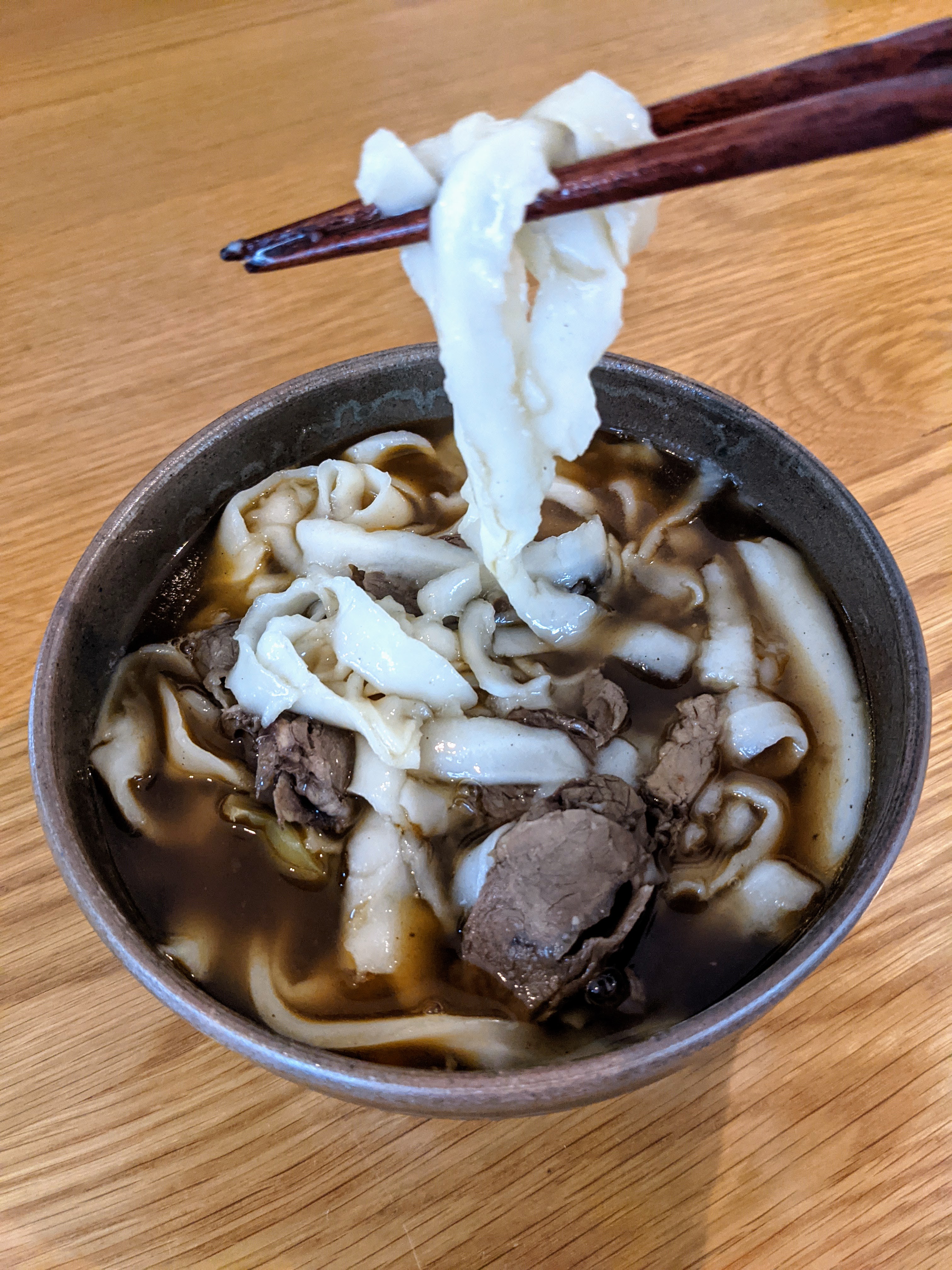
Daoxiaomian are reasonably common in Singapore, but as far as I can tell there are no specialist restaurants for these, or Shanxi food for that matter. Instead, they’re typically a sideline at northern Chinese restaurants serving up dumplings, lamian, and other wheaty fare. So one rainy day, I dialed up a bowl of the Signature Beef Shaved Noodles (招牌牛肉刀削面) from the wonderfully named Wonderful Cafe, a remarkably Google-resistant stall unpromisingly located at the S-11 coffeeshop next to Bishan station. (For my non-Singaporean readers, S-11 is a conglomerate that proudly markets “cheapest dormitories in Singapore for worker” (sic), recently in the news for hosting Singapore’s largest COVID-19 cluster; not where you’d expect to find gourmet fare.)

So how? Pretty good! The last time I tried these at Food Republic in Vivocity, the noodles tasted more undercooked than chewy, but the Wonderful version was more thinly cut and the contrast between the soft outside and chewy center was nice. The Taiwanese-style dark beef soup was rich with star anise, the beef slices were soft and a few token pieces of bok choy rounded out the bowl.

While not a Shanxi dish, I couldn’t resist also trying out the Shandong Shredded Pancake (山东手抓饼 Shāndōng shǒuzhuā bǐng) from the other side of the mountains. This turned out to resemble the love child of north Chinese spring onion pancakes with Singaporean roti prata, being flaky, onion-laced dough fried until crispy and then torn by hand to shreds. Oily, unhealthy and eminently snackable.

At the Ang Mo Kio outlet of chain 57° Mala Xiang Guo (57度麻辣香锅), which promises temptation from the tip of your tongue to your stomach, I found another Shanxi classic called guò yóu ròu (过油肉). Literally “passed through oil meat”, and variously translated as “oily pork”, “lightly fried pork” etc, the idea is that the meat is quickly stir-fried in oil, hence the “passing through”. At 57° (no, I have no idea what this refers to), the dish comes with crunchy wood ear mushrooms, lots of onions and a few tomatoes, tossed in an only mildly spicy sauce flavoured with soy, rice wine and a token Sichuan pepper. The pork shoulder here was quite dark and chewy, so much so that I initially suspected they had used lamb instead, but the combo worked a treat. As is apparently standard in Shanxi, the sauce came separately from the accompanying bàn miàn (拌面) noodles, handmade wheat noodles that are essentially the same as Xinjiang laghman and not to be confused with eggy, chewy Singapore ban mian (板面). Just pour on top and enjoy!

And that’s that: I was hoping to find a few more Shanxi dishes like sweet & sour meatballs (糖醋丸子), but they don’t seem to exist in Singapore. It’s time to knife-shave this episode and move onto the next province.

<<< Tianjin | Index | Yunnan >>>

34 Province Project: Tianjin 天津

Tianjin is best known as Beijing’s port city, and it tends to get overshadowed by its big neighbour only about 100 km away. While mandarins schemed in Beijing, Tianjin is where the merchants made money, and in the dying days of the Qing Empire it hosted no less than 9 foreign concessions ranging from Austria-Hungary to Belgium. Today’s Tianjin is China’s fourth or fifth-largest city depending on how you count, with some 15 million people.

I first ran into “Tianjin” food in the form of the mysterious Sino-Japanese dish tenshindon (天津丼, “Tianjin bowl”), a crab omelette plunked on a mound of rice, rather resembling the love child of Cantonese egg foo young with Japanese omurice. Alas, while a Chinese restaurant staple in Japan, nobody has been able to figure out any connection to an actual dish in Tianjin.

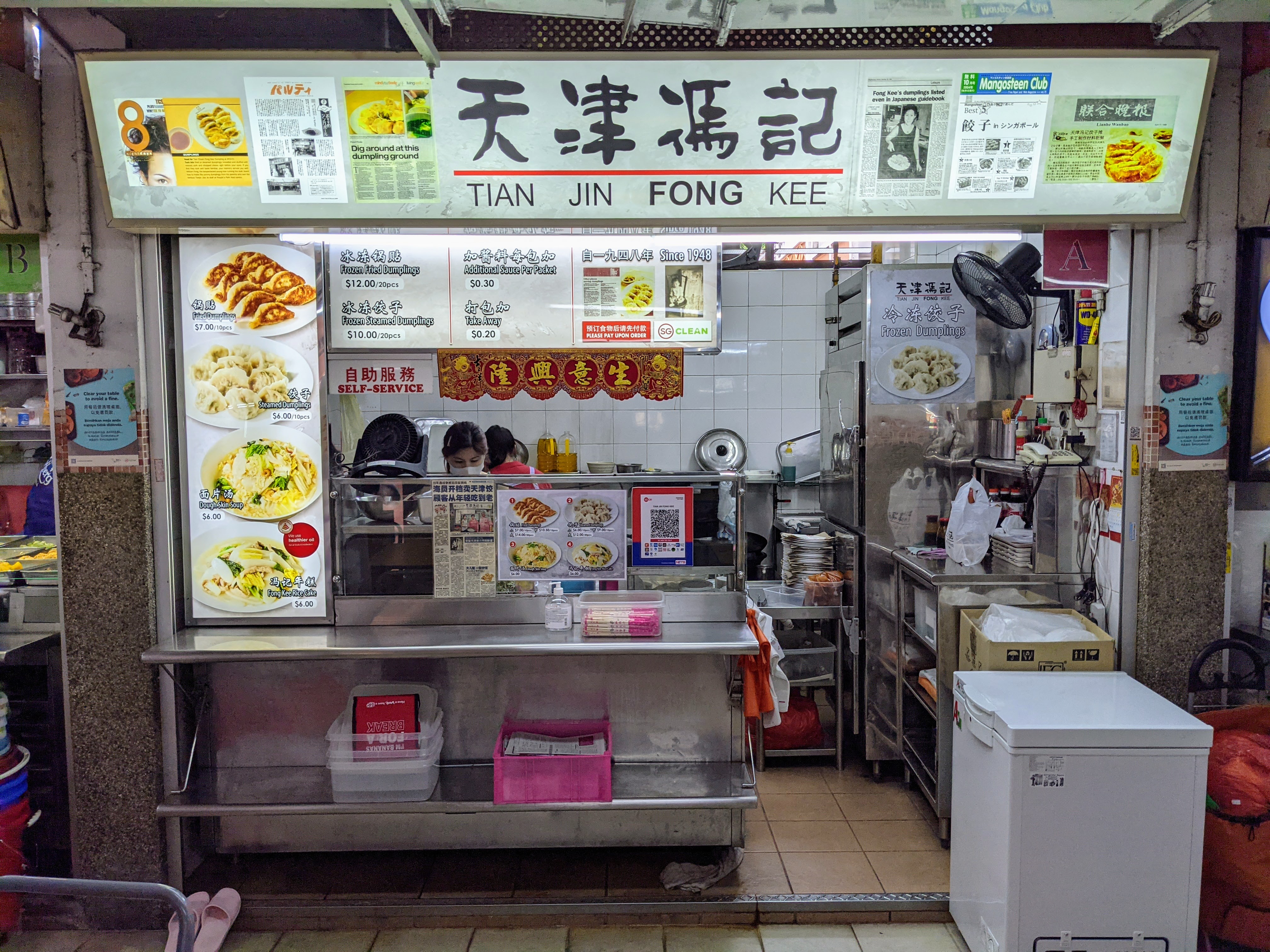
Much later, when living in Singapore’s Chinatown, a friend introduced me to Tian Jin Fong Kee Dumplings (天津冯记) in People’s Park, founded in 1948 by the Fong family from Tianjin. Back in the early 2000s, this was a mild-mannered dumpling shop by day frequented by heavy-drinking sailors and the ladies who love them by night. The regular dumpling menu was supplemented by a second Filipino menu full of dishes like sizzling sisig (chopped lungs), and you could wash them down with ice-cold San Miguels from a row of dedicated beer fridges. Alas, the former Fong Kee location has now been taken over by a nondescript Sichuanese joint, and while you can still sing “won’t you take me to Fong Kee town” about 50 meters away, you’ll now have to content yourself with an ordinary little hawker stall without even an alcohol license. Sic transit gloria fongkee. For old times’ sake, I bought a couple of bags of frozen dumplings (20 for $10, not a bad deal) to eat at home. They tasted just like I remembered: stuffed with the classic combo of pork and chives, but quite honestly, not particularly memorable.

So what’s real Tianjin food then? I asked my Tianjin-born buddy XL for his recommendations, and he gave me a long list of what he used to eat for breakfast, virtually all of which are basically unknown in Singapore: millet porridge (茶汤 chátāng), savoury tofu (老豆腐 lǎodòufu), mung bean noodles (嘎巴菜 gābācài)…

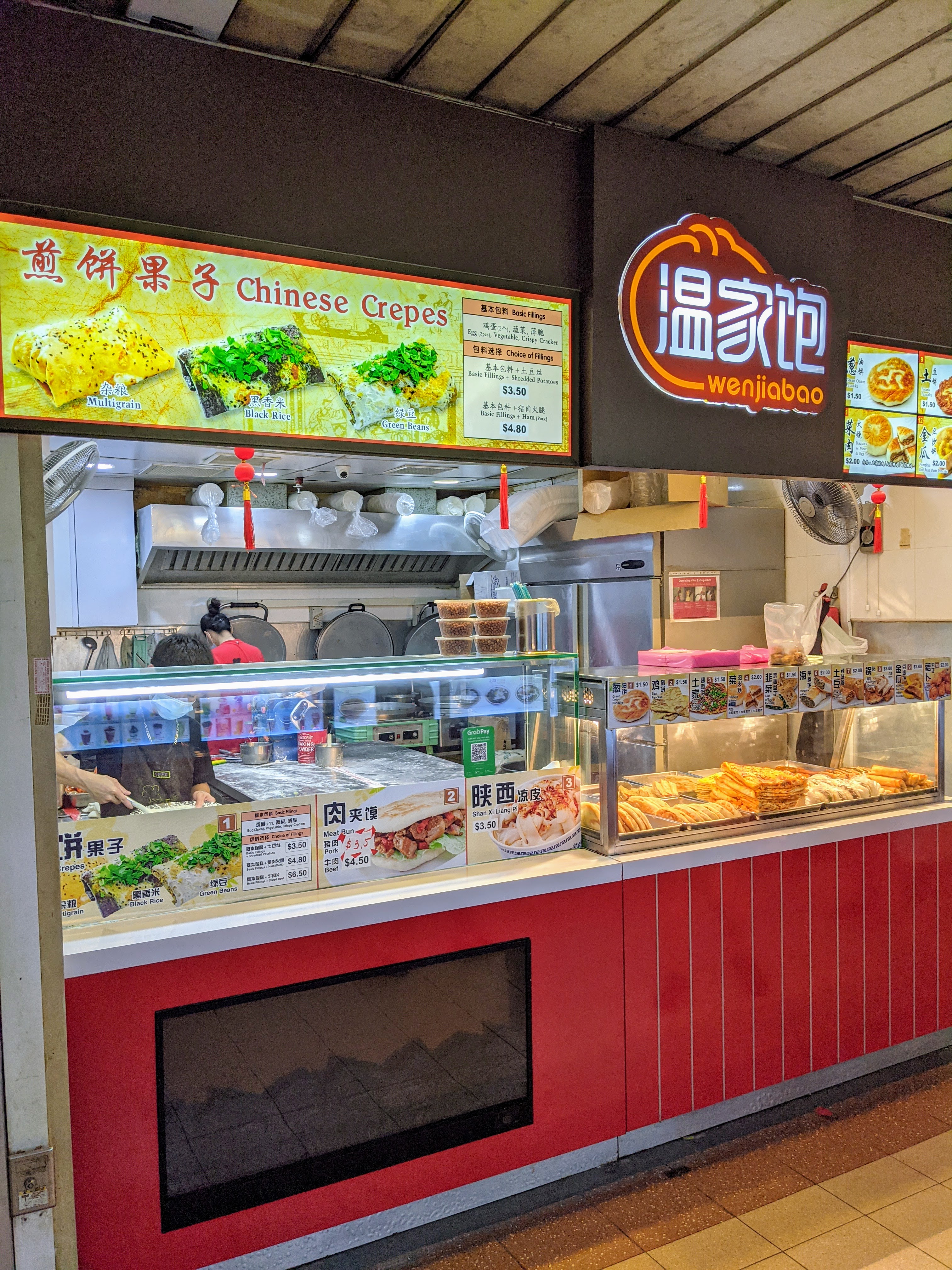
The one item on the list I could find was jiānbing guǒzi (煎饼馃子), often described as “Chinese crepes”, and available at Wenjiabao (温家饱, “warm home full”), not to be confused with former premier Wen Jiabao (温家宝, “warm home treasure”). They have several outlets, but one is in People’s Park next to the MRT station, a stone’s throw from Fong Kee.

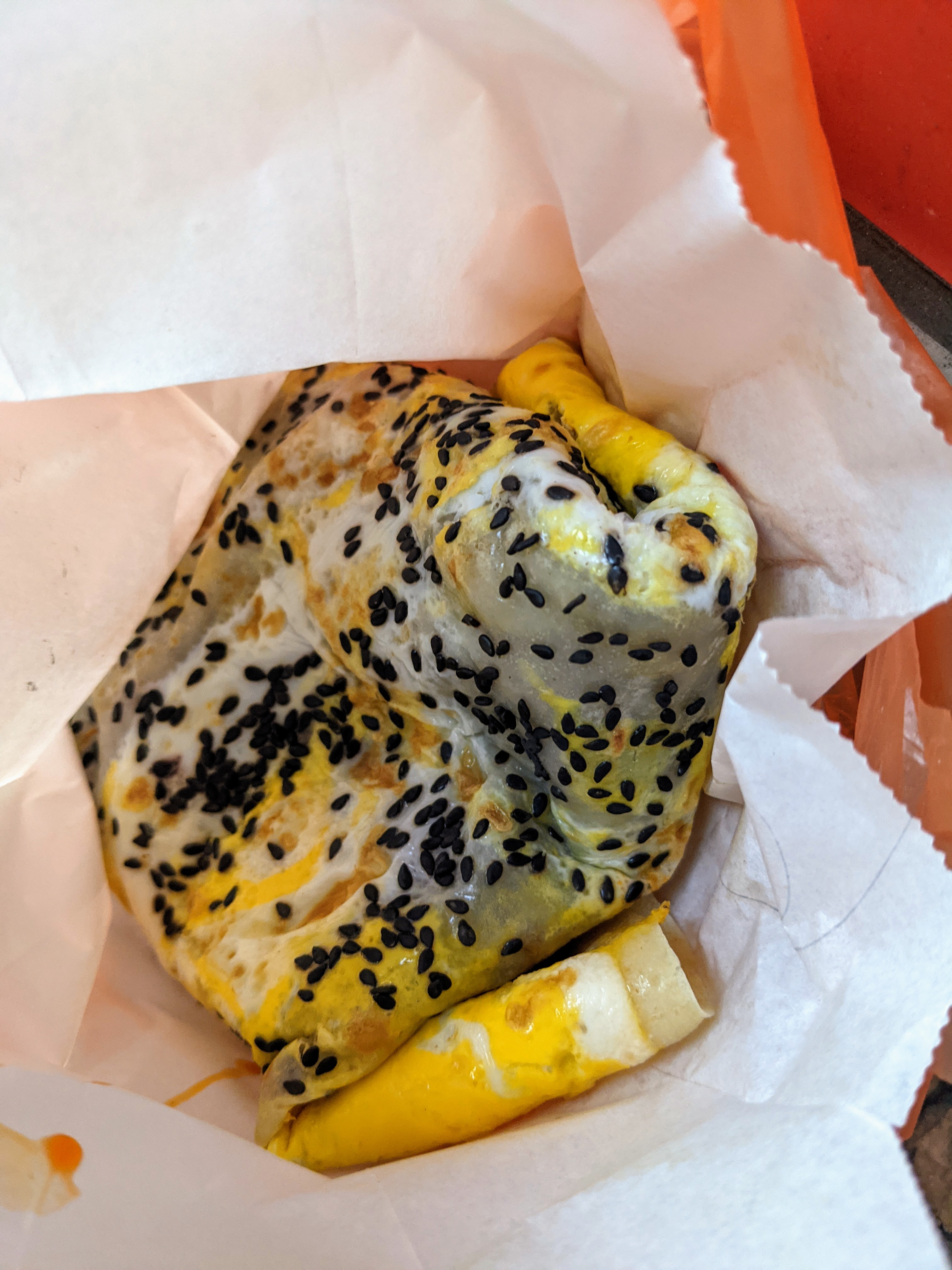
Jianbing are always made to order, and they start out very much like a French crepe, with a thin wheat batter fried on a hot plate and an egg cracked on top. But then things get interesting: the crepe is flipped upside down, slathered with your choice of sweet or spicy sauce, sprinkled with lettuce, baocui (薄脆) crackers and your choice of filling, with options including shredded potato, ham or meat. This is folded over twice and stuffed in a paper bag, and the end result is a piping hot delicious mess. Like an overstuffed doner kebab, eating them is definitely an art in itself, so have a seat and some tissues ready. $3.50 (plus dry cleaning bills) and very much worth it, and if you opt for the potato version, it’s also one of the few purely vegetarian Chinese savoury snacks out there.

Now I’m reliably informed that there are several styles of jianbing, and a true Tianjin-style one should use fresh youtiao dough fritters, not dry crackers. As far as I can tell, though, no jianbing shop in Singapore actually does this. Entrepreneurs of Singapore, here’s your chance!

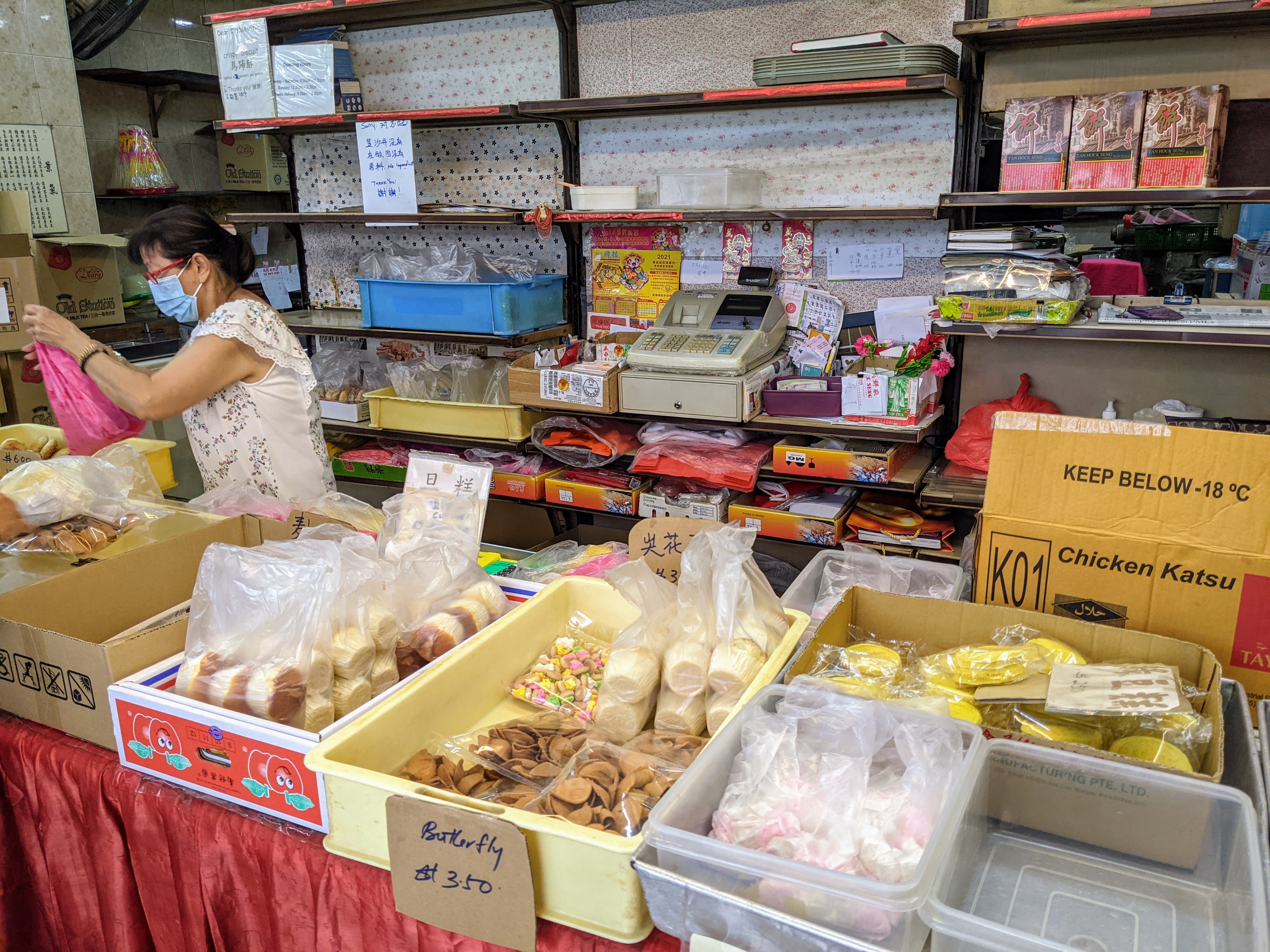
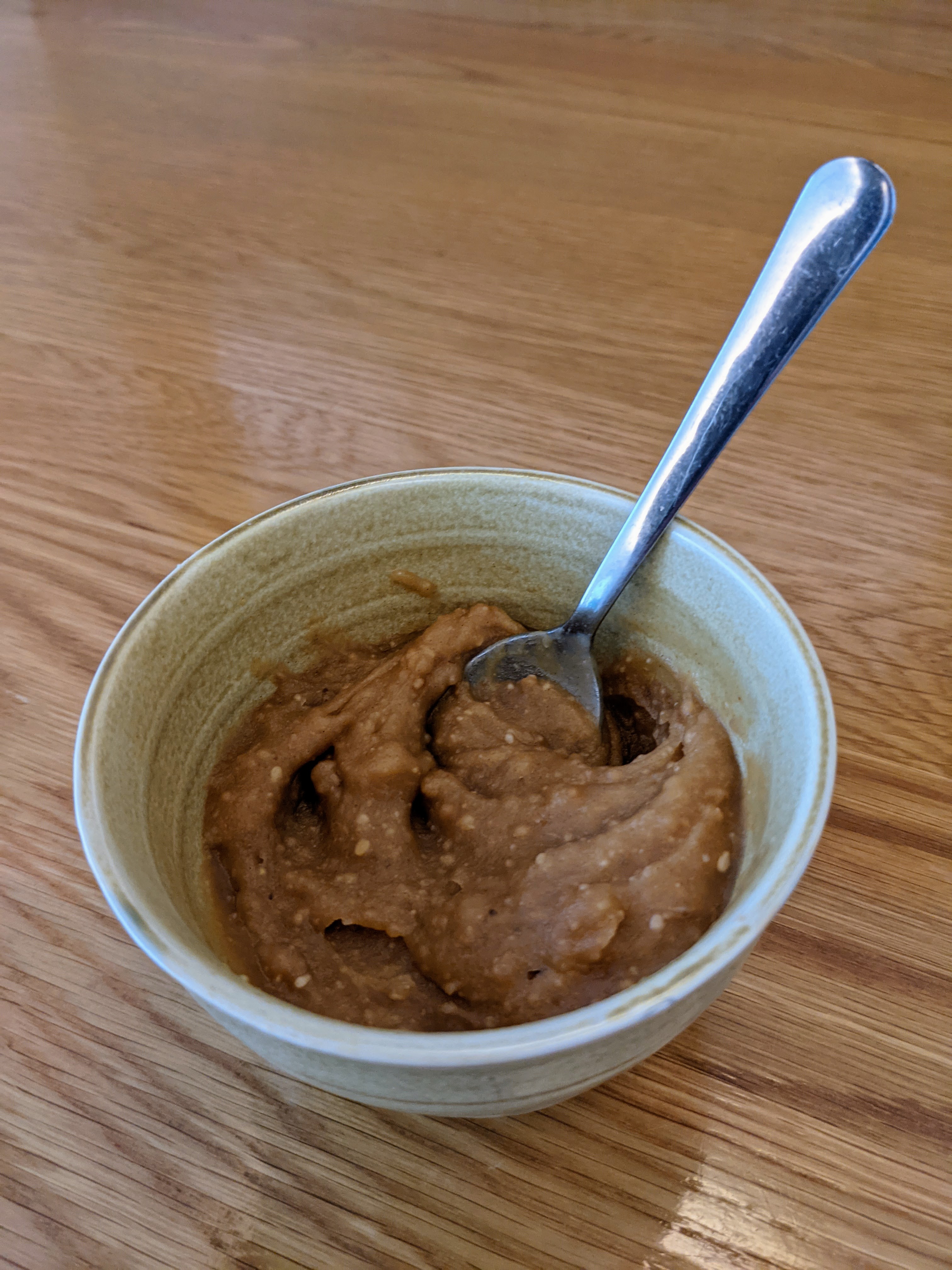
My next Tianjin snack encounter was fortuitous: hunting for traditional Hokkien pastries at Tan Hock Seng (about which more in the Fujian episode), I stumbled onto them selling DIY bags of miànchá (面茶), a Hokkien variant of chatang, for $6 a pop. Unlike the northern Chinese version made from millet, this is made using roasted wheat flour, but the basic idea is the same: just add hot water and stir with a spoon. With cane sugar and sesame seeds premixed in, the end result is an unappealing looking miso-like paste, but while sweet, the taste is actually surprisingly complex and moreish given the really basic ingredients.

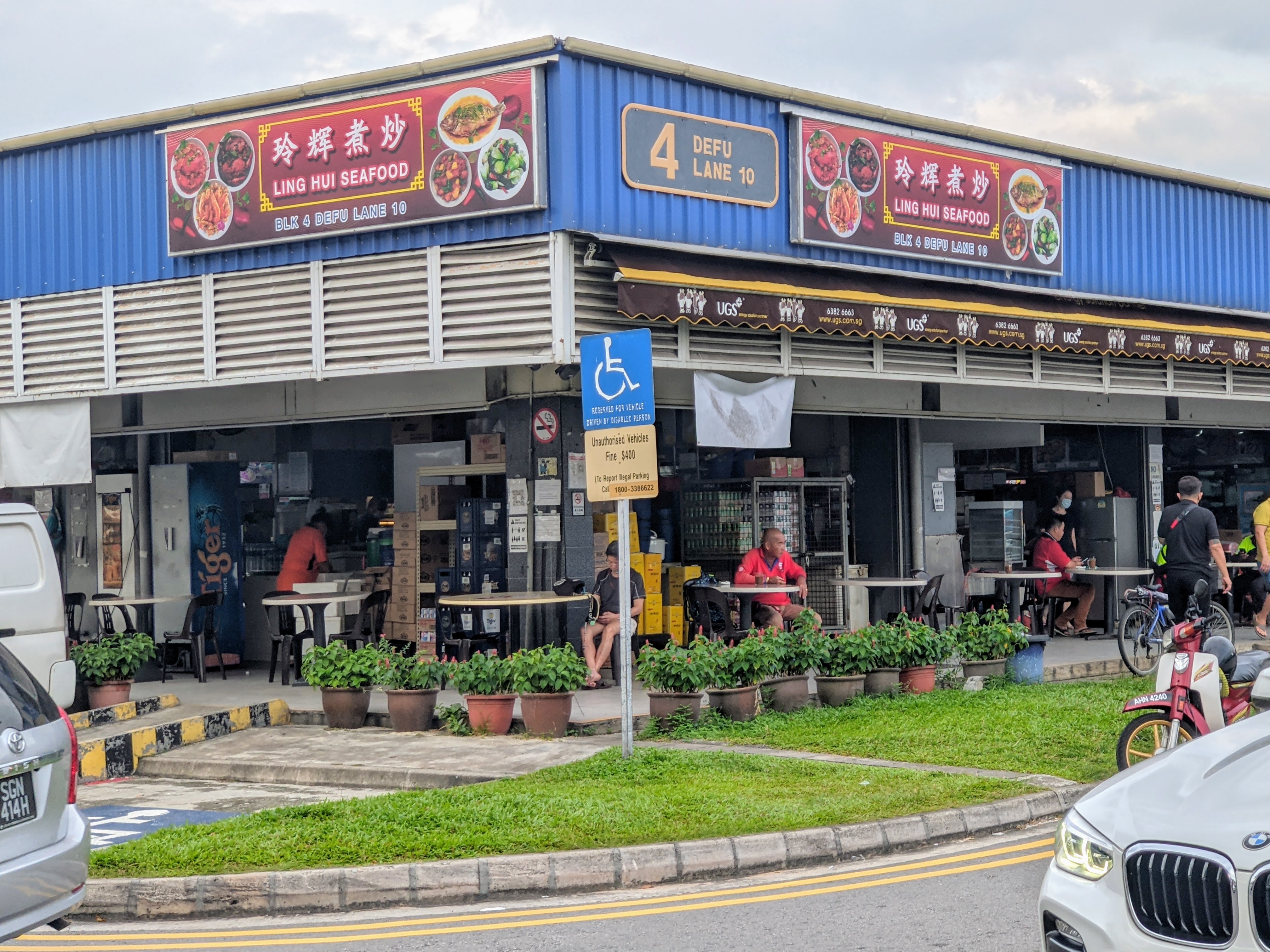
More serendipity awaited at Guangjuren Xiaochu (广聚仁小厨, “Gathering Kitchen”), a busy stall in the thoroughly unsexy Block 4 Defu Lane 10 food centre, packed with workers from the surrounding industrial area and, early on a Monday morning, one chao ang moh in sweaty fluoro yellow cycling gear. The rows of northern Chinese pastries looked tempting enough, but what really caught my eye was the Uncoagulated Tofu, or “tofu brain” (豆腐脑 dòufunǎo) in the original. It may have been partly the exhaustion and sleep deprivation of pedaling since 5 AM that morning, but when I dipped in my spoon and ate my first bite, the heavens parted and an angelic choir sang. This is what my crazy quest is all about! The tofu was still warm, bathed in a mildly salty, mildly sweet broth, with coriander, pickled radish, a mysterious but zingy green sauce (likely roasted chillies, 烧椒 shāojiāo) and a central dab of dark black mala sauce, with that Sichuan pepper crunch and just the right amount of chilli kick. Two wheels up, and conveniently located near the south end of the Serangoon PCN for other bikers out there.

I must append a footnote: this particular tofu brain is more Sichuan style, since the Tianjin version goes by the name of lǎodòufu (老豆腐, “old tofu”) and is usually a plainer affair dressed only with sauces like sesame paste. But beggars can’t be choosers, and trust me, I’m not complaining.

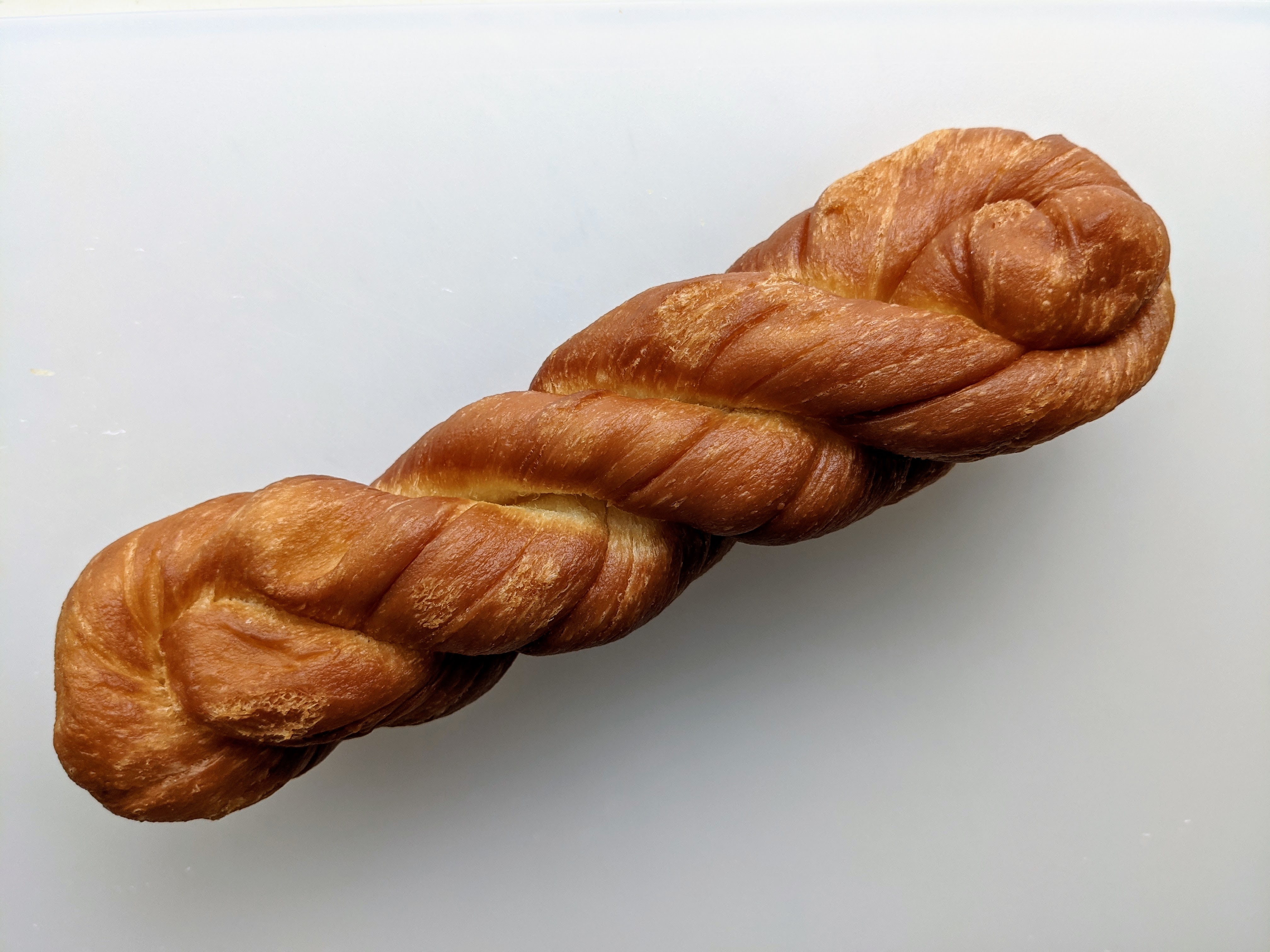
Last but not least, at Dough Magic (扑面而来 Pūmiàn ér lái, “straight at you”), a retailer of all manner of northern Chinese doughy comestibles parked in a tent outside People’s Park — South-East Asia’s very first shopping mall, opened 1970 — I found some máhuā (麻花). It’s now eaten all around China and even became Panama’s national snack, with all sorts of sweet and savoury variations, but Tianjin is generally credited with inventing it and the $2 version here is about as simple as it gets: roll out some donut dough, twist it into three strands, and deep-fry. You can’t really go wrong with this, and both kids heartily approved.

All in all, while many of these weren’t quite the real thing, this was still a thoroughly satisfying snack adventure. Onward!

<<< Henan | Index | Shanxi >>>

34 Province Project: Henan 河南

Henan, “South of the [Yellow] River”, is probably the biggest place you’ve never heard of. (If you’re thinking Chairman Mao and spicy food, sorry, that’s further south in Hunan with a “u”.) This is frankly surprising, since the area has been inhabited since around 2000 BC, gave birth to China’s first two dynasties the largely mythical Xia and the better attested Shang, and has housed no less than four imperial capitals. Its inhabitants invented Chinese writing, brought Buddhism to the country, and gave us the Shaolin Temple and its martial arts masters. Today’s Henan has a population of 96 million, larger than Turkey or Germany, and its capital Zhengzhou, which you’ve probably also never heard of, has over 10 million people.

Being located at the crossroads of China with people traipsing across for four millennia means that Henan cuisine (豫菜 Yù cài) is rather hard to pin down and the Wikipedia article on the topic is a real mess, even by the low standards of its coverage of regional Chinese food. Just chew on this:

” Henan cuisines focused on the mean and harmony principle, rather than on a single flavor. The spirit of Henan cuisine equals to the spirit of Henan people. It needs to be stated that Henan cuisine one a whole takes the entire approach of mixed cooking and adds significant cultural elements in it. For instance, looking at the geography of the place, Henan cuisine adds the concept of cultural mixing through harmony between the flavours used. […] the culinary style has embraced the nuances and given rise to what the modern Henan cuisine is. Thus, at the core, of its essence, Henan cuisine is as much a culinary form as it is a reflection of the culture and history of the place.

Helpful innit? Fortunately, my exploration of Henanese cuisine was conviniently curtailed by the fact that, as far as I can tell, there is exactly one (1) restaurant in all of Singapore that offers the stuff.

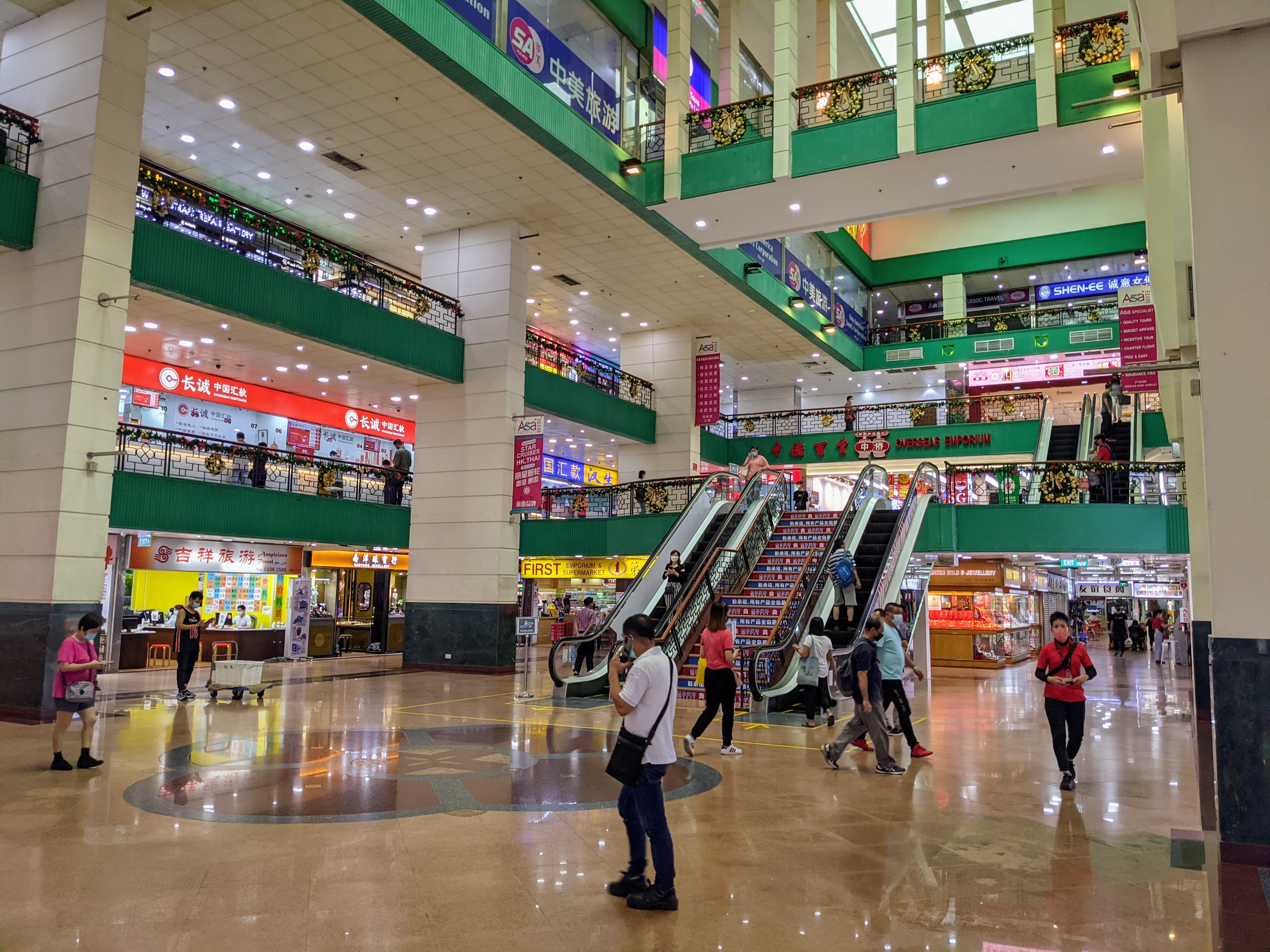
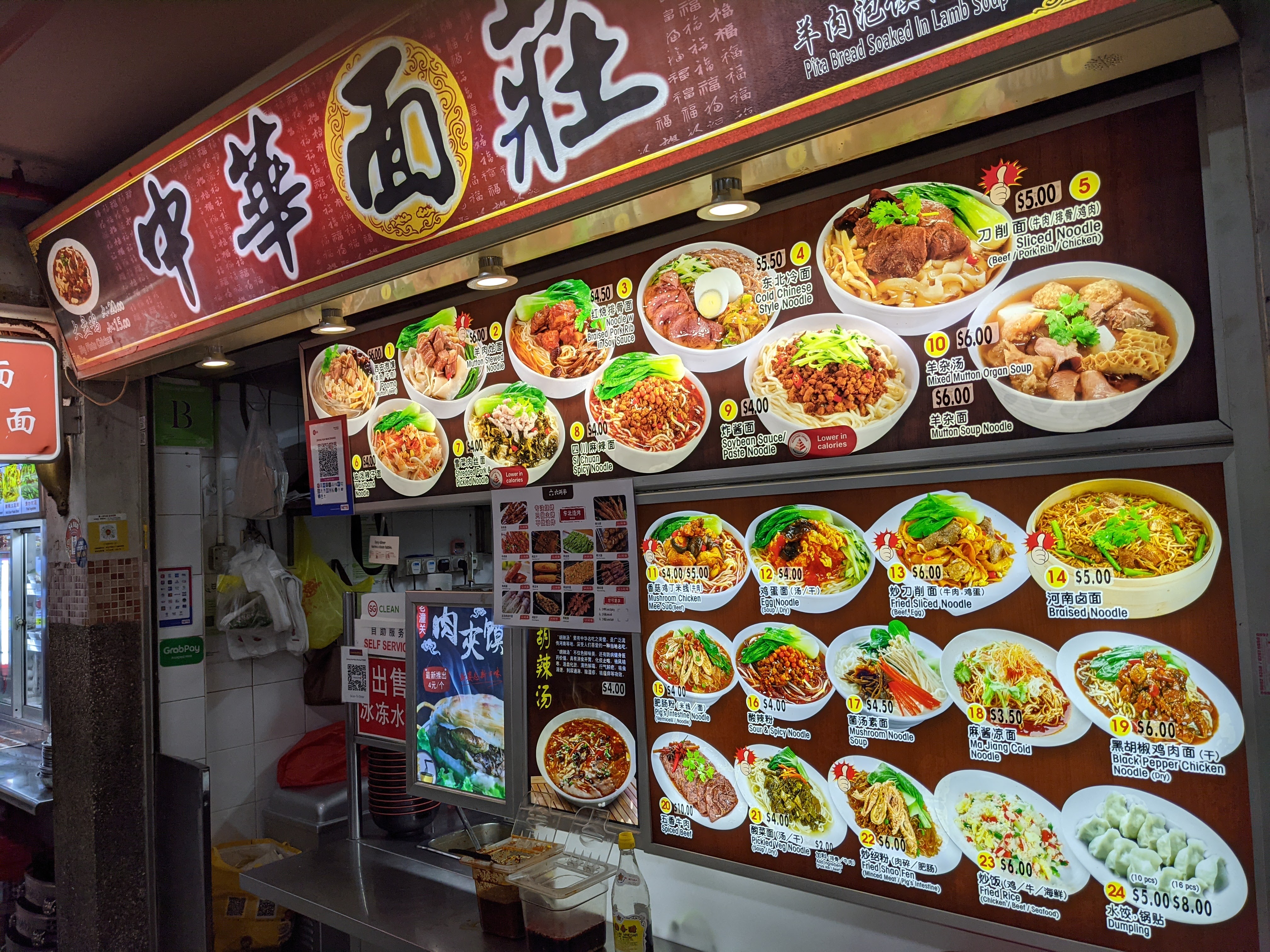
This shining beacon of Henanity is Zhong Hua Noodle House (中华面荘 Zhōnghuá miàn zhuāng), which as the name hints offers noodles not just from Henan, but all across China. It’s tucked away in the outside row of the People’s Park hawker centre, which over the past 10 years has quietly transformed itself into Mala Central, with what must surely be the heaviest concentration of Sichuanese shops in the country. Located in a sweltering, airless concrete alley without so much as a ceiling fan for a breeze, it’s certainly an effective way to simulate midsummer in Chongqing, and I made the trek here on three separate occasions to find out what Henanese food is all about.

I started off with the Braised Noodle (河南卤面 Hénán lǔmiàn), which is confusingly enough written with exactly the same characters as the completely unrelated Hokkien (Fujianese) dish called lor mee in Singapore, a gloopy dish of thick egg noodles in starchy gravy. By contrast, the traditional preparation of the Henan version involves steaming thin ramen-style noodles, stir-frying them with toppings, then steaming it again. I suspect these guys cut a few corners, since the end result was closer to stir-fried instant noodles with bits of egg, soybeans, and some pork, with zero vegetables but a little star anise to spice it up. Edible, yes; filling, absolutely; exciting, not really.

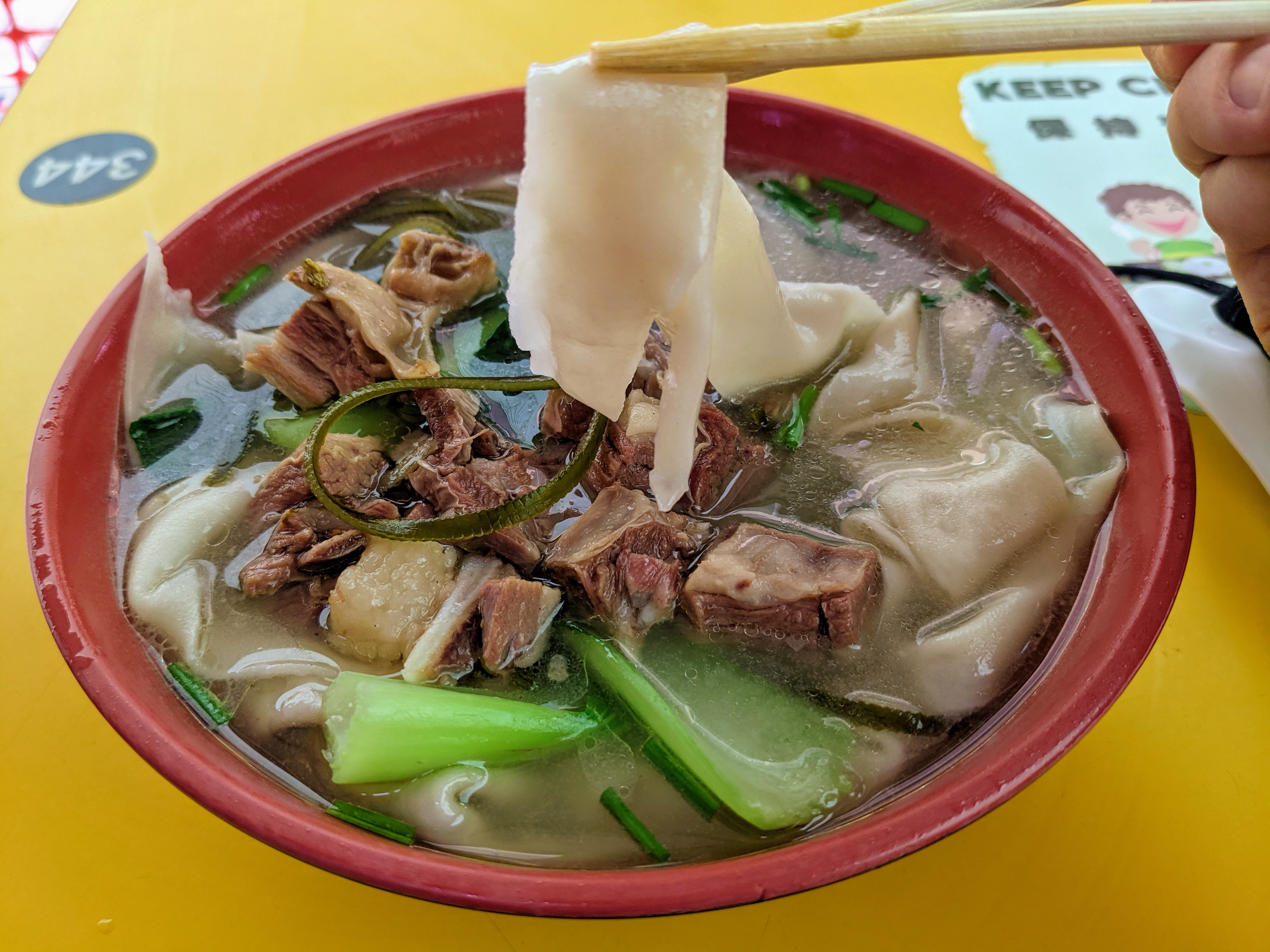
Second rickshaw off the rank was Mutton Stewed Noodle (羊肉烩面 yángròu huìmiàn), showcasing Henan’s very own noodle style huìmiàn. These hand-pulled noodles, while tasty, are not much different from Gansu lamian, albeit wider and maybe a bit chewier. The real key is the stock: lamb bones are stewed for hours on end until you get a rich, white soup, which is then combined with the noodles, some slivers of fatty, boney stewed mutton, crunchy thin slices of kelp, bonus glass noodles and a sprinkling of Chinese chives. Simple, hearty, and unexpectedly delicious, I can see why this is one of their top sellers.

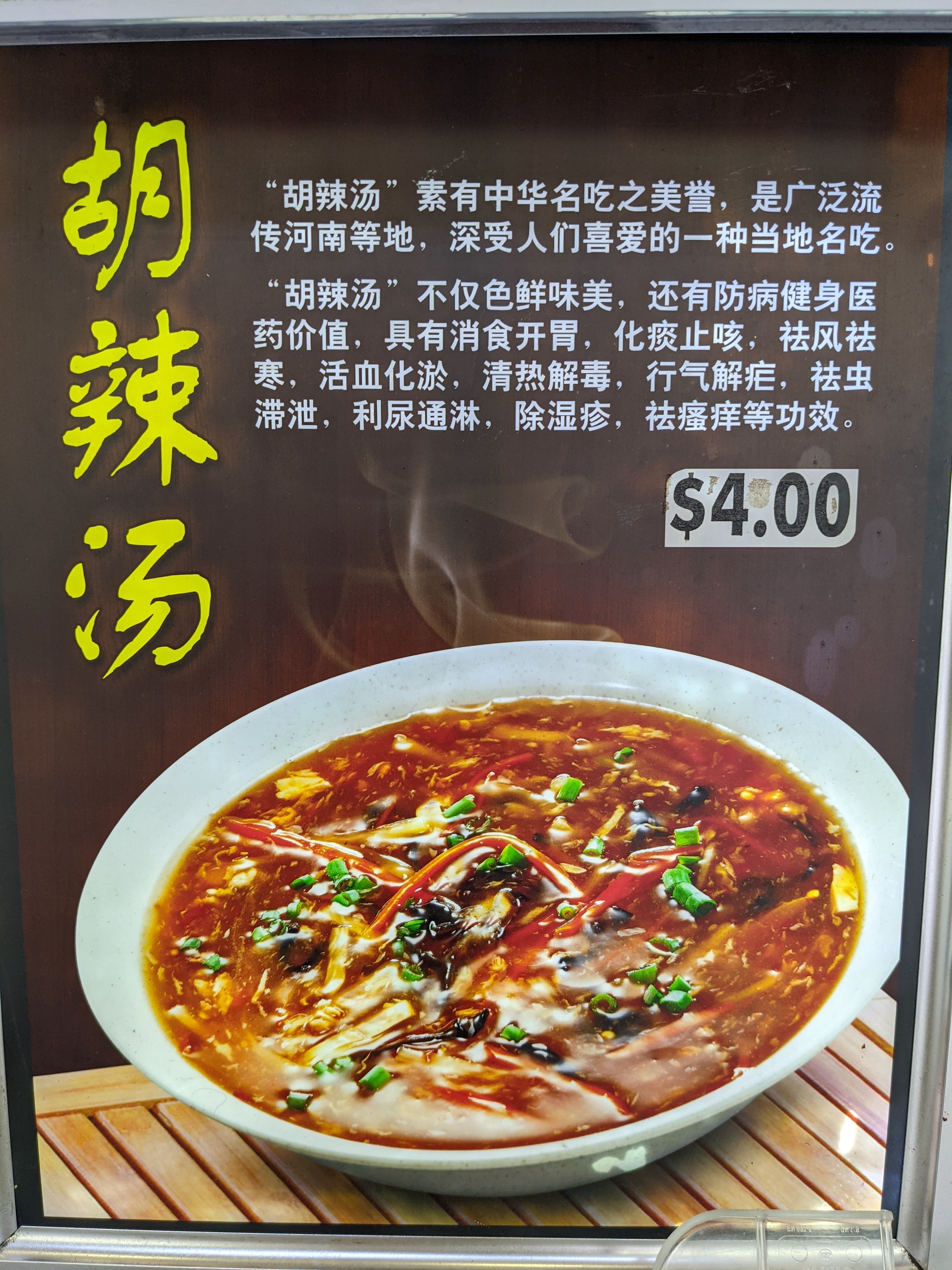
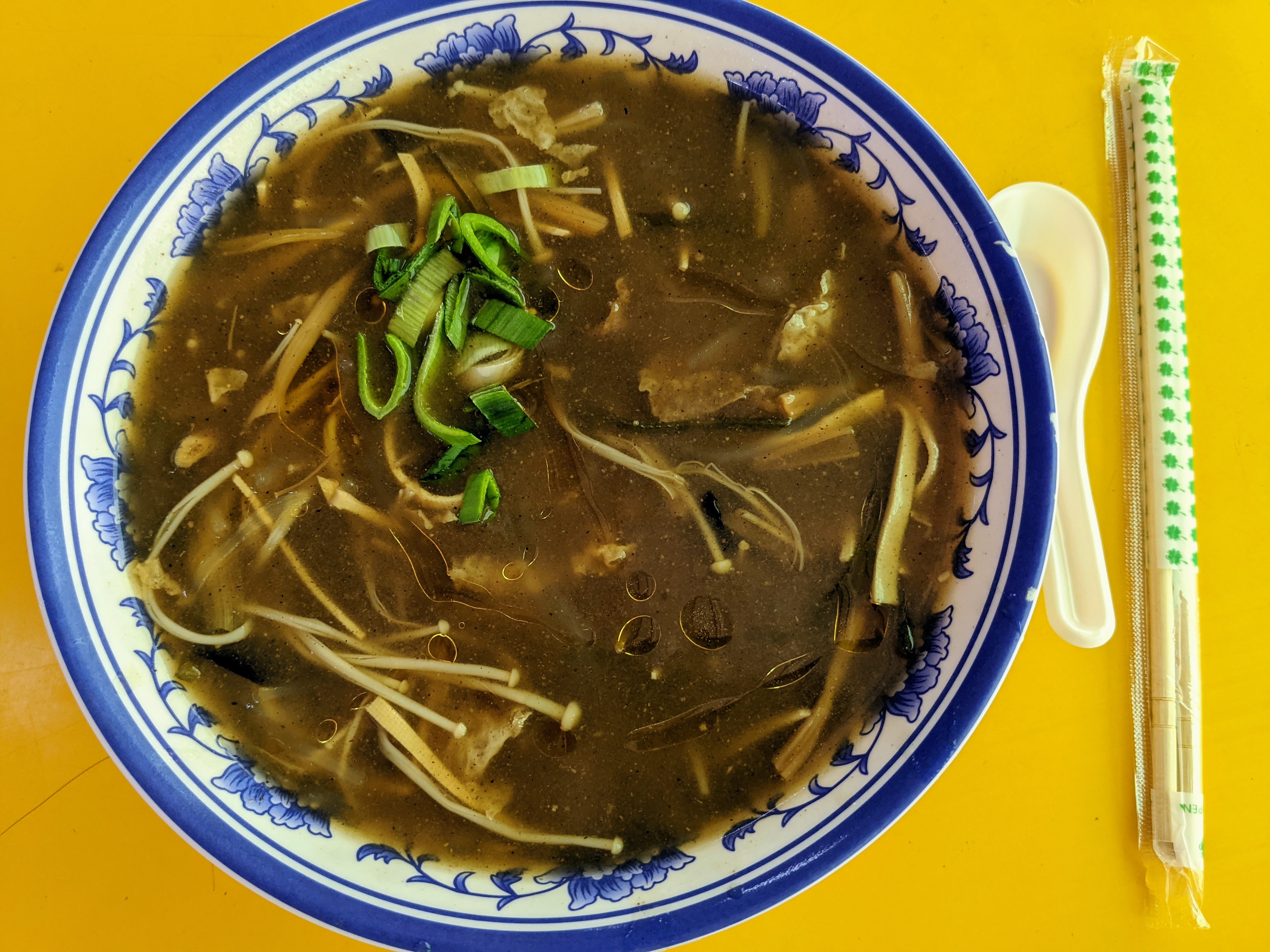
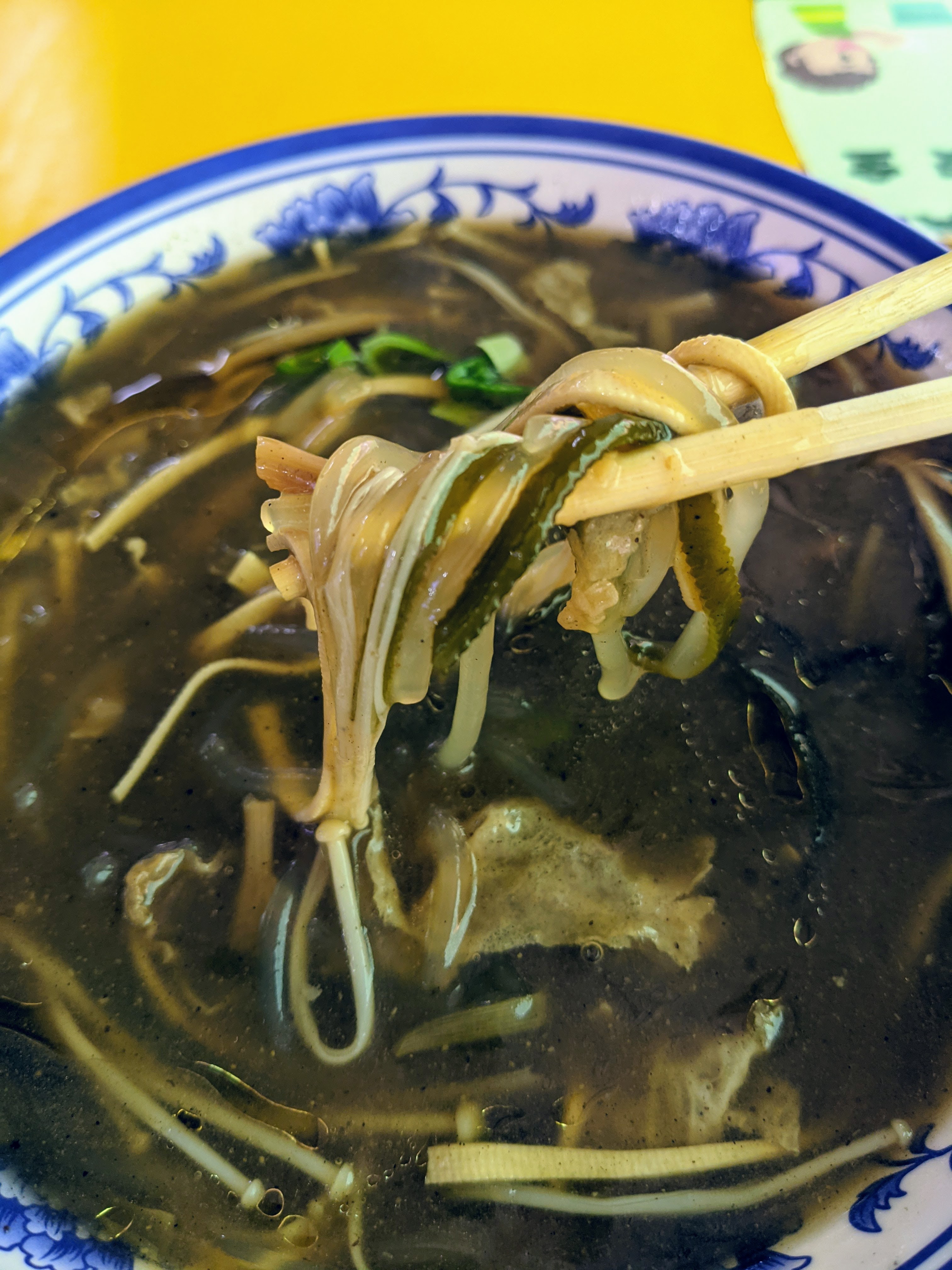
The ultimate boss challenge, though, was Henan’s most famous dish húlàtāng (胡辣汤), a common breakfast in the region and, if the promotional sign is to be believed, good for all things that ail you, including balancing your qi, removing phlegm and deworming. The Chinese characters mean “pepper spicy soup” and that pretty much sums it up, since it’s a beef broth liberally seasoned with black pepper and chilli powder, with some starch to thicken it up and a splash of vinegar and sesame oil. In the soup lurk a number of half-crunchy, half-gelatinous things: tofu skin, kelp, slivered lily bulbs, enoki mushrooms, sweet potato noodles.

Now I’ll be honest: of all the things I’ve eaten on my quest so far, this was my least favourite. It’s not all that spicy, with the pepper being the predominant taste, yet the chilli powder aftertaste is lingering and a tad bitter. The soup ingredients are all varying degrees of slimy and none have a taste or texture that can stand up to the broth. I can see this hitting the spot on a freezing Zhengzhou morning when you’re on the tail end of a head cold and need a pick-me-up or perhaps a dose of ivermectin, but in Singapore’s eternal summer, not so much.

That brings us to the end — oh, the Henanity! It’s time to hula onwards.

<<< Fujian | Index | Tianjin >>>

34 Province Project: Fujian 福建

Fujian, named after the cities of Fuzhou and Jianzhou and located on the coast around halfway between Shanghai and Hong Kong, is the single most intimidating Chinese province to try to cover from Singapore. Uniquely among the Chinese diasporas of the world, in Singapore Fujianese speakers — or Hokkien, as both the people and the language are known here — form the single largest dialect group, and that’s not even counting other groups like the Hakka (Kejia), Henghua (Putian), Hockchew (Fuzhou) and Hockchia (Fuqing) that hail from Fujian as well.

Yet you can hardly describe Singapore as a Fujianese city, and while plenty of Hokkien terms live on in Singlish, the dialect has long since been overtaken by Mandarin among the local Chinese. Similarly, few restaurants in Singapore explicitly advertise themselves as Hokkien: by and large, Fujianese influences have been blended into Singapore-style “Chinese” food, and only an ever-dwindling group of elderly proprietors, many third generation by now, carry on the torch.

Given the sheer variety on offer, for this episode I’m going to focus on Hokkien, Hokchiu and Henghua flavours, choosing both dishes and restaurants mostly for convenience and personal taste rather than popularity. For Hakka, stay tuned for the Guangdong episode, and you can find a few more Fujian-inspired eats in Taiwan as well.

Hokkien (Fujian) 福建

Fujian cuisine (閩菜 Mǐn cài) is one of China’s Eight Great Traditions, best known for its many soups: “no soup, no go” (不汤不行 bù tāng bùxíng), they say, meaning a meal isn’t complete without one. Soups are, of course, eaten across China, but Fujianese ones are often thickened by starch and called gēng (羹) instead of the usual tang. Many dishes also get a Southeast Asian touch from fish sauce (虾油 xiāyóu, literally “shrimp oil”) and shrimp paste (咸虾 xiánxiā), both ingredients rarely seen in the rest of China.

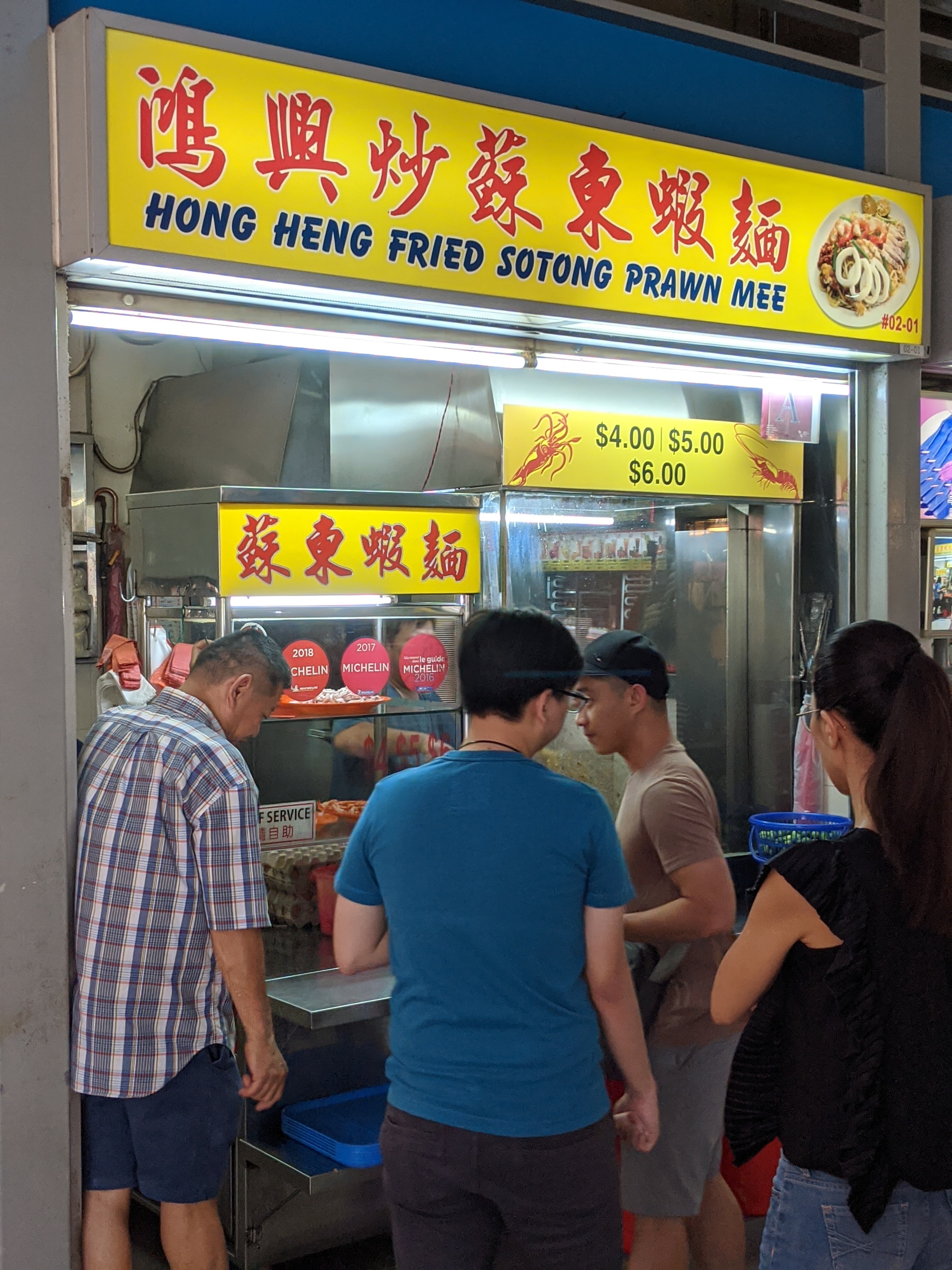
Interestingly — and we’ll see this again in the Hainan episode — the two most famous “Hokkien” dishes in Singapore are local creations largely unknown in Fujian itself. Hokkien mee (noodles) refers to at least three different dishes, which all appear to descend from lor mee (卤面), but in Singapore, it means noodles stir-fried in copious quantities of an aromatic broth made from prawns and pork bones and topped off with fresh prawns, squid, a calamansi lime and a dab of fiery sambal chilli spiked with hae bee hiam (虾米香) prawn paste. I’m not even that much of a prawn fan, but I do love this stuff, and when we moved back to Singapore, one of the first hawker meals we had was at Hong Heng Fried Sotong Prawn Mee (鸿兴炒苏东虾面) in Tiong Bahru, where a long wait and $4 gets you an irresistible Michelin Bib Gourmand worthy umami explosion.

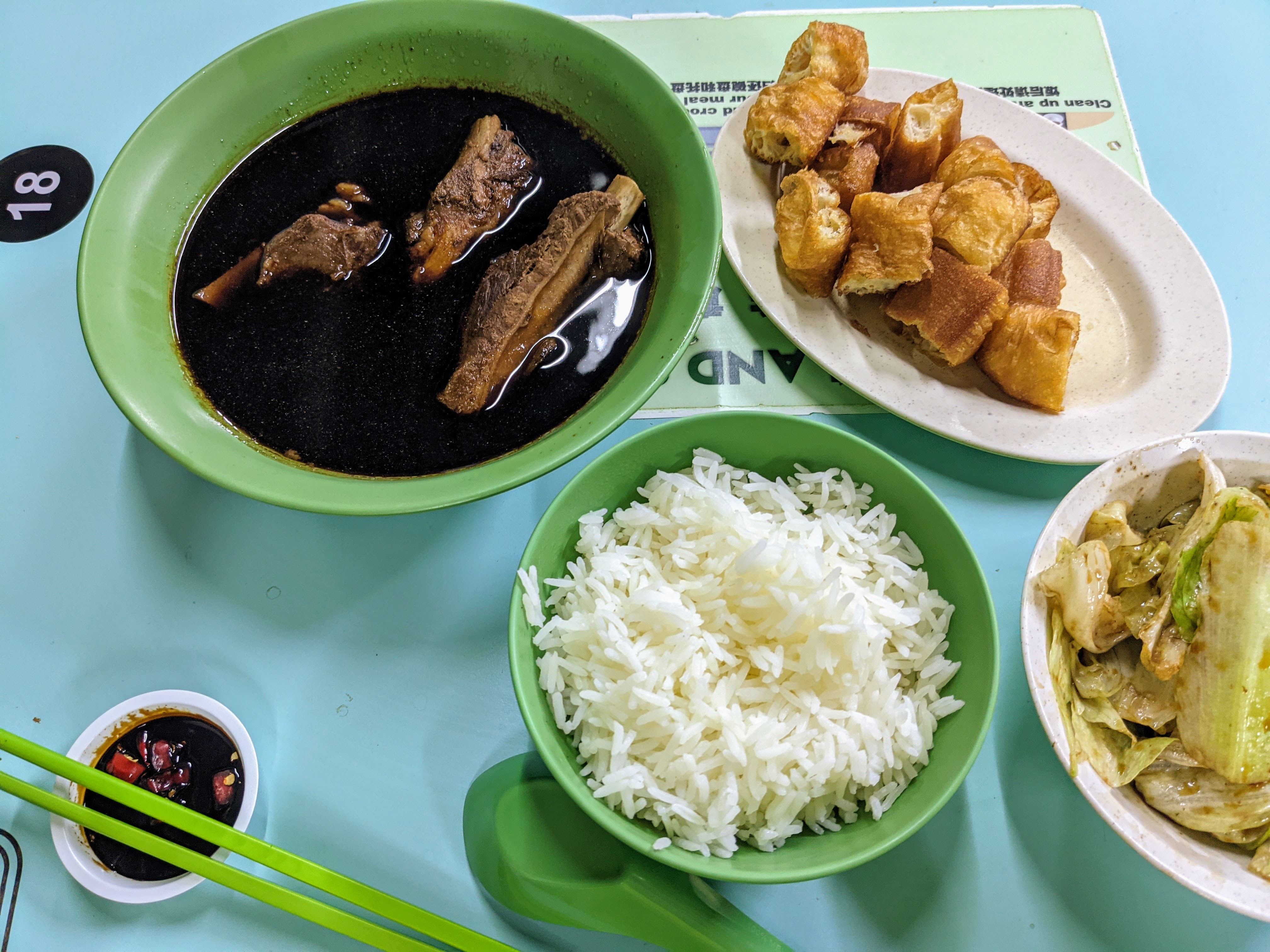
The other classic not-so-Hokkien dish is bak kut teh (肉骨茶 ròugǔchá), or “pork bone tea”, made by stewing pork ribs in a herbal soup. (The tea is an accompaniment, not an ingredient.) By legend, this was invented by Fujianese dock workers in Kuala Lumpur’s port town on Klang, and the original is strongly flavored with Chinese herbs and dark soy sauce. In Singapore, most shops default to the Teochew style, much lighter but peppery, but the Hokkien style is not hard to find either. At the tail end of one of my early morning bike rides, I ended up at the aptly named Morning Bak Kut Tea (朝市肉骨茶 Cháoshì ròugǔchá) at Hong Lim Complex in the shadow of the city centre. The soup here is pitch black but quite sweet, lacking the bitter herbal notes you run into at some shops, and the well-stewed pork was simply superb, meltingly soft and full of flavor. The sides, alas, failed to impress: the you char kway (油炸粿) dough fritters were chewy and stale, not improving much even when dunked in the soup, and my attempt to order stewed pickles (菜尾 choy buai/cài wěi) somehow turned into “fresh vegetable” (生菜 shēngcài), basically iceberg lettuce quickly doused in soup, which tasted about as exciting as that sounds. To add insult to injury, I unaccountably neglected to order the obligatory pot of Iron Goddess of Mercy tea to go with it all. Total damage $8.

One Hokkien dish that has, unusually, made the leap into trendy Asian restaurants worldwide is the pork belly bun, popularized by the Momofuku chain. In Singapore, they’re called kong bak pau (炕肉包) and the undisputed King of Kong Bak Pau is Westlake (西湖小吃 Xīhú Xiǎochī) on Farrer Rd. While named after the famous tourist spot in Hangzhou, the menu consists basically of whatever the chef likes and thus runs the gamut from Hokkien to Cantonese and even some Sichuan fare from his student days in Chengdu. Open since 1974, the yellow and lime green decor is, uhh, eye-catching and the faded newspaper clippings and Japanese signage hint at past days of guidebook glory, but on a Friday night they were still packed.

The justly famed “Braised Pork with Pau” is served DIY style, with pillowy buns, meltingly soft pork belly in a very moreish bean sauce, and a few token sprigs of lettuce and coriander. The regular buns are plenty good in my view, but you can choose to pay double for Iberico pork if you choose. Another classic Hokkien dish on the repertoire here is the ngoh hiang (五香 wǔxiāng), consisting of minced pork and prawn flavored with the five spice powder of the name, wrapped in tofu skin and deep fried until crispy. At Westlake, these are skinnier than usual, served piping hot, and the best I’ve had anywhere. We rounded out the meal with a yam ring, a Cantonese-ish invented-in-Singapore dish with stir-fried goodies in gravy filling out a crispy bird’s nest of mashed taro. At $78 for 4, the price was right, with only one catch: more or less everything was very salty, with the stir-fried veg on the side particularly ludicrous. Drink water, you’ll need it!

Finally, it was time to tickle my sweet tooth and pay a visit to an old-school Hokkien bakery. Tan Hock Seng (陳福成), incongruously located smack dab in the middle of Singapore’s business district, is located in a small row of shophouses surrounded on all sides by skyscrapers, and even its shophouse neighbours are thoroughly gentrified. In perennial danger of their lease running out, they’ve already announced they intend to close their doors by November 2021, leading to queues as patrons rush to stock up. Their signature is the rather obscure beh teh sor (马蹄酥 mǎtísū, “horse hoof biscuit”), a crunchy, flaky, very dry shell hiding a sweet, sticky, mostly-maltose filling. Cautiously flavorful and definitely best eaten as fast as possible, you’ll want to have some tea to wash them down. $5 for 5 while they’re still around.

Hokchiu (Fuzhou) 福州

Fuzhou is Fujian’s largest city and capital, so you might be excused for thinking they speak Hokkien, but no! Singapore’s Fujianese diaspora came mostly from the southern parts of the province around Amoy (Xiamen), and linguists differentiate their Southern Min (闽南 Mǐn Nán) from Fuzhou’s Eastern Min (闽东 Mǐn Dōng). And if that’s not confusing enough, in Singapore this 50,000-odd community is often known as Hokchiu, from the Hokkien reading of the city’s name. Despite their small numbers, Hokchius pack quite a punch in the South-East Asian Chinese diaspora: the richest men in Malaysia and Indonesia respectively, Robert Kuok and Sudono Salim, are both of Hokchiu descent.

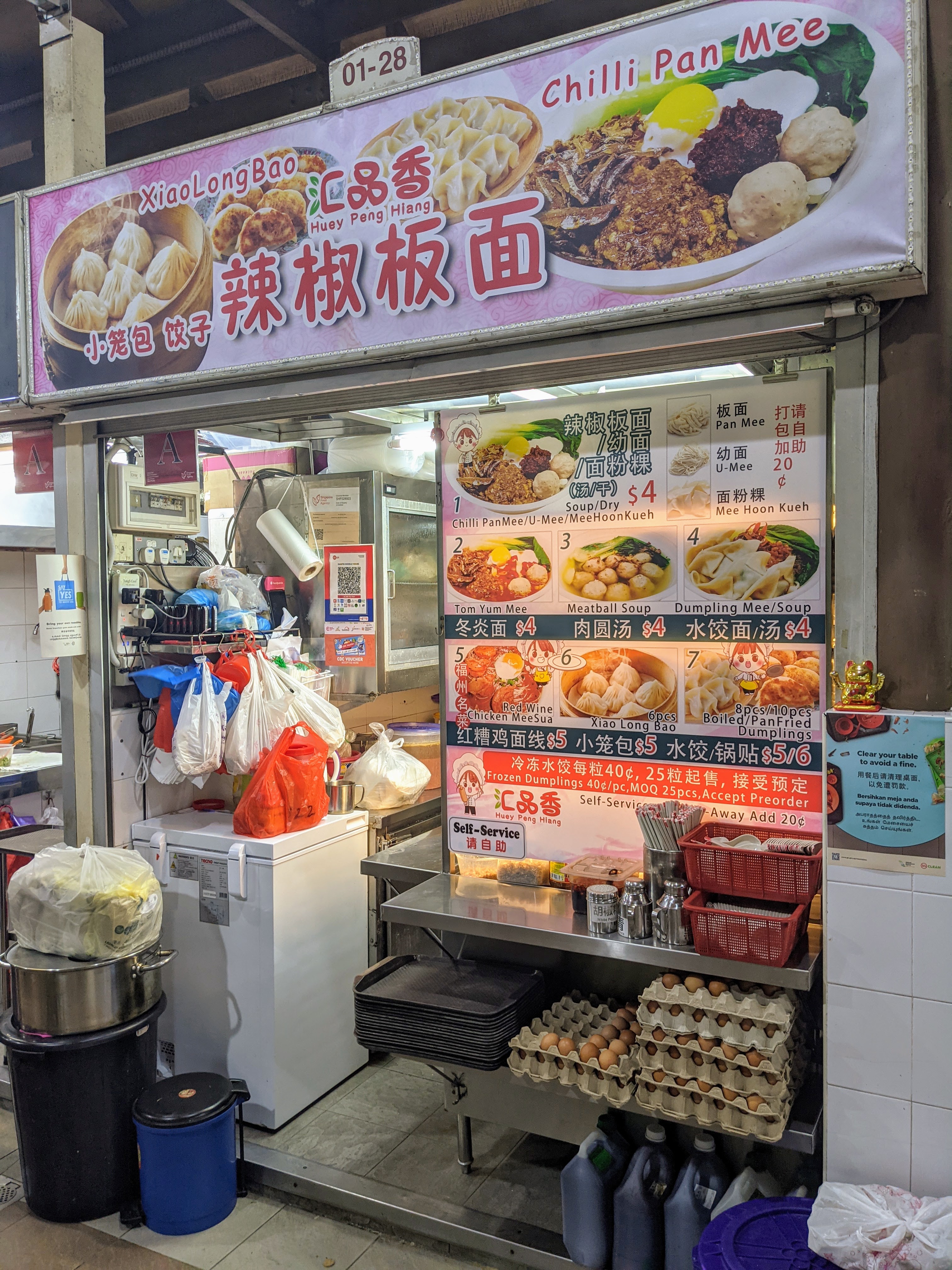
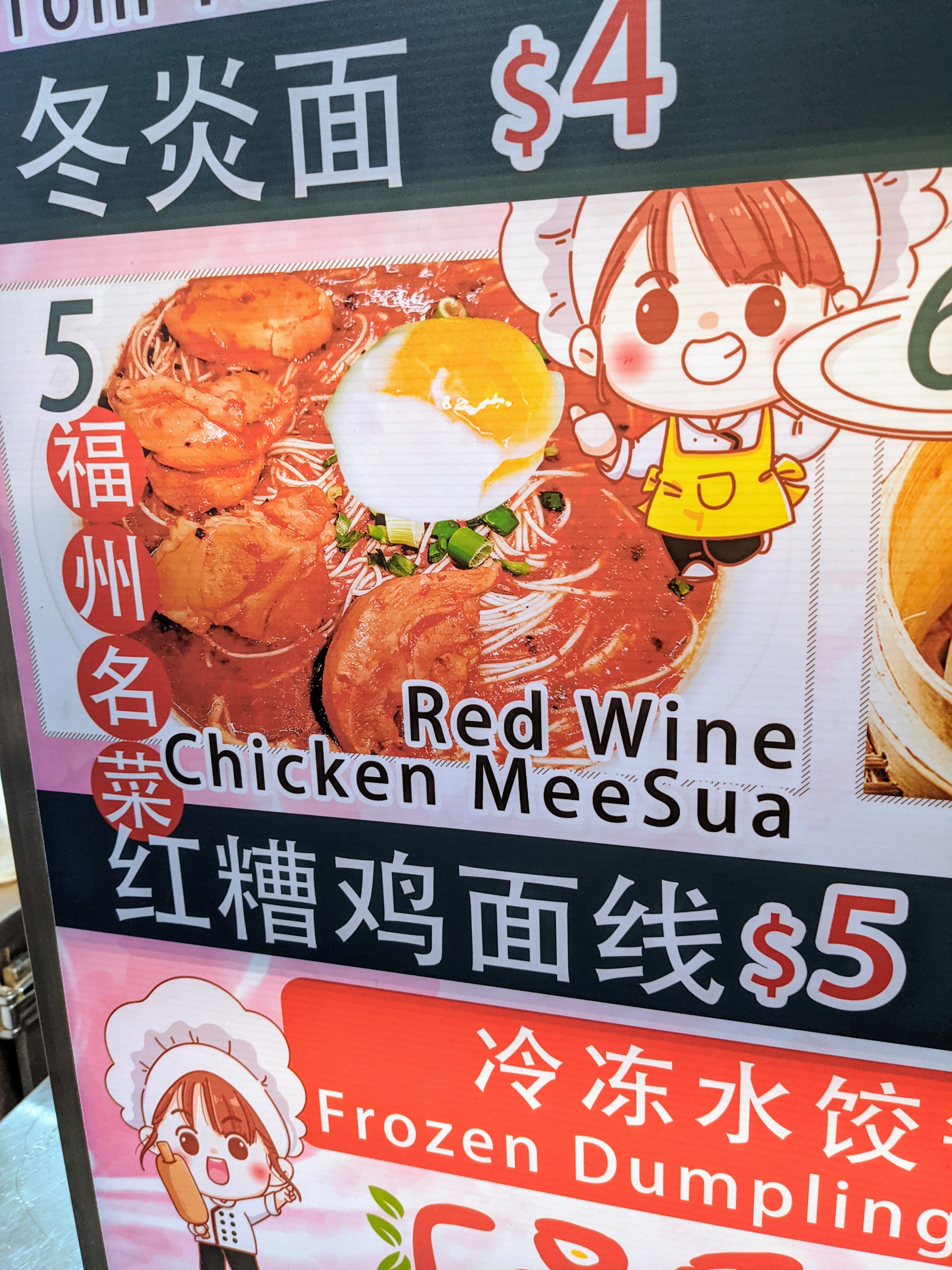
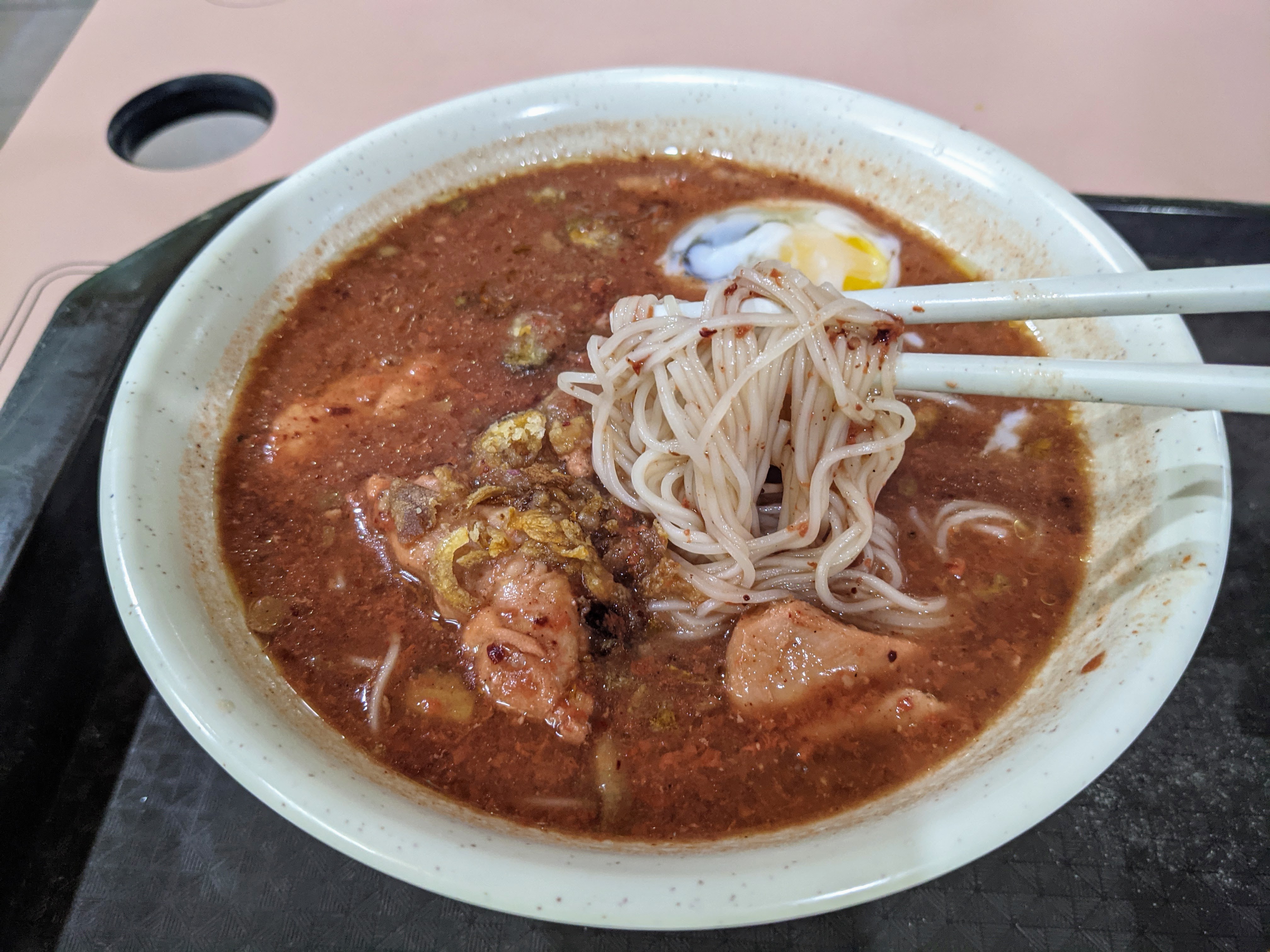
I unexpectedly kicked off my Fuzhou foodie adventure by stumbling upon Huey Peng Hiang (汇品香 Huìpǐnxiāng) in Sembawang Hills Food Centre on my way back from another early morning bike ride. The stall mostly sells chill banmian and dumplings, but tucked away on the menu was red wine chicken mee sua (红糟鸡面线). Flavored with hóngzāo (红糟), the lees (leftovers) of making rice wine intentionally fermented with a specific red mold, the soup looked pretty intimidating but turned out to be delicious, with a rich broth of chicken stock, bits of ginger and slightly sweet miso-like notes. The mee sua are thin wheat noodles that do a good job of sucking up the broth, and there’s a half-boiled egg on top for that extra protein punch. Two cheery anime girl thumbs up for $5, although probably better for lunch or dinner than breakfast.

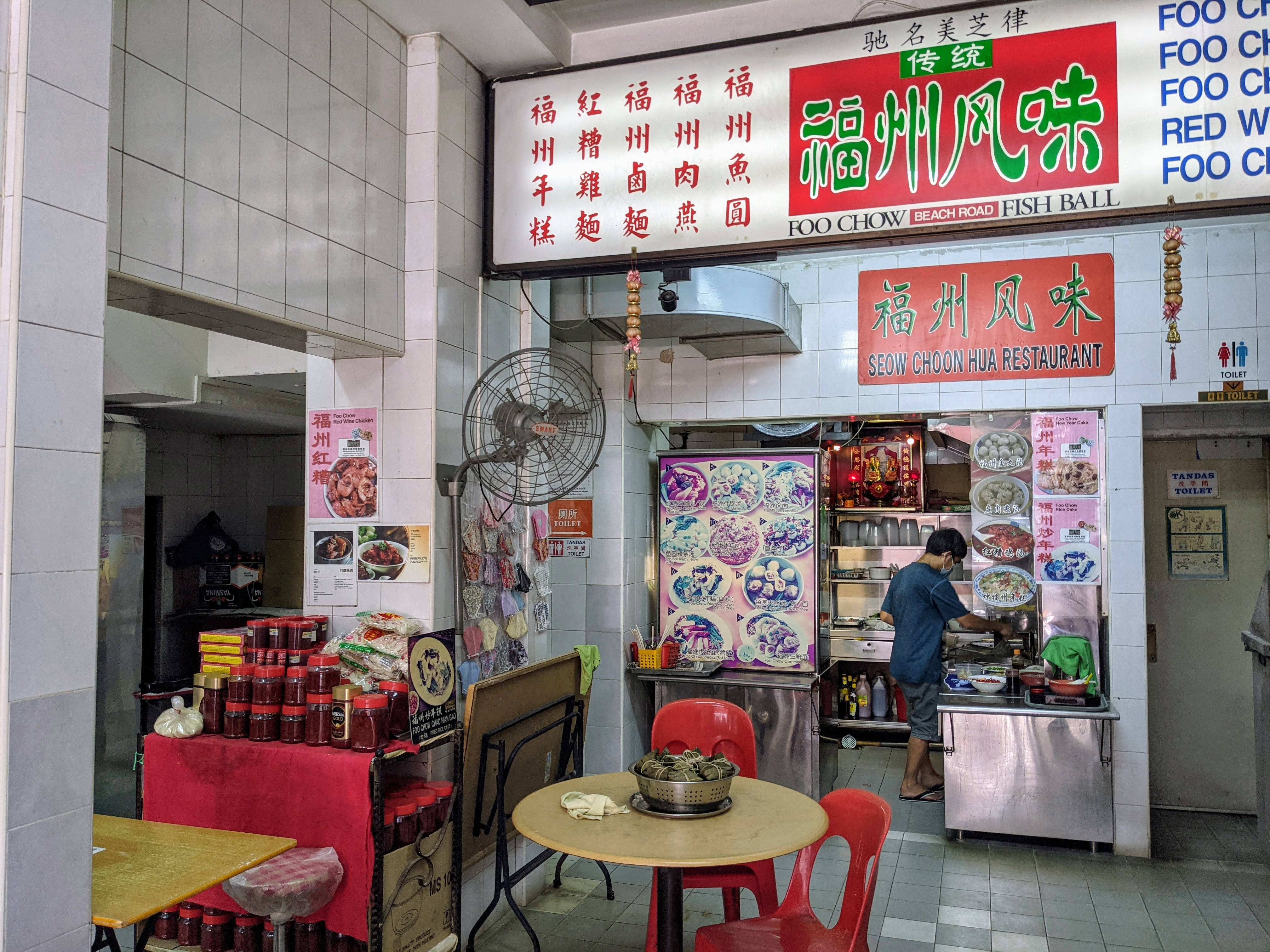
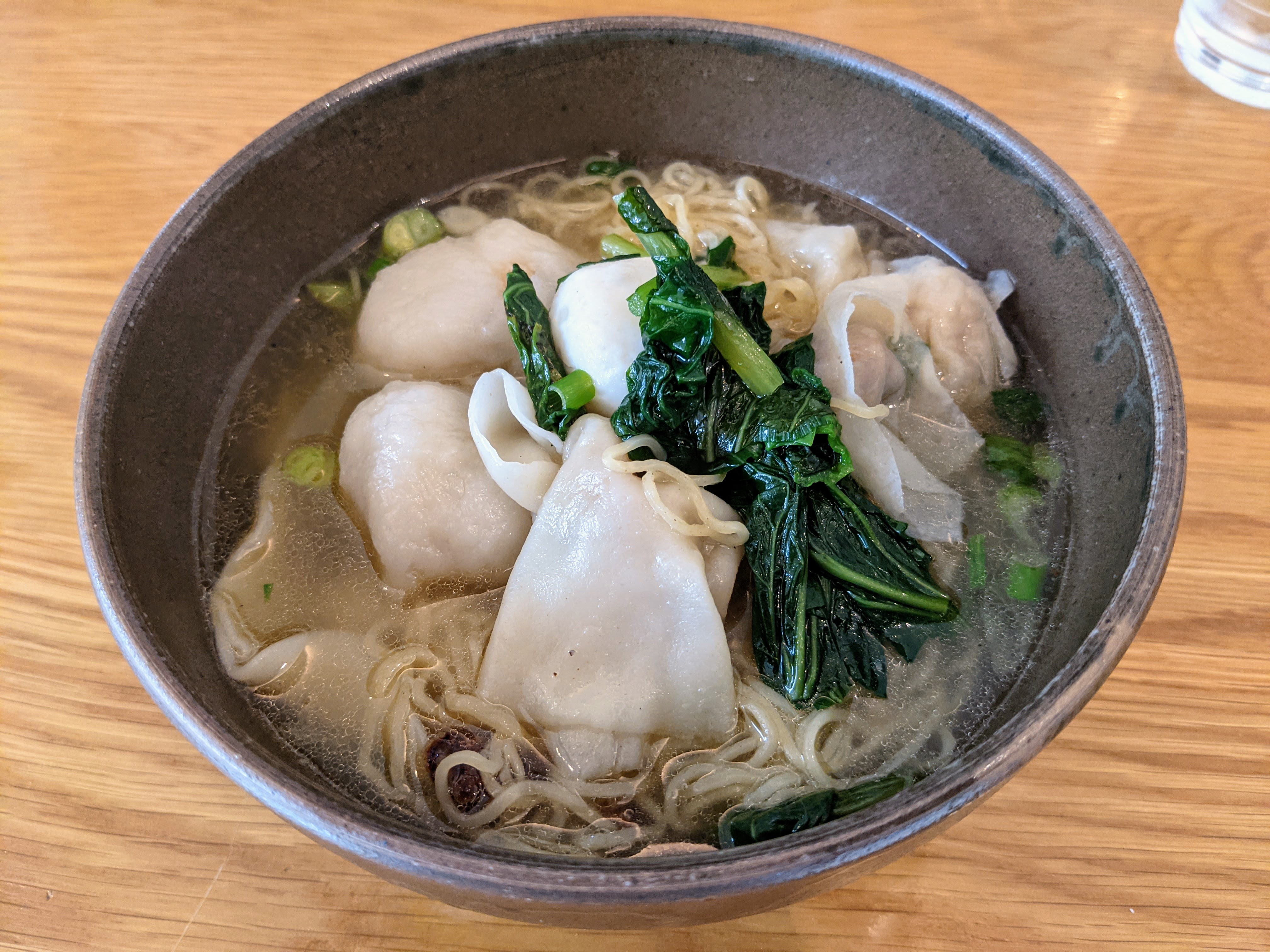
For Fuzhou round 2, I paid a visit to Seow Choon Hua (箫钟华) in Kampong Glam. Notionally a restaurant, this tiled, utilitarian, fan-only space decorated with fading posters is a bit of a time warp from the 1980s, and with no online presence of any kind they must be struggling in the COVID era. The Chinese signboard here proudly proclaims “Fuzhou Flavours” (福州风味), and indeed everything on the menu is a Fuzhou speciality: red wine chicken, stir-fried niangao rice cakes, but what they’re famous for is Fuzhou fishballs (福州鱼丸). Fishballs in the normal Teochew style ubiquitous in Singapore are made from finely ground fish, springy, and have very little taste. In Fuzhou, though, they’re stuffed with tasty minced pork, and unlike the bland mass-produced versions you sometimes see at food courts, Seow Choon Hua makes their own. The end result is a bit lumpy, soft to bite into, and bursting with porky goodness inside. I ordered the $6 Foochow Mixed Soup, which came with tasty stuffed fishballs, a token regular fishball, a few chewy biǎnròuyàn (扁肉燕, “flat meat”) dumplings where the dumpling skin itself is made from 90% pork meat mixed with glutinous rice flour, and a standard-issue wonton dumpling or two. Nothing mindblowing, but made with care and generously portioned, and worth a visit before the clock runs out on this relic from the past.

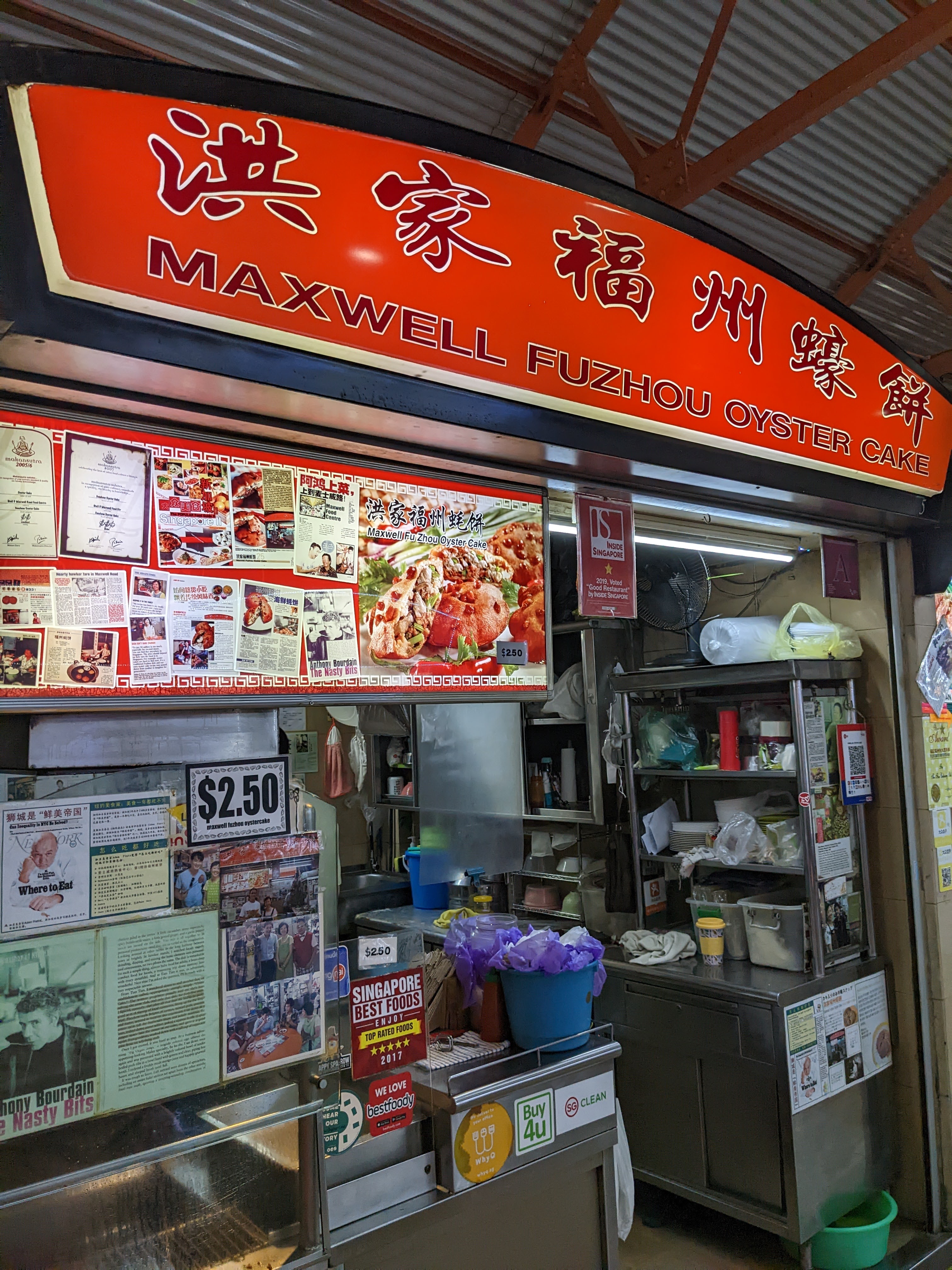
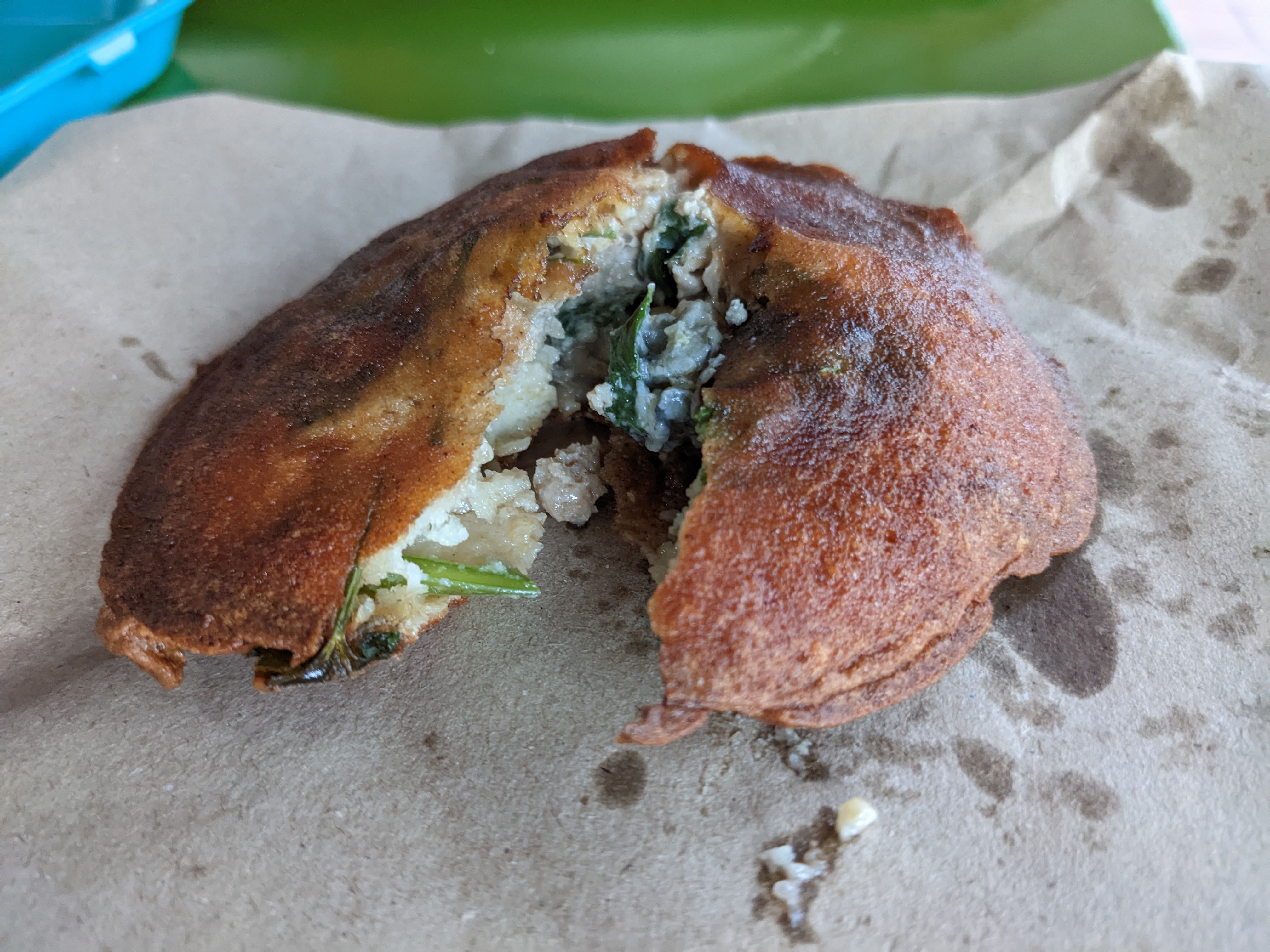
And for round 3, I dropped by Maxwell Fuzhou Oyster Cake at the legendary Maxwell Hawker Centre. I have to say I appreciate the singularity of purpose of this stall: it’s been here for over 40 years, dishing out a menu composed of exactly one dish, oyster cake (蚝饼 háobǐng) at $2.50 a pop. Far rarer than the ubiquitous oyster omelette (蚝煎), a pan-Fujian dish also popular in Taiwan, oyster cake are specifically a Fuzhou dish: deep-fried, UFO shaped patties of small oysters, prawns, minced meat and cilantro. I’m not a huge oyster fan and I don’t particularly like oyster omelette either, but these were really nice! I thought they would be all doughy like Indian vadai donuts, but no, the rice-based dough makes the shell crisp and the inside stays surprisingly juicy and meaty, the overall effect not entirely unlike deep-fried dumplings. Yum! I’m a convert.

Henghua (Xinghua) 兴化 / Putian 莆田

One of the more obscure dialect groups in Singapore is the Henghua (Xinghua in Mandarin), also known as Putian after their erstwhile hometown in northern Fujian (no connection to Vladimir Vladimirovich). Legend says that they, in turn, migrated to Fujian from Henan province, meaning that like the Hakka they’re now migrants twice over. Putian being a coastal town, they’re best known for their seafood dishes, with Chinese razor clams from nearby Duotou known across the country.

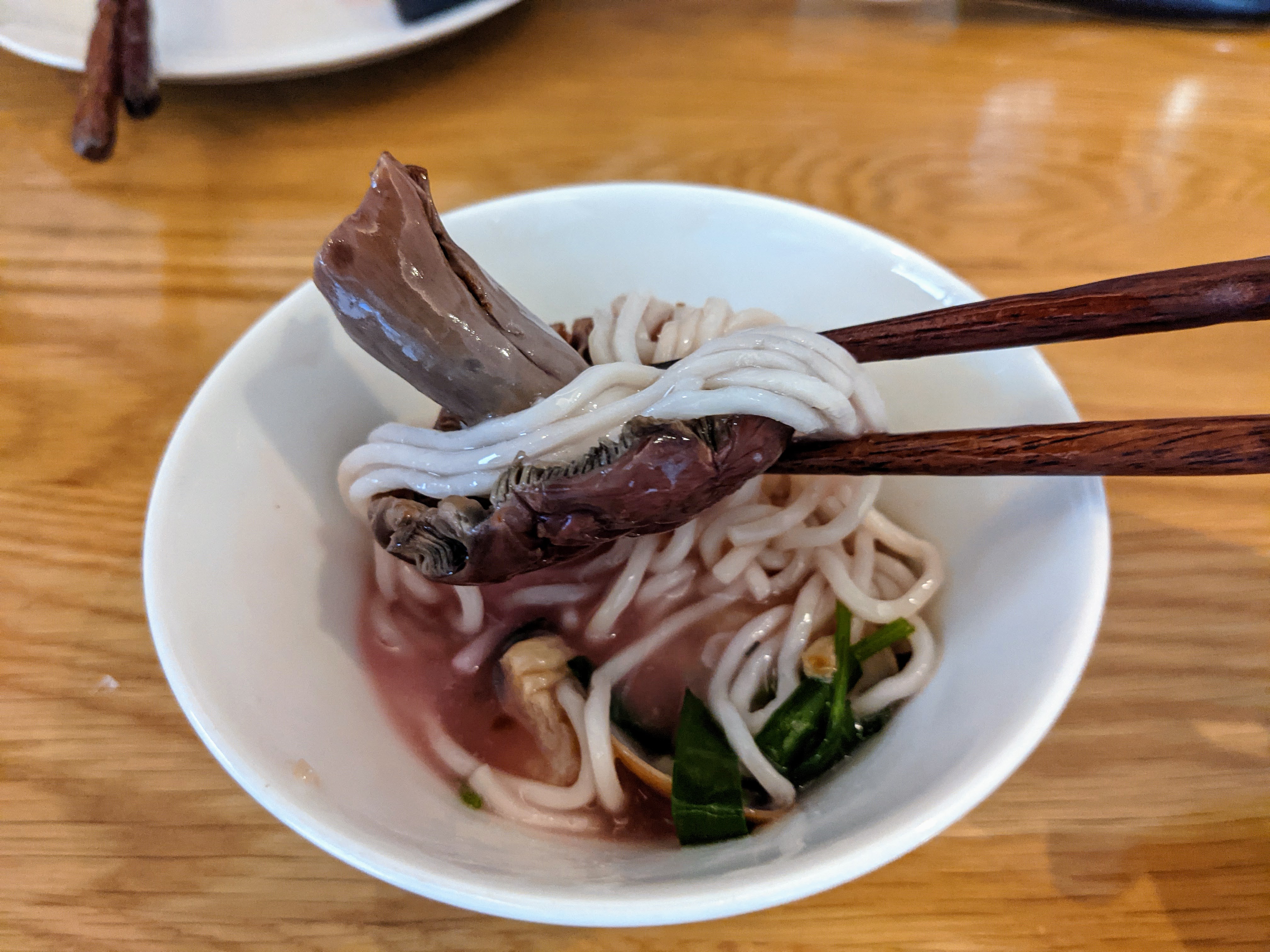
Still, Henghua food would likely languish in obscurity if not for a little coffeeshop called Putien (莆田) in Kitchener Rd that cooked its way to a Michelin star and became a pan-Asian franchise extending all the way back to Fujian itself. Their promise is “Fresh ingredients, original taste”, so with another Sunday lunch in lockdown beckoning it was time to put them to the delivery test. First off the block was bianrou soup, containing Putien’s take on Fuzhou’s meat-skin dumplings, served here in a light seaweed soup not unlike the Korean miyeok-guk. Unlike the usual gloopy, herbal, dark brown Singapore version, the Henghua spin on lor mee was light, packed with clams and mushrooms, and flavored with the red yeast rice we also saw earlier in Fuzhou. The murky pink soup looked pretty unappetizing, bearing a disturbing resemblance to the meat juices sloshing around the bottom of a styrofoam supermarket pack, but once you got over that the taste was shiok, packed with seafood and mushroom umami. Last but definitely not least, Henghua fried bee hoon (兴化炒米粉) was for me the standout: in Singapore, fried bee hoon (thin rice noodles) is the canonical cheap starchy $1 breakfast flavored with soy and a few scraps of cabbage, but this had been cooked in a rich seafood stock and was bursting with more yummy clams, scallops, tofu puffs, eggs, veggies.

All in all, Putien delivered on their promise, the ingredients and preparation was clearly a step above the norm and while there weren’t any tastebud-exploding culinary revelations, it was all very competently done. Check out the Shandong episode for our second visit!

I went back for round two with a quick lunch at Xing Hua (兴化) at Suntec, not to be confused with any of a number of other restaurants called Xinghua Something around Singapore. This seems rather transparently aimed at the same market as Putien, with a similar slick, modern ambiance, menu and pricing. The bian rou soup here was the tastiest of the three I’ve had so far, with larger dumplings with a thin wrapper and meaty pork inside, although I gather Putian’s gluggier version may be more authentic. The Putian Deep-fried Duck with Yam (莆田芋香鸭) was great, flaky and crispy on top with bits of duck in the Teochew-style smooth yam paste. The most interesting dish of the day was the Putian Ca Fen (农家擦粉 nóngjiā cāfěn), literally “farmer-style rubbed noodles”, made with a mix of rice bee hoon noodles and wheat mee sua served in a funky, thickened, mostly pork broth with an aniseed note, studded with bits of prawn, pork meat, intestine and Chinese cabbage. Distinctly un-Instagrammable, and probably better suited to a cold winter day than tropical Singapore, but unusual and tasty just the same. Total damage for three came to $52, but the place looks pretty empty every time I walk past, so get there while you still can. Extra bonus points for the rather striking logo that hides the characters for 兴化 in there if you look carefully.

<<< Shaanxi | Index | Henan >>>

34 Province Project: Shaanxi 陝西

Any post about Shaanxi, “West of the Shan Pass”, has to start with a disclaimer not to confuse it with its near-namesake Shanxi (山西), “West of the Mountains”. Even more confusingly, the two border each other, with single-a/high-tone “wrong” Shānxī just east of double-a/falling-rising-tone “right” Shǎnxī. But here’s an easy mnemonic: nobody ever talks about the other one, because double-a Shaanxi is where it’s at.

Indeed, Shaanxi is the province whose cuisine I fell in love with first. As a foodie, I’m always looking for tastes that are both new and delicious, and the Qin cuisine (秦菜) eaten there delivers in spades. It wasn’t exactly love at first sight though: my first encounter with lamb & bread soup yángròu pàomó in Box Hill, Melbourne left me distinctly nonplussed, and I didn’t quite grok my first biángbiáng noodles in Sydney’s Chinatown either. But at some point I stumbled through the dimensional portal at Murray Place Arcade in Burwood, and before I knew it my tastebuds were hooked.

In 2018, I had the chance to visit Shaanxi’s capital Xi’an for a single day, and I tried to make the most of it by eating everything in sight. With a history spanning some 3000 years, the city’s history defies zippy summaries, but under its old name Chang’an it was the capital of the Qin Dynasty (221-206 BC) and its megalomaniacal founder Qin Shi Huang, who was China’s very first emperor and whose famous Terracotta Soldiers guard his mausoleum to this day. (Fun fact: Japan’s old capital Kyoto, founded in 794, copied Chang’an’s layout.) Located at the eastern end of the Silk Road, Xi’an also hosts a significant Muslim community, who had a particularly big influence on the culinary scene. The photogenic Muslim Quarter serves up tons of tasty treats to this day, and a read through this droolsome blog merely scratches the surface.

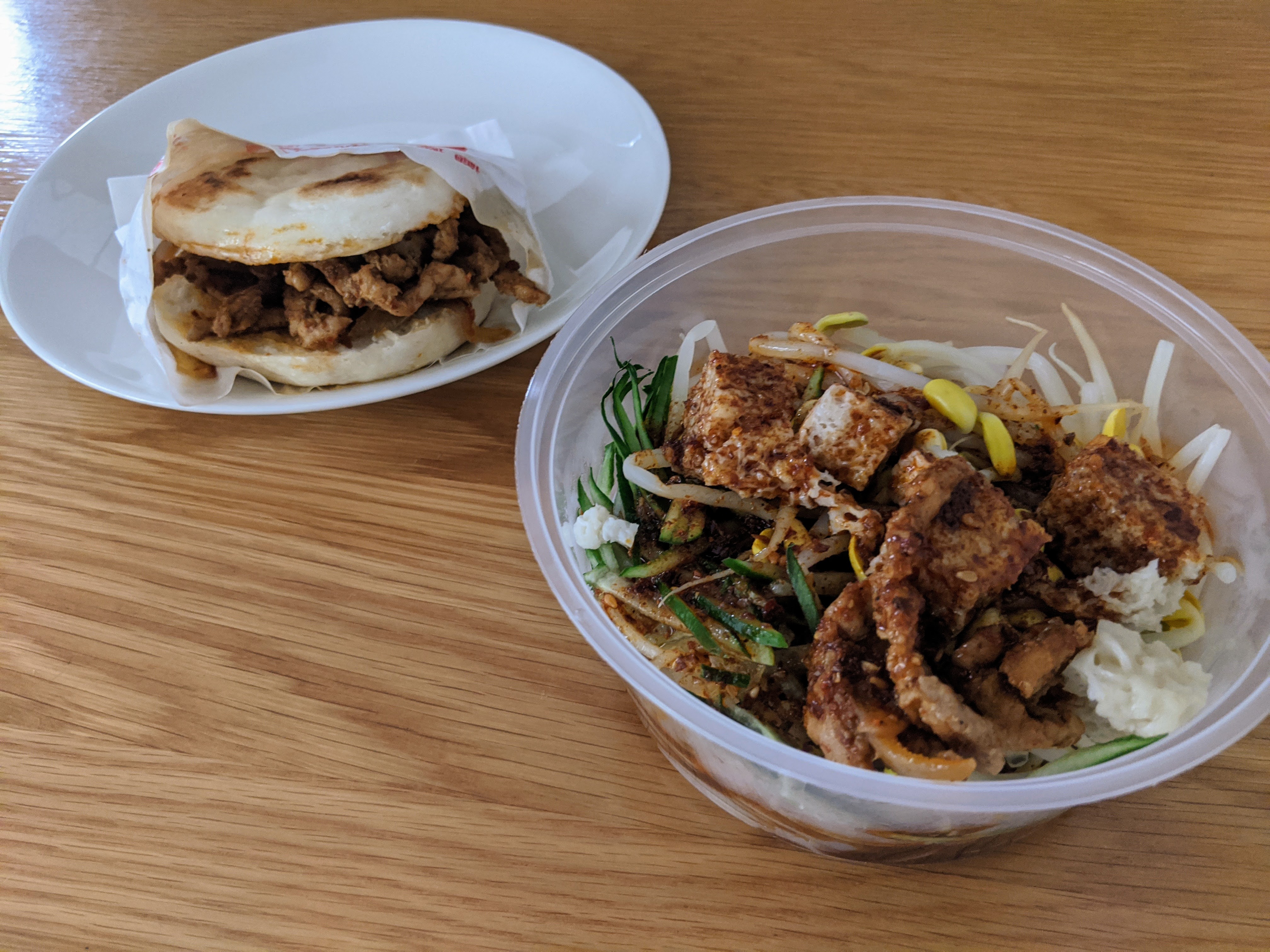
In Singapore, Shaanxi restaurants are not exactly mainstream, but you can find about half a dozen if you look. I started off with fast food outlet Qin Ji Rougamo (秦记肉夹馍), lurking in the excitingly named Alexandra Retail Complex near Labrador Park MRT, where I sampled the classic Xi’an Triangle: a Chinese-style pulled pork burger (肉夹馍 ròujiāmó/ròugāmó), a bowl of cold liángpí (涼皮) noodles, and a can of Ice Peak (冰峰 Bīngfēng). The rougamo here are great, the mo flatbread a delicate spiral crispy at the edges but soft enough to eat, and the rich pulled pork doused in sauce melts in your mouth — and all over your pants if you don’t eat carefully enough. The liangpi noodles themselves were fine and toppings were positively fancy, with a spray of cucumber, beansprouts, little crunchy dough balls and spongy kǎofū gluten, but you can only get the “default” kind with chilli oil (I prefer the sesame variant) and it comes premixed and quite soggy (I prefer them drier, with DIY toppings). And the Ice Peak, well, it’s orange Fanta, no more, no less. At $11.90 nett, it’s a pretty good lunch, but I’ll get soy milk and try another side dish next time.

Next stop was Biang Biang Noodles Xi’an Famous Food (biángbiáng面西安名吃) in Toa Payoh, a lunchtime delivery saviour for me during Singapore’s “circuit breaker” lockdown. The noodles here are named after the sound they make when slapped against a board while made (biáng! biáng!), and in a clever bit of marketing that biáng has a literally unprintable character that claims to be the most complex in the Chinese language. If you want the original style, you need to order what they call “Shanxi signature noodles” (油泼面 yóupōmiàn, “oil-splashed noodles”), which gets you a bowl of wide, chewy, belt-sized wheat noodles, served “dry” with a splash of oil, a dash of chilli powder, a spray of leeks and a token vegetable: simple but delicious. If you order “biang biang”, you get the same noodles, but with tomatoes, eggs and stewed pork on top.

There’s a fair selection of other Shaanxi favorites here too, but the lumpy, dry rougamo here can’t hold a candle to Qin Ji and the liangpi is nothing special either. One dish did catch my eye, namely Qishan noodles (岐山臊子面 Qíshān sàozimiàn), where the middle word is omitted from the English name because it’s virtually untranslatable. If you look it up in a dictionary, 臊 sāo means “urine-scented”, leading to occasional hilarity, but pronounced with a falling tone (sào) it means “embarrass”. A convoluted legend says the name actually comes from near-homonym 嫂 sǎo meaning “sister-in-law”, and the character was swapped over time. At Biang Biang the menu even spells it wrong as 哨子面 shàozimiàn, which would be “whistle noodles”. Confused yet? After all this, the actual meaning of 臊子 is a tad anti-climactic: it’s… minced meat sauce. Canonical saozi has cubes made from red carrots, green garlic shoots, black wood ear fungus, yellow eggs and white beancurd, all topped with a soup that’s supposed to be hot & sour, but not pungent (urine or otherwise) and no mala either. Biang Biang’s version substitutes potato for eggs, but otherwise ticks all the boxes.

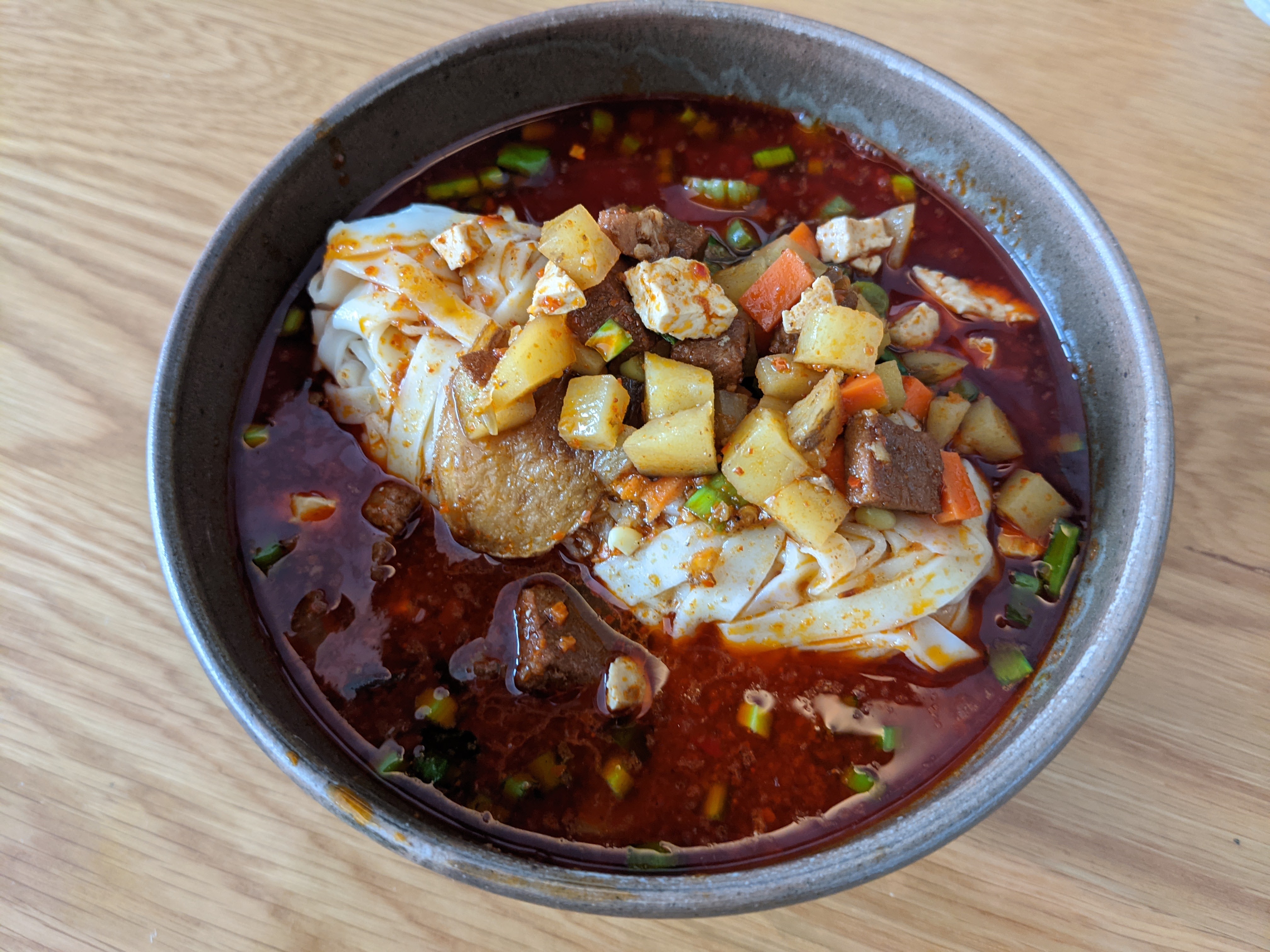
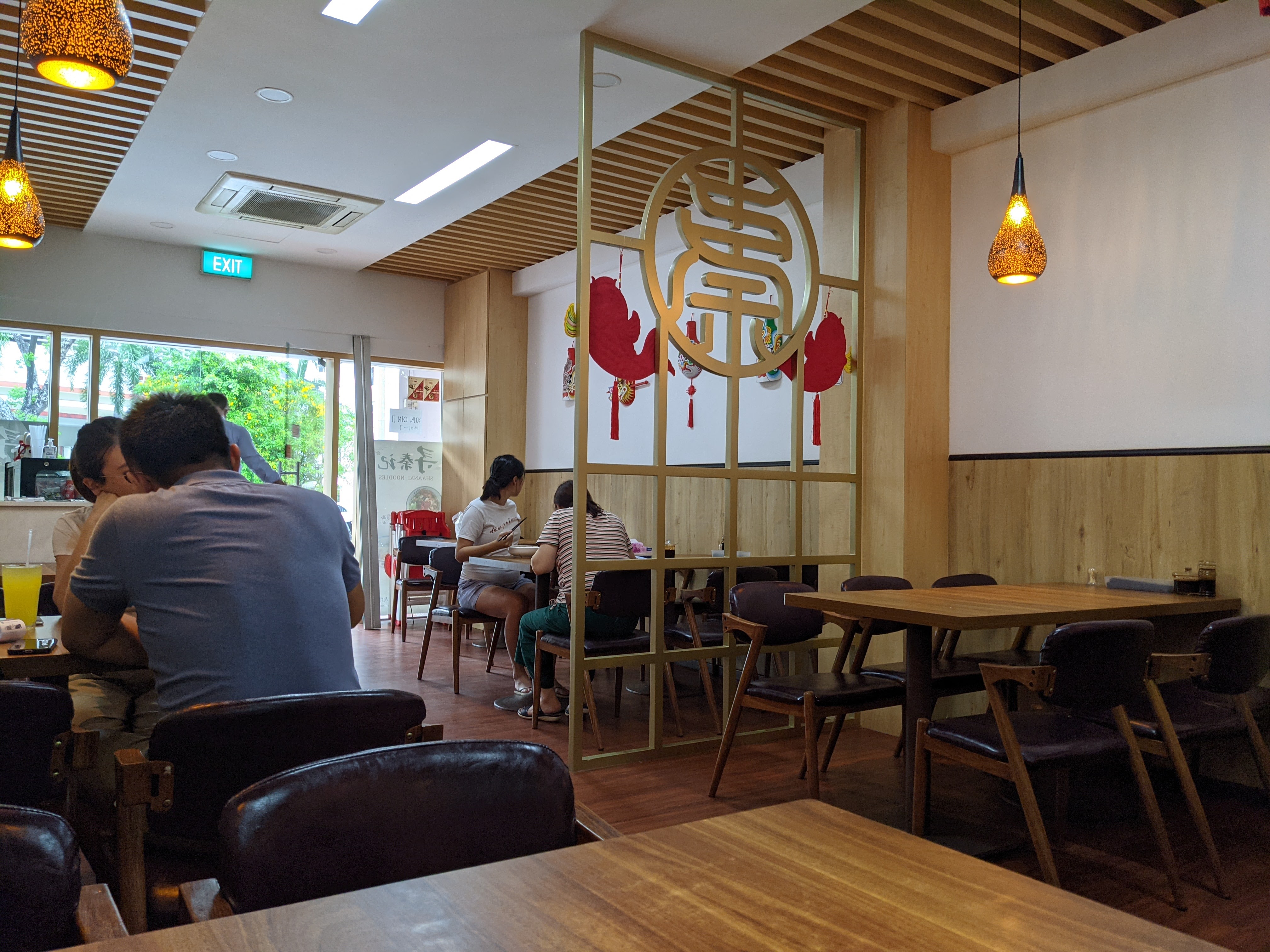
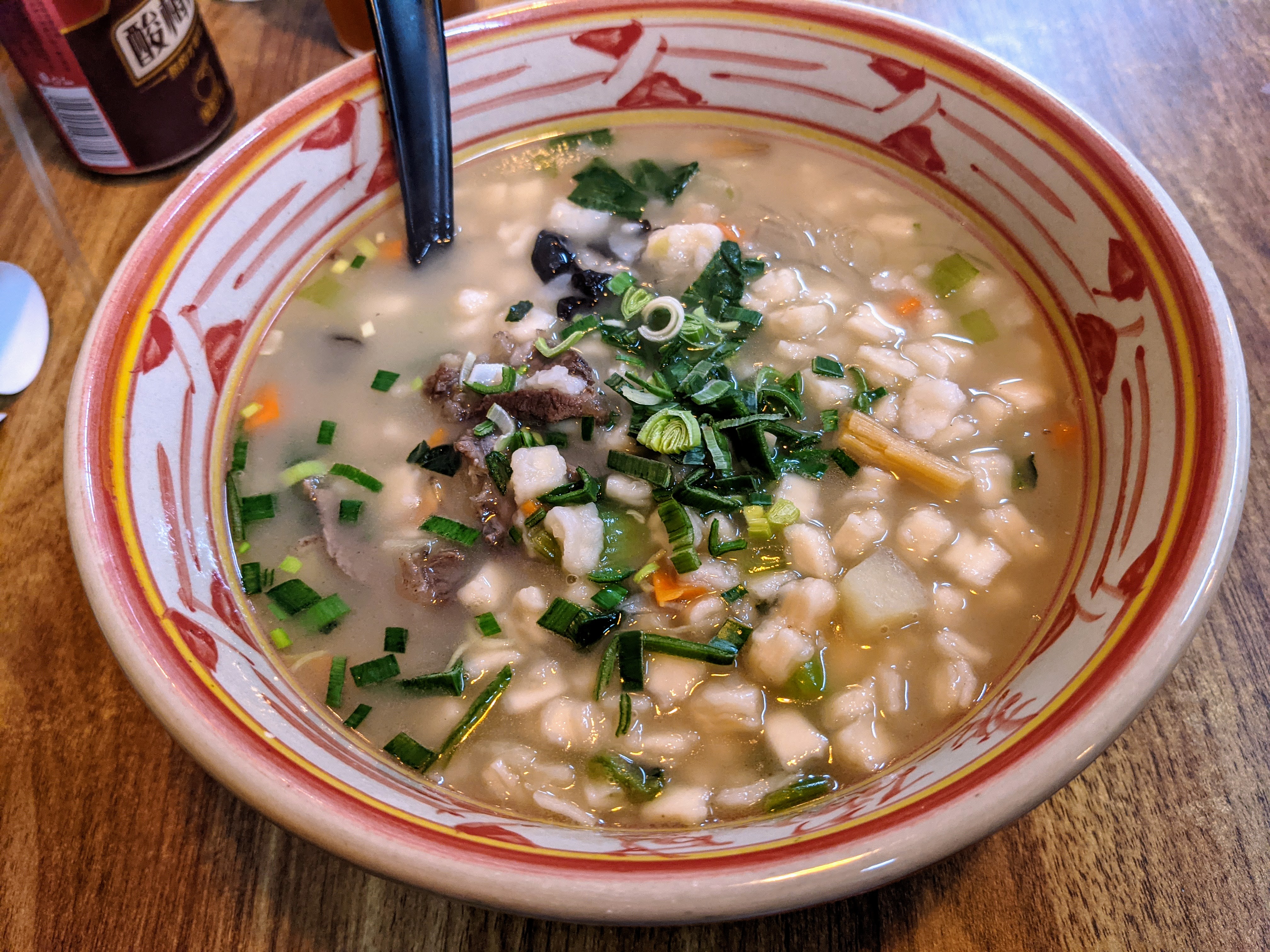
Third up, I paid a visit to Shaanxi Noodles (寻秦记 Xúnqínjì, “Seeking Qin Brand”) in hipster enclave Tiong Bahru for another shot at lamb paomo (羊肉泡馍 yángròu pàomó). This rather unusual soup consists of a thick lamb broth with slivers of meat, a few token veggies, and the same mo flatbread as used for rougamo, shredded by hand and sprinkled into the soup by the diner themselves. The lady taking my order quizzically asked me if I knew how to eat paomo, but apparently didn’t believe my claim that I did, since my mo had been neatly presliced into little cubes. Sigh. On the upside, the soup was rather tasty if salty, and came with the canonical sides of chilli paste and pickled garlic, which added a nice kick.

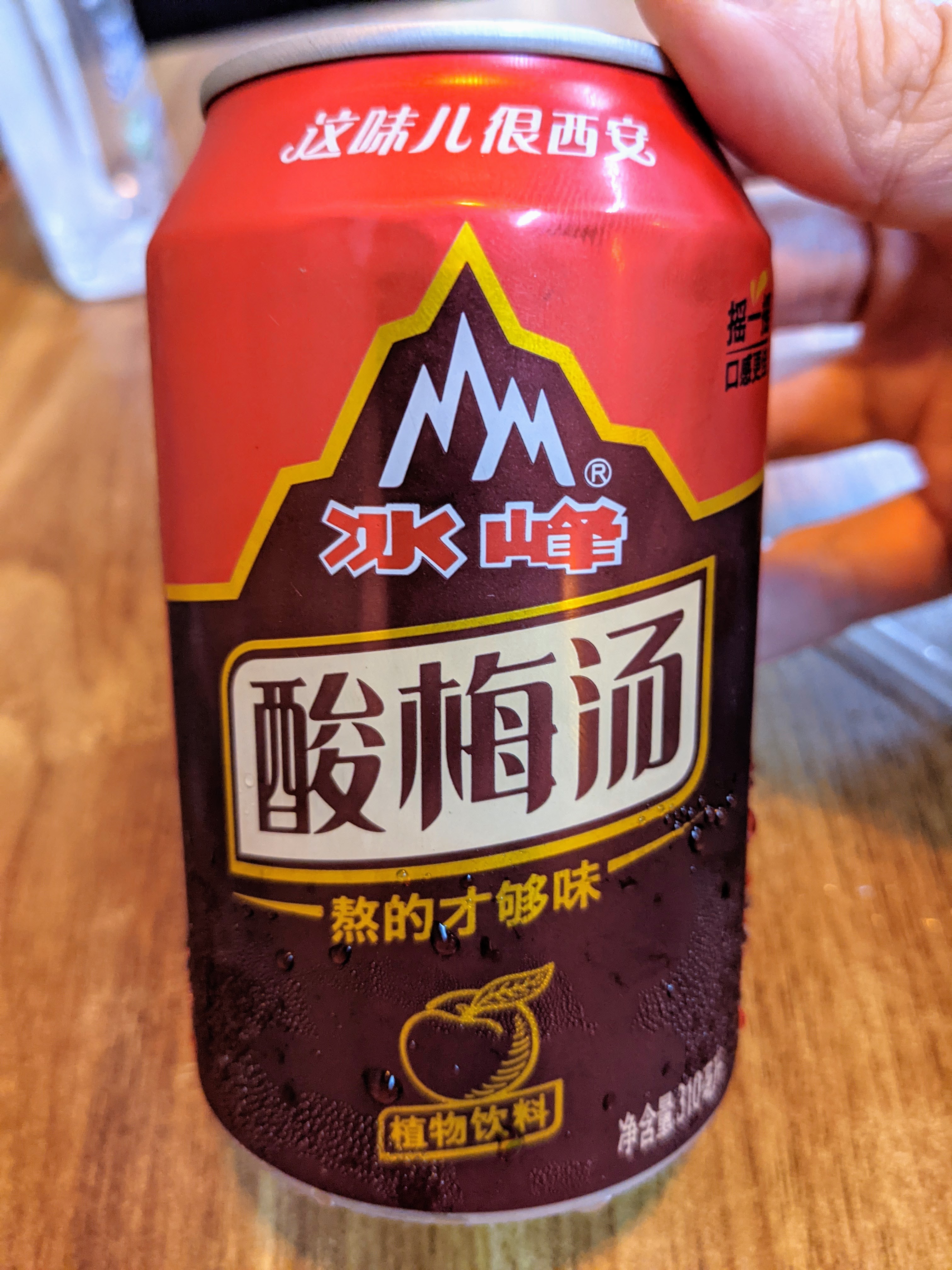
To wash it down, I tried Ice Peak’s attempt at sour plum drink (酸梅汤 suānméitāng). The can somewhat dubiously claims that “this taste is very Xi’an” (这味儿很西安 Zhèwèier hěn Xī’ān), although it’s ubiquitous in China and widely available in Singapore too. It was syrupy sweet and tasty enough, but rather inoffensive/bland and lacked the smokey notes from the better brands.

Total damage $15.50, which is kinda expensive for a bowl of (not-quite-)noodles, but you are paying a premium for the air con and hip surrounds. One thumb up.

Honorable mention: Xi’An Impression (西安印象) in People’s Park Complex, which serves up all your Shaanxi favorites and more, without unnecessary frills like an English menu, air-conditioning, or reliable opening hours. Onward!

<<< Taiwan | Index | Fujian >>>
34 Province Project: Taiwan 台湾

Taiwan is an island about 180 kilometers off the coast of mainland China. And that’s really all I can say about the place without somebody snorting peas up their nose, since I’ve already gotten brickbats for including it in this series as a “province” of China. This, too, is a political statement: the People’s Republic of China insists this is the case, and while the Republic of China says so too in its constitution, in practice the island has been quietly backpedaling away from the concept for a while.

This kind of thing bedevils all things Taiwanese, since you can’t even write about Taiwanese things without picking sides. Traditional characters like 台灣 lean “Green” (pro-independence), while simplified ones like 台湾 lean “Blue” (status quo), and even the romanization is different, with the pan-Greens opting for indigenous tongyong pinyin, the pan-Blues preferring China’s hanyu pinyin, and a lot of place names still using the older Wade-Giles system. And that’s just for Mandarin: the local dialect and its speakers are called Hoklo locally, Hokkien to the Singaporeans, Minnan if you’re a linguist, Banlam if you’re saying “Minnan” in the dialect itself, and Fujianese from a mainland point of view. Wah lau! For consistency I’m going to stick with Mandarin, simplified and hanyu pinyin, and use dialect names only when used in Singapore as well.

I had the occasion to visit Taiwan for about a week way back in 2007, checking out both some of the top draws (Alishan, Taipei) as well as a few places off the beaten track (Chiayi, Guanziling). Since both have been quite successful in combating COVID-19, there has been talk of Singapore and Taiwan opening up a travel bubble, but in the meantime there’s plenty of Taiwanese eats right here.

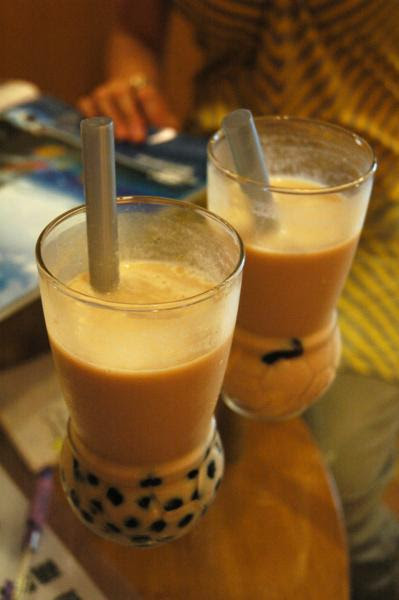
Taiwanese food is hugely popular in Singapore, exemplified first and foremost by bubble tea, such that top outlets sported long queues before last year’s lockdown. You know a dish has hit prime time when this concoction of milky tea with chewy tapioca balls, 珍珠奶茶 zhēnzhū nǎichá “pearl tea” to the Taiwanese and 波霸 bōbà “busty lady” in the US, has acquired its own Singaporean acronym, “BBT”. Taiwanese snacks like fried chicken have also long been ubiquitous, with global Taiwanese chain Shihlin Street Snacks originally hailing from Singapore, and Taiwanese Michelin-star dumpling maestros Din Tai Fung now sport no less than 24 (!) outlets across the island.

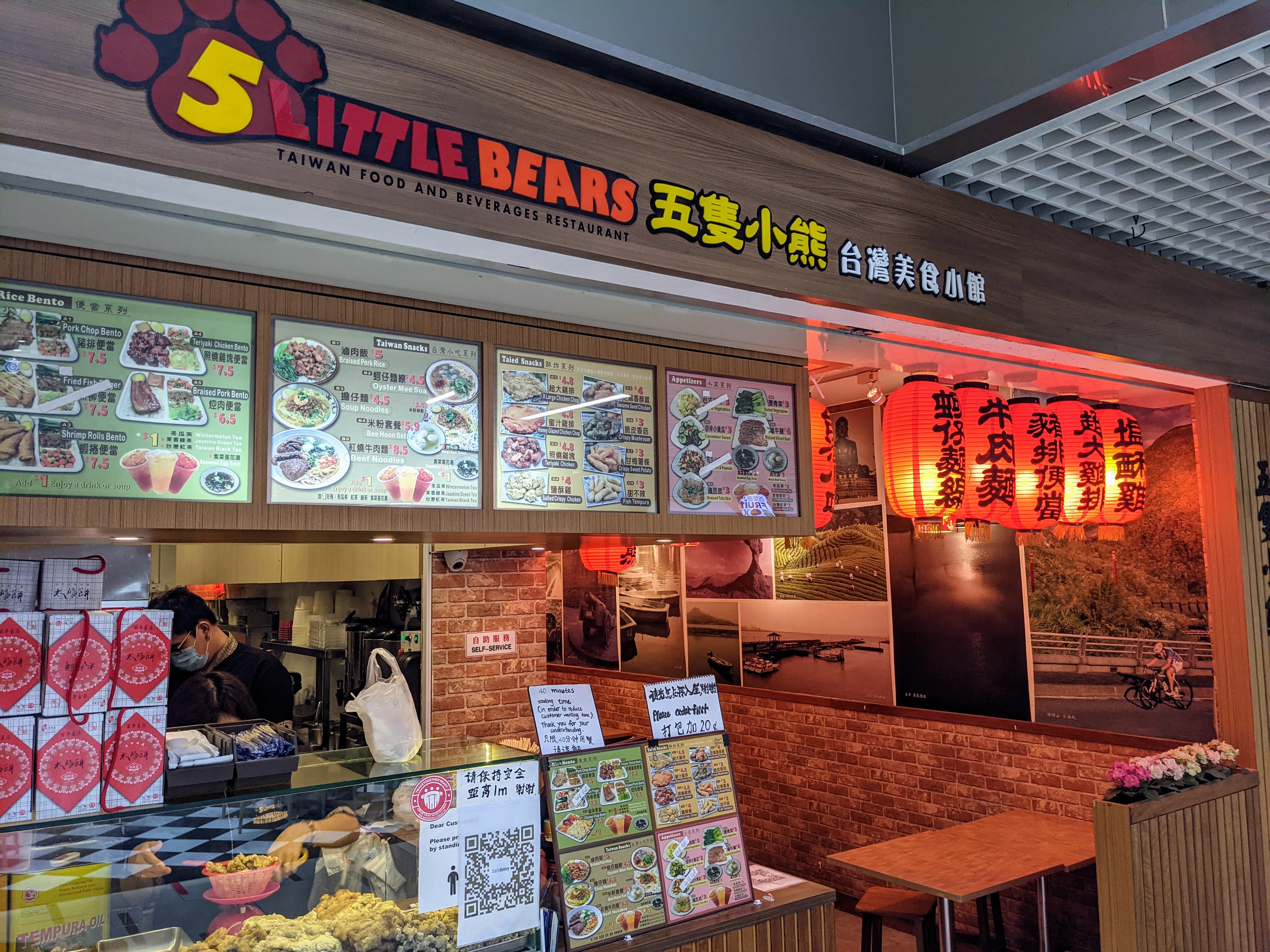
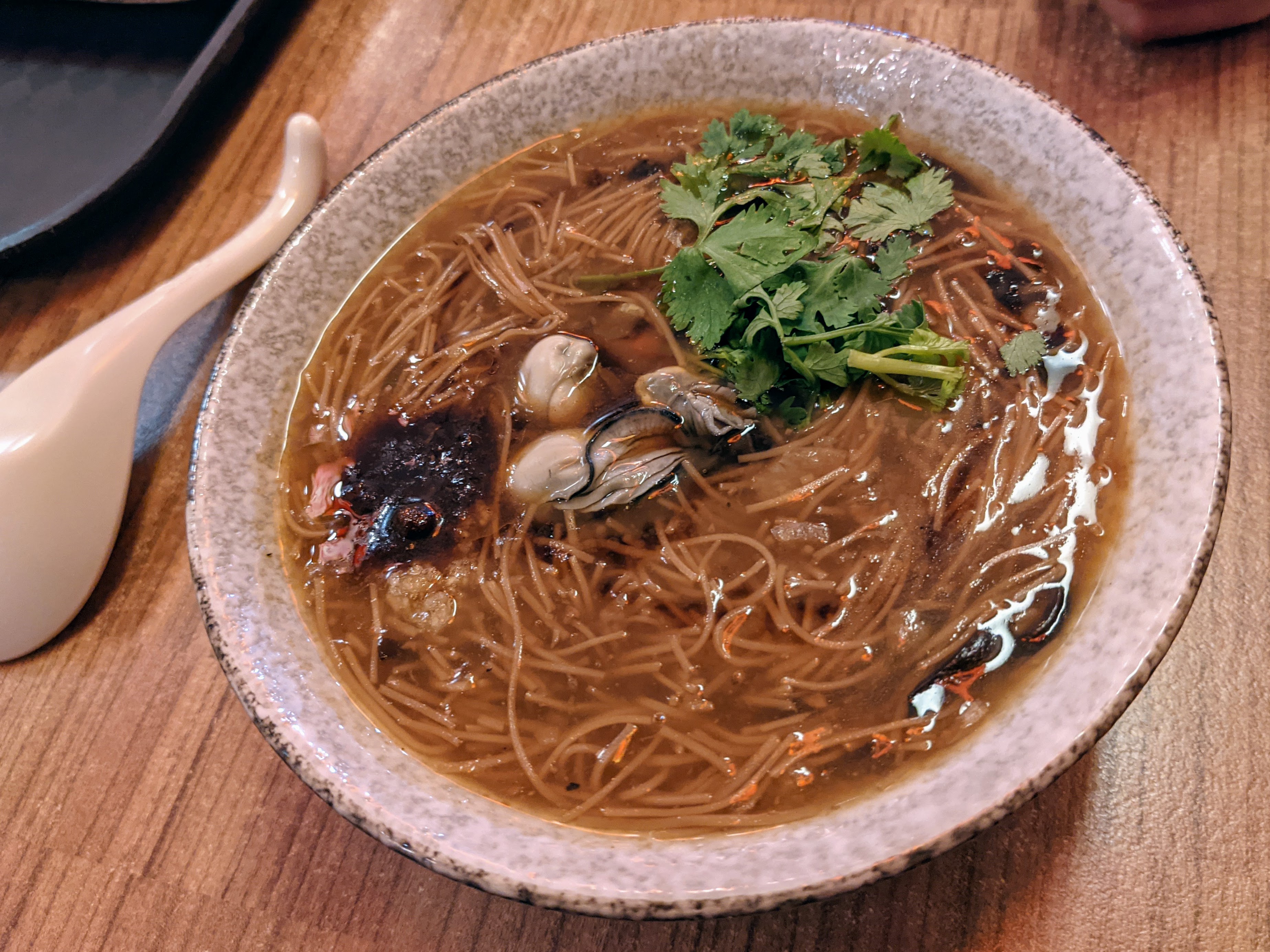
I started my Taiwanese tour with lunch at 5 Little Bears (五只小熊), an unassuming little eatery in the basement of busy Paya Lebar Square. The Japanese-style red akachochin lanterns gave a good hint of what was to come, since the oyster mee sua (蚵仔面线 kèzái miànxiàn) was the most Japanese thing I’ve eaten outside Japan: there was a powerful dashi-style seafood funk to the soup, with a few token oysters, some strands of black fungus and uniquely Taiwanese caramelized brown wheat mee sua noodles. The starchy soup, though, was much closer to Fujianese geng than anything you’d find in Japan. It was quite good, but a little monotonous and salty.

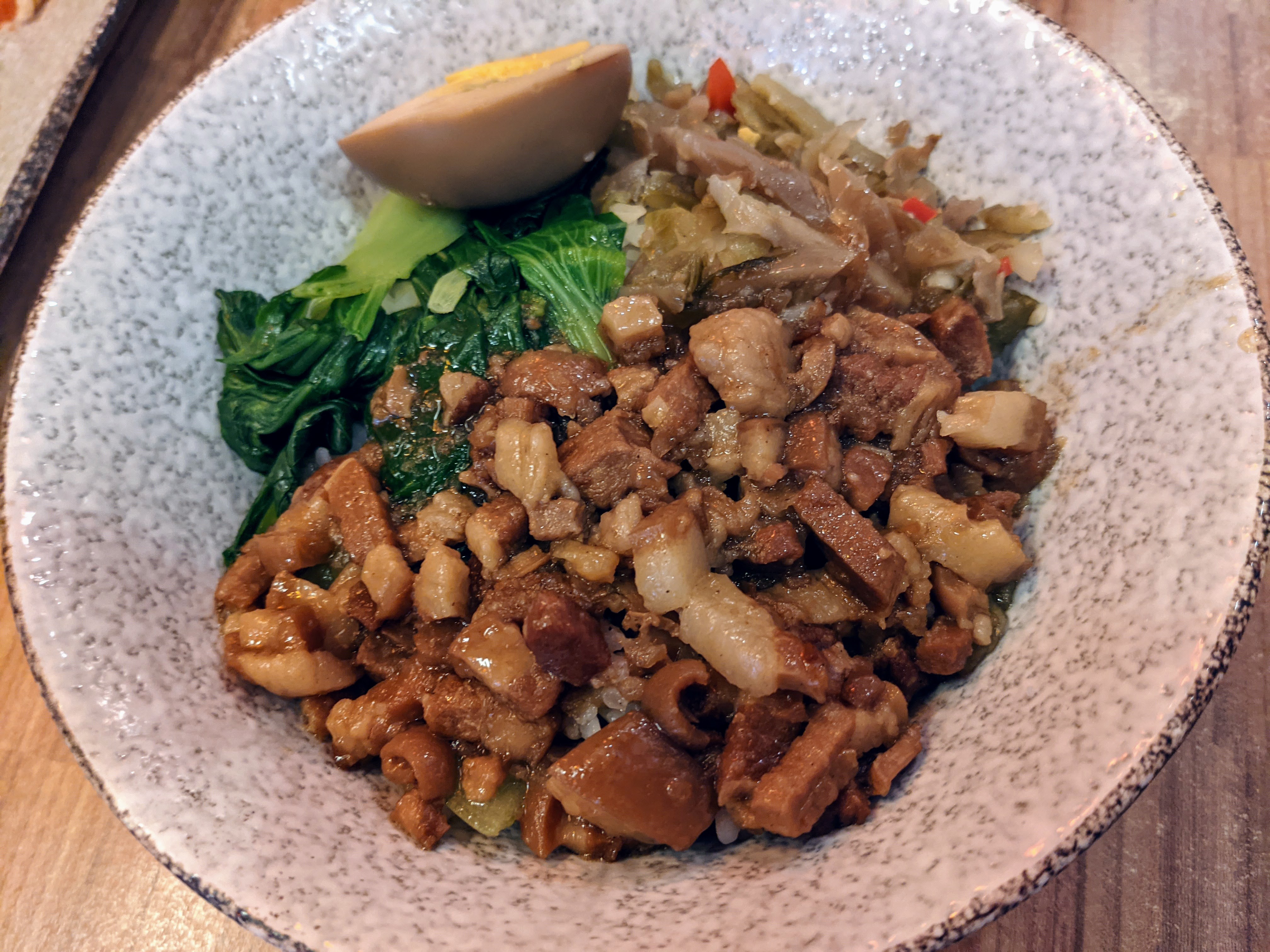
Our other main was minced pork rice (卤肉饭 lǔròufàn), a Taiwanese family favorite we make at home sometimes using a recipe from a Taiwanese friend. It’s not a terribly photogenic dish, but the pork was soft and flavorful, the zhacai (榨菜) pickles on the side livened it up nicely, and a tea egg and few sprigs of bok choy rounded it out. The kids had a couple of generously portioned bento sets (便当 biàndang), both word and concept being another Japanese loan that stuck around, plus an obligatory plate of crispy chicken to share. Total damage $28, and two thumbs up.

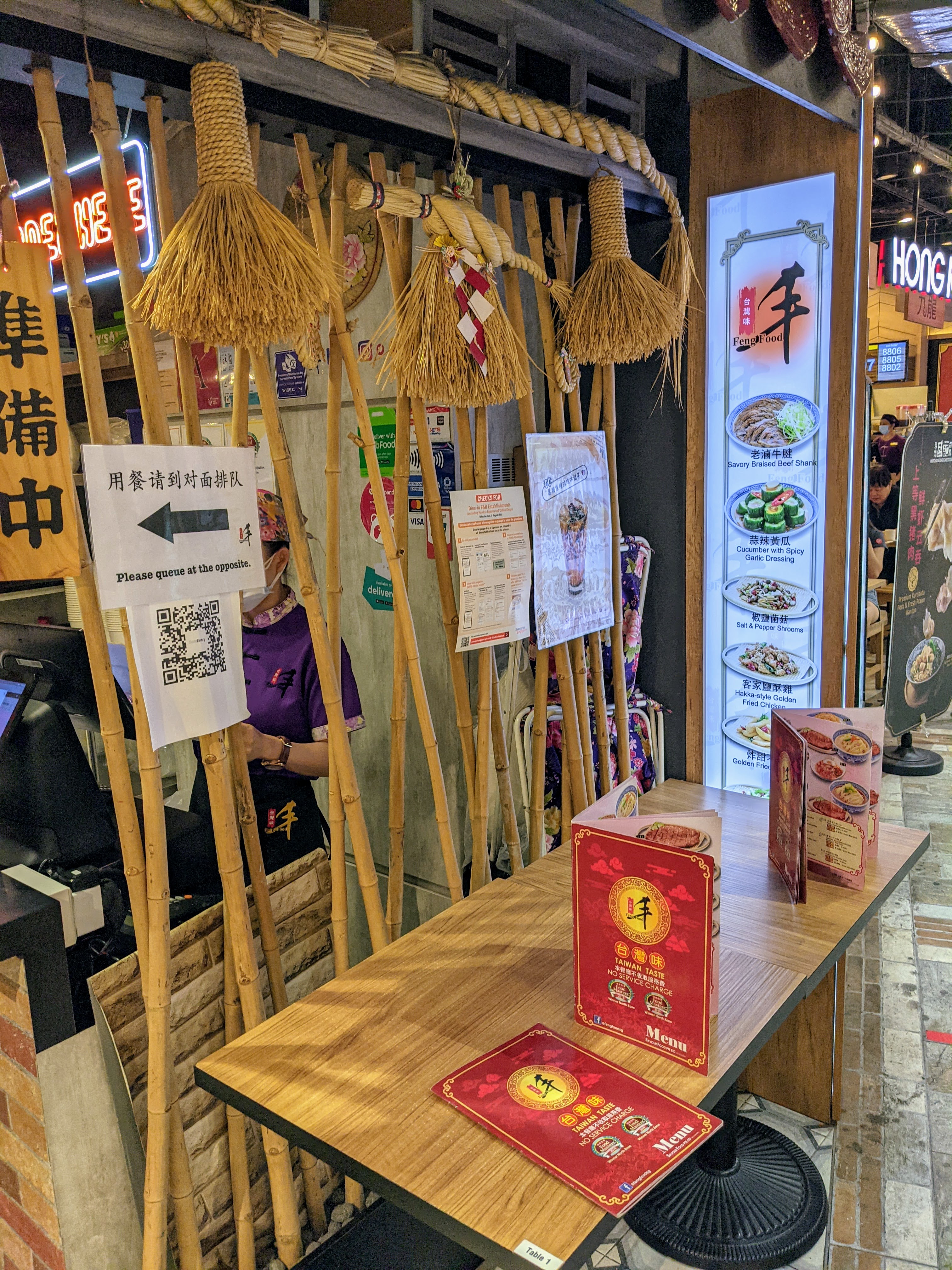
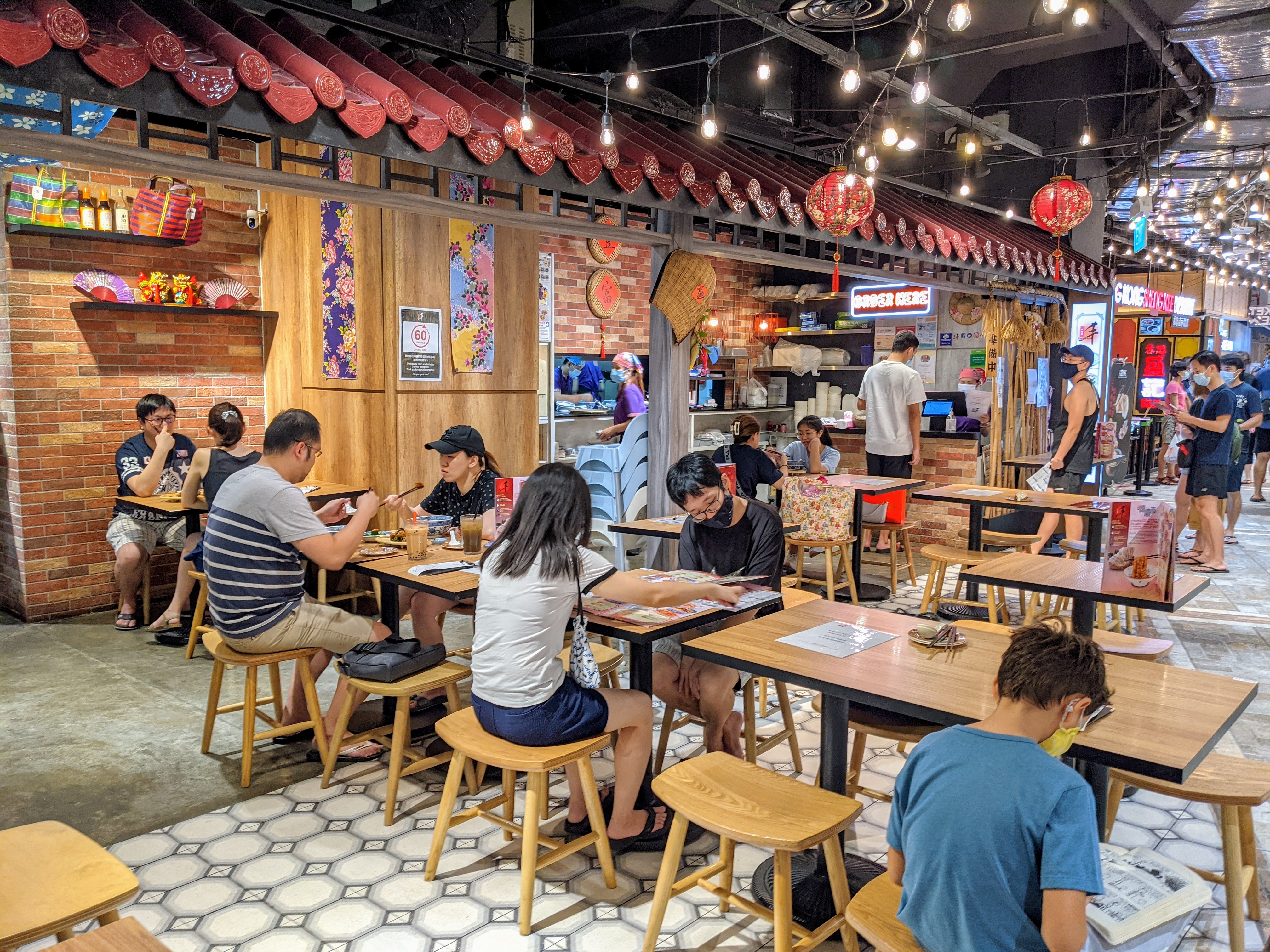
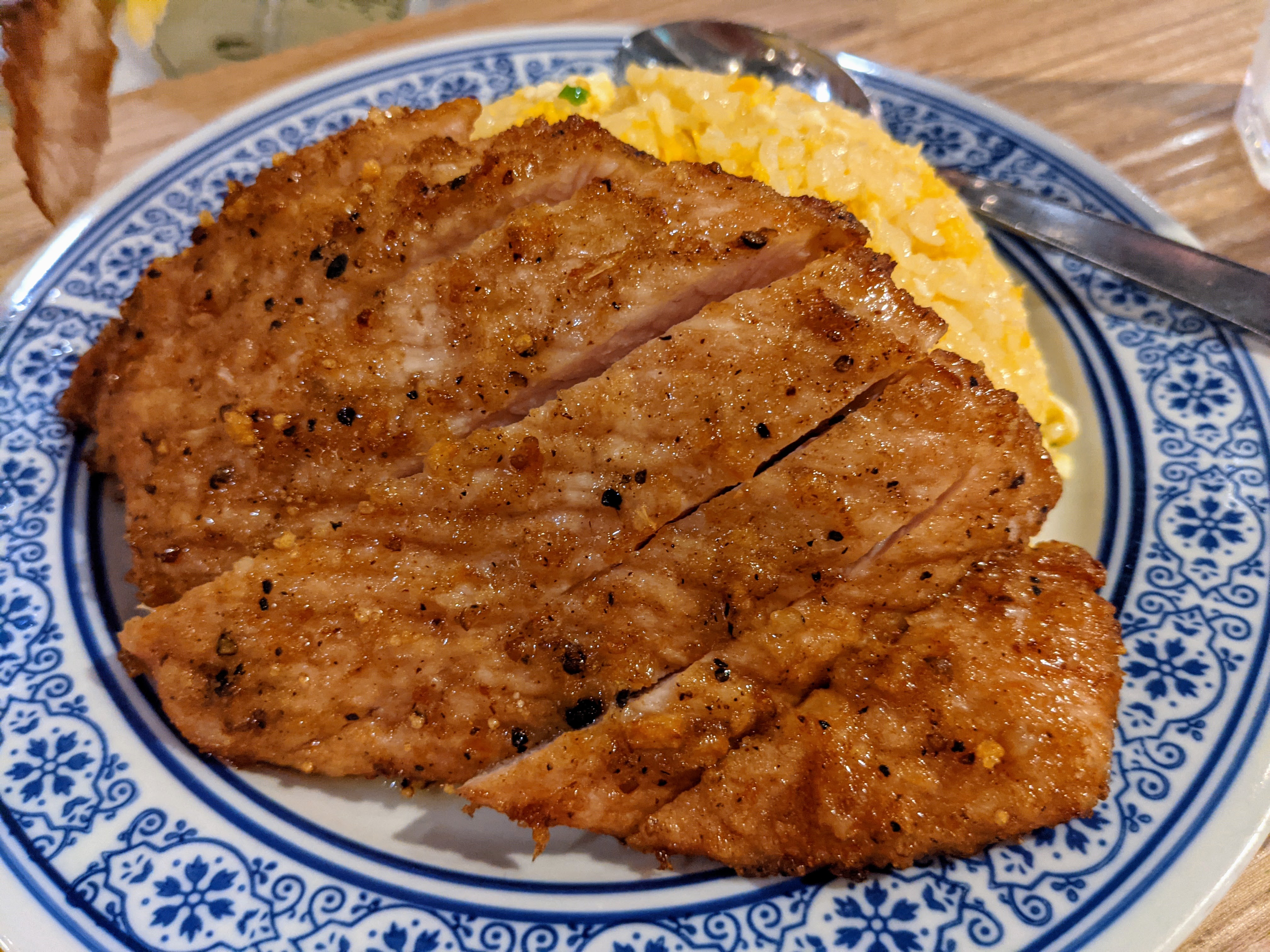
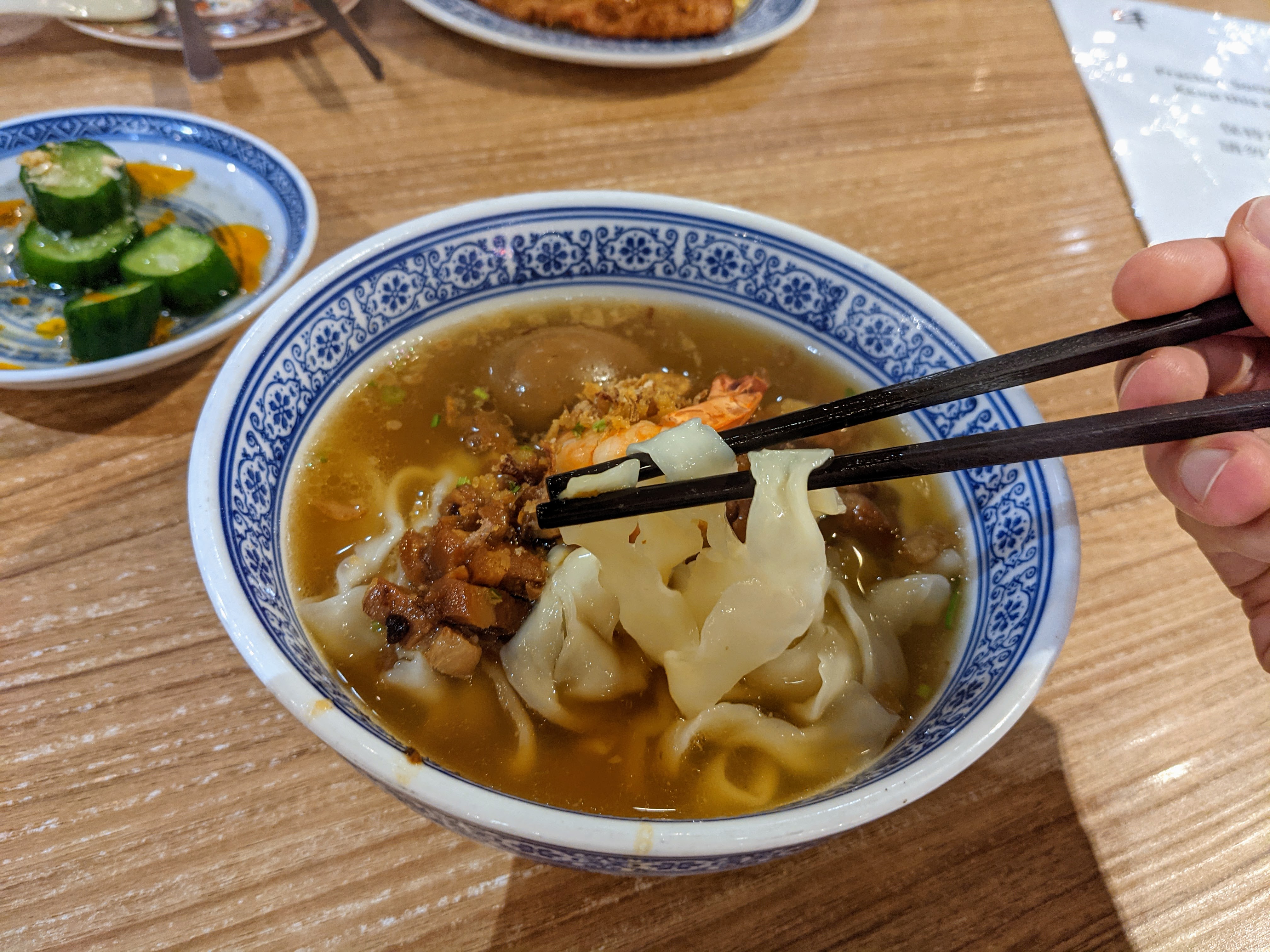
Second stop on my little island tour was Feng Food (丰台湾味 Fēng Táiwān wèi) in the cavernous basement maze of another shopping mall, this time Northpoint City, where you may be lost forever if you don’t leave a trail of breadcrumbs marking your way out. Done up like a country village with bamboo and straw decorations, they’ve expanded to cover the space of two regular restaurants and were doing a roaring trade for Sunday lunch. My son’s Marinated Pork Chop with Egg Fried Rice (豬排蛋炒飯) was exactly what it says on the tin, reminding me quite a bit of Din Tai Fung’s equally excellent version, only much more generously sized. I tested their “famous” Tainan Danzai Noodles (台南担仔面), but I’m sorry to say I’m not entirely sure what the fuss is about: the topping was a small pile of chopped pork belly with a single shrimp and a chewy tea egg, the soup was a mild variant of Singaporean prawn noodles, and the special imported guān miào (关庙) sun-dried chewy noodles I’d paid a buck extra for tasted very much like Shanxi‘s “knife-shaved” daoxiaomian. Taiwanese beef noodles still retain the noodle crown for me.

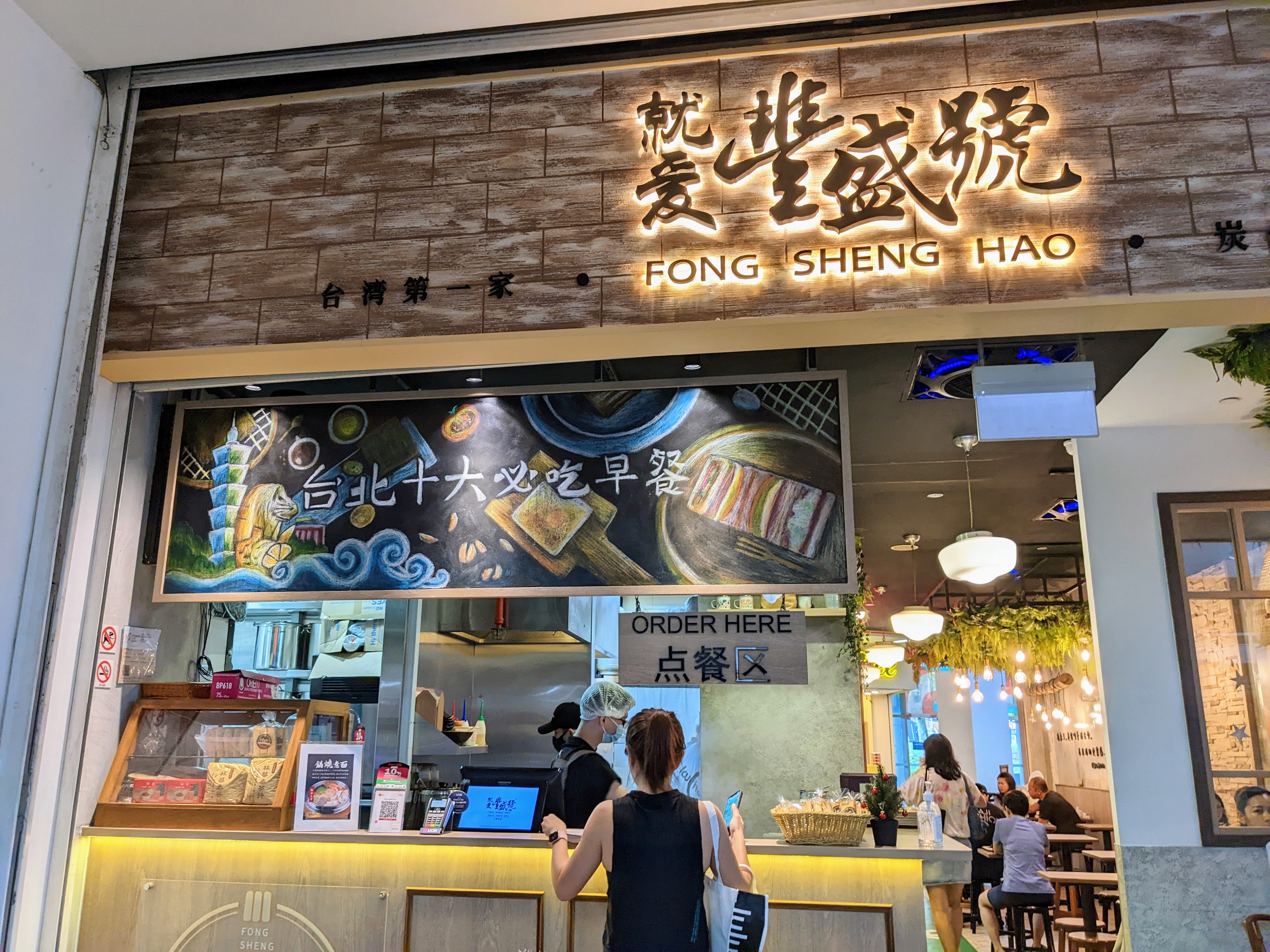
Next, I wanted to eat some Taiwanese toast, this too likely originally an import from Japan that has taken on a life of its own. I first tried my luck at True Breakfast in Cuppage Plaza, but the odd location in Singapore’s sketchiest Japanese nightlife mall hadn’t dissuaded a huge line of people from rocking up, and when a bit of table math indicated I was in for at least an hour’s wait, I skedaddled off. Plan B: Taiwanese sandwiches-and-more chain Fong Sheng Hao (丰盛号 Fēngshèng hào, or 豐盛號 in the original), which I ended sampling not once but twice.

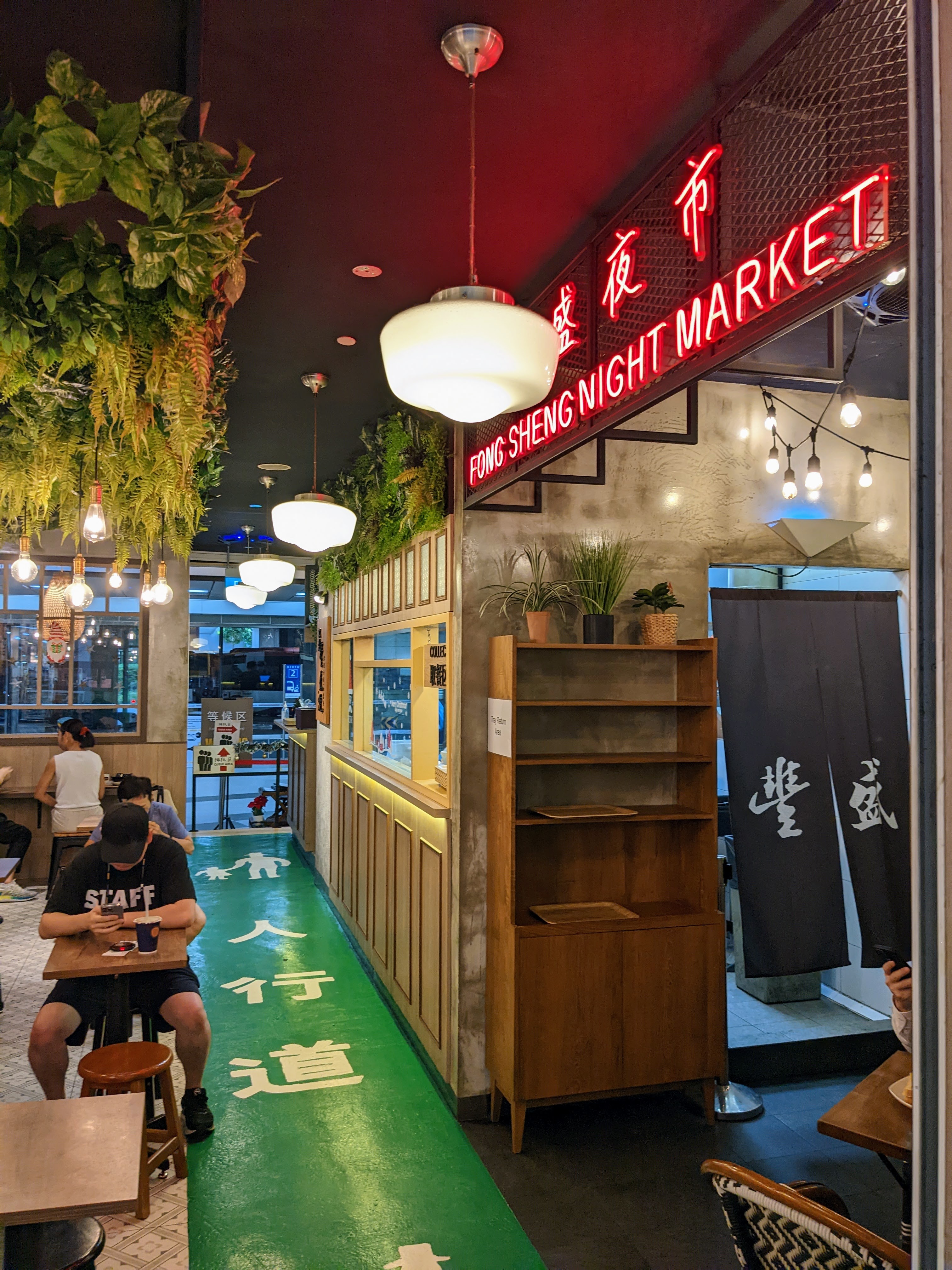
Fong Sheng Hao aims for a Starbucks-meets-Taipei vibe, light wood paneling, plants, slightly incongruous neon and pedestrian path markings. First order off the block at Westgate, devoured on the spot while not entirely sober after a conference’s happy hour, was nothing short of amazing: Pork Egg and Cheeese (肉蛋起司) doesn’t sound like much, but the charcoal-grilled toast was just right and my god, that fluffy, cheesy omelette, soft but not runny, and it paired perfectly with the hey-why-is-my-spoon-dissolving strength milk tea too. It was so good I tried a takeout breakfast from NEX, same order but adding in an optional leaf of lettuce, and this time it was… OK… but not spectacular? Maybe there was less egg, maybe it had cooled down and condensed on my ride home. Lesson learned, eat your sammies on the spot.

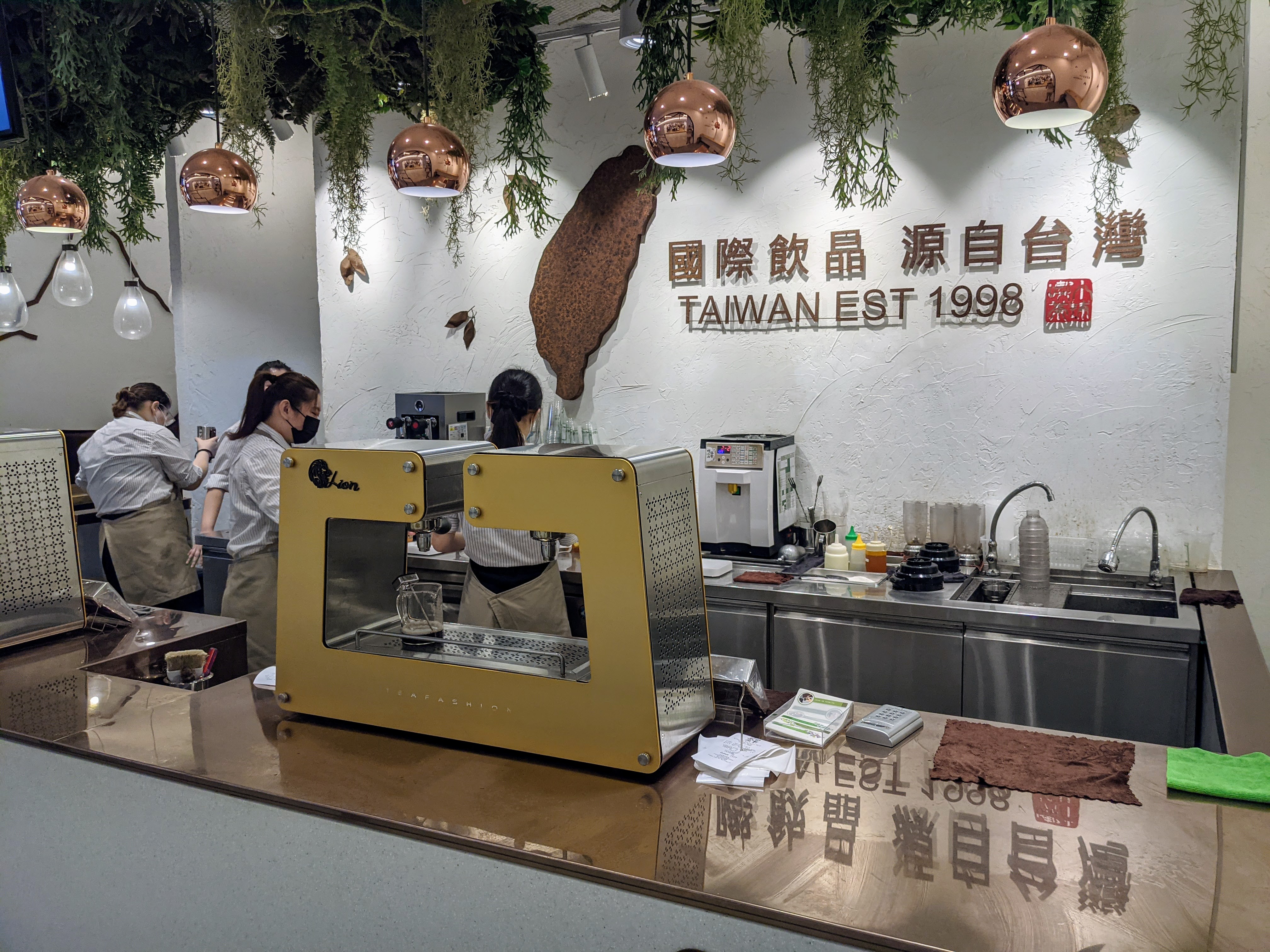
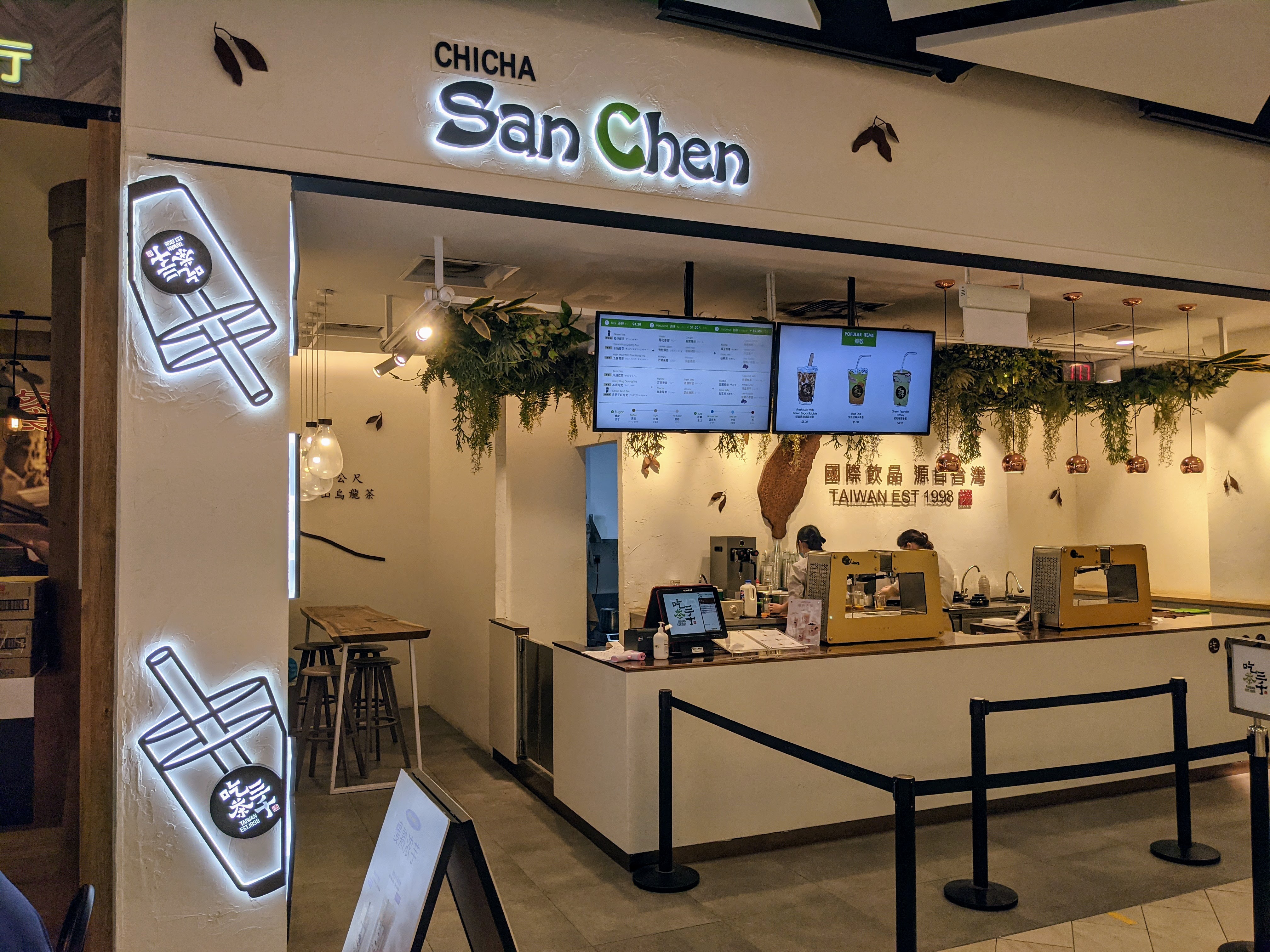
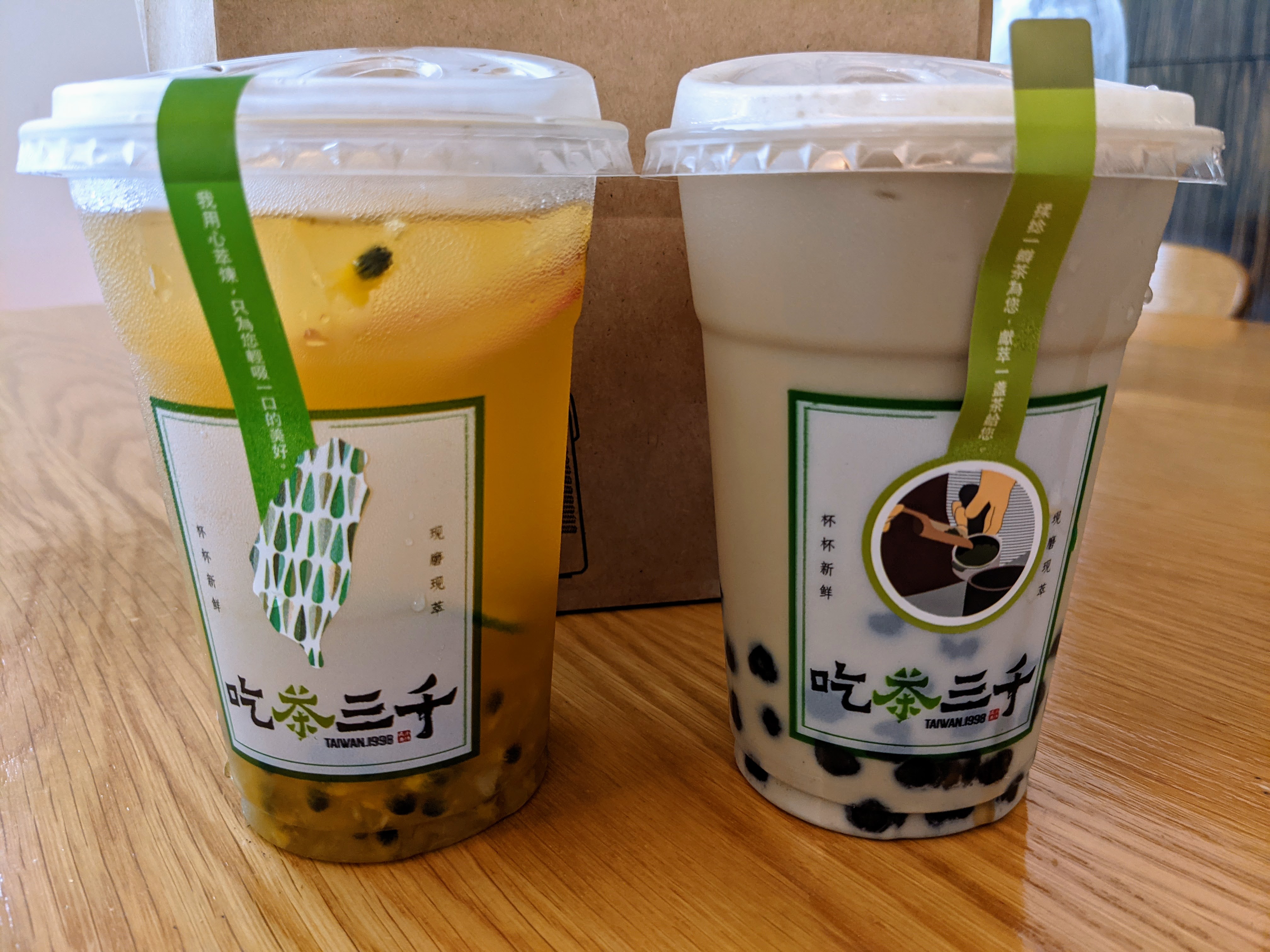
To wash it all down, the only option was bubble tea. Singapore is spoiled for choice, with half a dozen Taiwanese chains staking their claims on the island, but after extensive research consisting of reading this blog article, I ended up at the Paya Lebar PLQ outlet of Chicha San Chen (吃茶三千), hailing from bubble tea epicenter Taichung and now franchised across Asia. The name means “Eat Tea Three Thousand”, which for the record makes no sense in Chinese either. Every high-end BBT retailer has a schtick, and Chicha’s is that each cup of tea is made from actual tea leaves brewed to order, hence the chunky percolators at the register and the clinical lab-coated vibe. I went with a Dong Ding Oolong Fresh Milk Tea (冻顶乌龙鲜奶茶) with added Country King Pearls (国王珍珠), Dong Ding (Frozen Peak) being a Taiwanese variety of oolong tea, plus what the English menu insipidly calls Fruit Tea, which really doesn’t do justice to the majesty of the Chinese name, “Treasure Island Classic Fruit Tea” (宝岛经典水果茶). Were they worth $5 a cup? Somewhat to my surprise, probably. The Dong Ding oolong had a deep, roasted flavor my wife likened to Japanese hōjicha, with soft chewy pearls, while the Fruit Tea was indeed a Treasure Island of apple, lime, passionfruit and tiny pineapple slivers, marinated in surprisingly light Phoenix Eyebrow black tea (凤眉红茶) that as far as I can tell exists solely at Chicha.

Round 2, sponsored by ComfortDelgro Taxis in a bizarre campaign to encourage hailing cabs off the street, was their plain old Bubble Milk Tea (国王珍珠奶茶), basically the same as drink #1 but with regular black tea instead of oolong, and Osmanthus Oolong Tea with Mango (水仙桂花), where the marketing department probably correctly concluded that nobody would order a “Narcissus Osmanthus” in English. The Bubble Milk Tea was, indeed, classic and very tasty indeed, while the Mango-Oolong-Narcissus thing was a bit too much and lacked the excitement of any actual Fruit.

I ordered all four drinks with 0% added sugar, but the fruit and the milk respectively were sweet enough that this tasted just fine. All in all, probably the best BBT I’ve had to date, and fruit teas in particular warrant further exploration.

If Taiwanese food is your thing, there’s plenty more to explore in Singapore, but over twenty more provinces await, so my Long March continues.

<<< Jiangsu | Index | Shaanxi >>>