EY 470 AUH-SIN Y B777-300 seat 54K

Another three-hour layover at a time when I’d really much prefer to be sleeping. I picked up a few bottles at the tax-free, noted to my surprise that Romeo & Julieta No.2’s are appreciably cheaper in EY’s in-flight sales than here (US$11.50 vs US$15 for box of 3), tried and failed to find a local souvenir that didn’t involve dates, and then hacked on my laptop for a few hours.

I’m starting to kind of like AUH though. The two-layered squashed-octopus shape means it’s really compact and easy to get around, and the bizarre blue-green tiles roof-fountain-structure pulls off the rare trick of making a terminal really stand out: there is no way you can possibly mistake AUH for any other terminal anywhere. It’ll be a real shame if the new Etihad terminal here is just another soulless box of glass and steel.

I’d picked my seat on this flight carefully. Conventional wisdom says seats at the back of the bus are bad, because it takes a long time to disembark and because the turbulence is worse, but I knew I’d be in no hurry in Singapore (my Access Card would get me past any immigration queues and I’d have to wait for my suitcase anyway, and turbulence doesn’t particularly bother me — I find it oddly relaxing in a “yay, I’m flying!” way. Etihad’s online seat map showed that the back of the plane has two rows with only two seats on the window sides, so I picked the second to last row: this way, I figured I’d guaranteed full recline, I’d have some useful extra space between my seat, and I’d have a fair shot at nobody sitting next to me.

Once in my seat, I realized that the extra space was virtually nonexistent: on eg LH 747s, it’s enough to stretch out both your legs, but here there wasn’t really appreciably more space than the other rows. And yes, the seat next to me stayed empty, but with a load of no more than 40% there were plenty to go around and a few lucky guys — including the guy in 53K — got a whole three-seat row to stretch out on.

Drink and cracker service rolled around soon after takeoff, but it took close to two hours until they got around to lunch. Here’s the menu:

Asian glass noodle mixed seafood salad

White fish masala, biryani and harissa vegetables
Saffron vegetable lasagna with basil tomato coulis
Singapore hawker’s chicken laksa yong tau foo

Ginger and kiwi fruit mousse
Strawberry coulis

Cheese

Tea and coffee
Hot chocolate

Note to the menu writer: if you’ve got two “coulis” in one meal, one of them atop lasagna at that, you’re trying too hard. Indeed, the crew did the right thing and reduced that down to “fish, vegetable or chicken?”, and I opted for the “chicken” as it just sounded so bizarre. I wasn’t disappointed: the entree turned out to be a collection of tofu, fishballs, shrimp and, yes, chicken on a bed of thick rice noodles with a sauce that was half laksa, half rendang, with coconut shreds, laksa leaf and plenty of spices. I suspect this might be a bit much for people unused to Southeast Asian cuisine, but for me the end result was delicious, and even the noodles had stayed firm instead of degenerating into sogginess. Full points to Etihad for ingenuity!

I watched No Country for Old Men, which isn’t very good in-flight fare because it demands your full attention, but it does certainly deserves its Oscars. I also realized that Etihad’s headphones, which are excellent for economy (solid, padded, cover the whole ear, comfy) also incorporate noise canceling — I’d just gotten a broken set on the DEL-AUH flight, and this time too the wiring was flaky enough that turning my head was enough to flip the canceling on and off.

And then to bed. Even us economy class plebs got socks, eyeshades and earplugs, and even the brown blanket seemed a little fluffier than what you’d usually get in Y. Two seats with a liftable divider ain’t too bad, and while they never turned the cabin lights off, I managed to contort myself into a semi-sleeping position and catch a few Z’s.

The menu had promised us a “refreshment” prior to arrive in Singapore, which I figured would be the same sandwich-and-juice deal as on the RUH flights. But nope: we were treated to cups of frozen-solid Haagen-Dazs instead.

Disembarkation, immigration and baggage claim went fast enough: the only problem was that the handle I used to pull along my diving gear-laden suitcase had been knocked cleanly off. On my previous trip, the same beaten-up old Samsonite had lost a wheel, but off it was to the baggage claim office. Sorting out the claim took a while, and I was told to expect a call sometime within a week — I was thus rather surprised to get a call on Saturday morning for pickup, and even more surprised to get the fixed bag on Monday. They’d even replaced the top handle as well!

EY 316 RUH-AUH Y B777-300 seat 26D

A brutal flight time, as departing from RUH at 5 AM means getting up at 3 AM. Check-in and immigration were uneventful, although I was disappointed (but not very surprised) that the immigration guy couldn’t tell me when my visa expires. Why, you ask? Because Saudi visas don’t state this date: instead, they just have the date of issue and the number of months it’s valid. The catches are that 1) these are Islamic (lunar) months of 28 days, not Western months; 2) business (non-working) visas appear to have a restriction on how many days within that period they’ve valid; and 3) it depends on the visa type if the days start counting from date of first issue or date of first arrival. Gah.

Same plane as last time, but much lower load, maybe 20% in economy. I watched through that creepy safety video again (I think the dead white eyes of the characters are to blame), devoured the sandwich and juice tossed to us after takeoff, and attempted to sleep.

Wahhabalinese Adventures 2: Riyadh and Janadriyah

First Wife Bribed for Understanding

YANBU, 26 February 2008 — Ah, the complexities of having multiple wives. Some may think this makes life easier, considering that multiple wives means multiple housecleaners and multiple food-preparers and if one gets on your nerves you can go hang out with the other one until the first one behaves properly. But in fact it’s not as easy as it sounds to have a number of women in your life: life ain’t easy for a player, as some might say. So it may come to no surprise that – according to the daily Al-Madinah yesterday – a man lavished his first wife with a grand fete filled with expensive gifts and jewelry when she did not dispute his desire to marry a second woman. Perhaps there is no better way to reward a woman for allowing you to marry another woman than to give her lots of shiny things. —Arab News

Somewhat to my surprise, Riyadh was rather more fun this time around: by now I felt that I pretty much knew how things worked, and thanks to my diving buddies I was introduced to another side of life in Saudi through an invitation to dinner at one of the expat compounds on the outskirts of town — which shall remain nameless for soon to be obvious reasons. Just getting in entailed running an impressive security gauntlet: the outer gate checked who I was, who I was meeting and whether there was an invitation for me, the second automated gate some hundred meters away was opened on command, and the taxi I’d arrived in was turned around at the third and final gate, which was guarded not just by the compound’s own guards but two Saudi army soldiers sitting on top of a tank! This would be pretty excessive anywhere else, but four compounds in Riyadh alone were bombed in 2003-2004, using tactics like first blowing up a car and then sending in an a larger bomb disguised as an ambulance.

Compounds are popular among expats not just because of the security, but because they are in effect little bubbles where Saudi laws don’t apply: women can go wherever they want (within the compound) and wear whatever they want, people can mingle at the pool, and even alcohol is available. It was Wednesday night, the Saudi version of Friday, so after dinner at the compound’s restaurant we adjourned for a drink. I was expecting a juice bar where staff dribbles a little siddiqi (moonshine) into your Coke in exchange for a hefty tip, the way we used to do it at unlicensed university parties, but no: these guys had created an entire English pub, complete with wood paneling, jukebox, Premier League on the telly and beer being ladled out from an honest-to-Allah tap. Ladies in low-cut tops and skirts were clinking together glasses, the guys waved around cigars and the very worst of Britney Spears, Vengaboys and Bon Jovi blared out from the speakers. I had to pinch myself to remember that I was in Saudi.

But rest assured that even if you lack the wastah to get underground, Saudi Arabia has a plenthora of alcohol-free “malt beverages” that provide all the calories of beer with none of the kick, most of them attempting to make up for the fact by adding in copious quantities of sugar and artificial flavor. The bizarrest by a mile has to be “Budweiser NA Green Apple”, the solitary American entrant in the market, and I can state for the record that it is neither overly sweet nor artificial-tasting; it’s merely absolutely disgusting. This is not beer, nor even close to beer — it’s like Sprite with fermented oatmeal poured in. Yecch.

On my last full day, I headed out to the fortuitously timed Janadriyah festival, Saudi Arabia’s largest (only?) cultural event held yearly for two weeks in February-March. It had opened the day before with a camel race and the traditional arhda dance, which I’m told involves the royal family waving around swords as they waddle around, but being a Wednesday I had to work then. Information in English regarding the event is incredibly sparse (the newspapers couldn’t even agree on opening times or schedules), but I chartered a taxi and zoomed 45 km north of Riyadh into the surrounding wastelands to check it out. (For posterity, it appears that the event is open all day, but the best time to come is after 4 PM when things are in full swing.)

Rather stupidly, I’d arrived just before high noon, and it turned out that the site is gigantic and taxis aren’t allowed inside — I thus had to plod about on foot, spending the first half hour just trying to figure out which of the several dozen buildings scattered over the sands actually contained anything of interest. Signage in English was nonexistent (well, there was one that said “Exit” and pointed to the gate), but there were a couple of Arabic-only maps left over from previous years, so I figured that the area with the most points of interest marked had to be the place to go and headed there, pausing along the way for a few camel snapshots courtesy of a bunch of friendly herders.

Basically, Janadriyah is a mutant cross between a temporary exhibition, a job fair and a souk. The centerpiece “village” contains two large buildings full of stalls with artisans making and selling local products ranging from daggers and coffeepots to honey and kebabs. One of the buildings is very nicely done up like a traditional two-story souk, complete with narrow streets, balconies and pavilions; the other is just a square block with stalls along the sides. But in addition to the artisans, there’s a Saudi Who’s Who of ministries and companies showing off: the Interior Ministry had a rather gory exhibit showing the aftermath of the compound bombings and what they do to drug dealers, while Saudi Arabian Airlines had built a replica of an airplane cabin and even had a stall selling SV goods, including the playing card sets I’d lusted for — but, alas, the guy running the stall was AWOL and nobody else could sell me one. There are also quite a few shops selling food of all kinds, but having just had my breakfast I picked up a few ridiculously huge pastries for a riyal a pop, trekked back across the sands and returned to the hotel to nurse my burgeoning headache. In the unlikely event that there is a next time, I’ll go late in the afternoon and bring a hat.

SV1069 RUH-JED Y B777-200 seat 45D

…skipping a dull week in Riyadh and heading straight to the next destination…

I’d wanted to try out Nas or Sama for this flight, but neither had conveniently timed flights, while Saudia’s departures are near-hourly and reasonably priced at SR 280 (~US$75). I’d already booked my ticket before the Delhi detour, but changing the departure with a call to SV’s Singapore office was quick, effortless and free, and I could confirm that the date was changed online. Props to SV.

Riyadh’s domestic terminal is creepily similar to the international terminals — no surprise, really, as they’re all cast from precisely the same mold, down to way you have to X-ray all bags (carryon and checked) before check-in and then walk back out through the metal detector before going through security again into airside.  Being the beginning of the Saudi weekend, Wednesday evenings at the airport are unsurprisingly busy with fairly long lines at the Saudia desks, but I’d budgeted for this and check-in itself was unproblematic. The airport’s flight info monitors are rather annoying though, as not only do they switch back and forth between Arabic and English (which is understandable), but they spend half their time showing pretty pictures of the airport…

The airside of the domestic terminal looks identical to the int’l one as well, but one lady was sufficiently impressed by the cascading fountain in the center to lift her veil to take a better look! The domestic terminal is noticeably more lively than the international one, with three restaurants/cafes doing a brisk business and a gift shop/bookstore that, much to my surprise, even stocked the latest Economist. I opted for the Saudi Gazette at a sixteenth of the price, picked up a green salad and bottle of water from the Sport Cafe and leeched off the Saudia Al-Fursan Lounge’s unsecured wifi. Quite a few Umrah pilgrims also heading to Jeddah were already in ihram: consisting basically of two towels wrapped around your body, it looks rather like a cross between a terrycloth bathrobe and a shoulder-baring Roman toga, and the terminal’s bathrooms were full of pilgrims taking care of their ablutions before donning it.

As on my previous DXB-RUH-DXB sectors, the plane today was again a B777, again looking a little worse for the wear and in the odd 2-5-2 configuration. Getting everyone settled down took a while though: for example, in my row, seats F/G/H were taken up by the three Saudi wives, with seat F objecting to having a young Saudi guy sit next to her in E, so the guy was swapped with an Indian lady who didn’t object to my male presence and satisfied Ms. F’s sense of decorum. Now repeat this all over a plane that appeared full to the last seat, and I was surprised that we in the end managed to take off more or less on time.

The plane had the same IFE as on my previous DXB-RUH flights of equal length, but this time it wasn’t even switched on. As flight time was about 1.5 hours, there was enough time to serve a quick meal, which turned out to be precisely the same chicken-and-rice mandi as last time, with a small salad and piece of cake, but minus the bun or drink service other than tea/coffee. About half an hour before arrival, the same prerecorded voice that informed us of seatbelt signs and pre-flight supplications announced in remarkably crisp British English: “We have now entered miqah. At this point, pilgrims should don ihram and recite talbiyah.” Turns out the plane from RUH actually flies over the sacred territory around Mecca — and that’s the closest I’ll ever get to it. (I should have taken a window seat.)

Neatest sight while deplaning: a lady tapping out a text message on her phone under her veil, lighting it up from underneath.

XY 406 JED-RUH Y A320 seat 15E

King Abdulaziz Int’l Airport is a mess. Turns out check-in desks are layered two deep when you enter the domestic side, and I’d plunged in towards the Saudia desks and wandered around for a while, looking for Nas… but then I spotted competitor Sama and guessed (correctly) that Nas would be near them, behind the sign saying “International departures”.

You know you’re flying off the beaten path when your very appearance at the check-in desk appears to make the day of the young Pakistani guy running… not the counter, but the old-fashion analog scale next to it, used to weigh bags. (Mine clocked-in at 17 kg, and Weighing Machine Guy was simply delighted to report that it would be free.) This ticket, too, had been booked prior to my Delhi detour, and while the departure date was easily changed by e-mail (!) to Nas customer service, I had to pay SR 50 extra at check-in, and sorting this out took a few minutes. This also meant that my original fare of SR 269, 11 riyals cheaper than the Saudia fare, turned out SR 39 more expensive than the legacy carrier with better schedules, flexible tickets, meals and all. Oh well…

Once through security, I was presented with what looked like a badly maintained bus terminal, which is in fact pretty much what it is: rows of hard plastic seats and half a dozen tightly packed gates for the buses waiting on the other side, without a single jetway. The air was thick with cigarette smoke and flies hopped happily on tables, so I was glad I’d already eaten and thus didn’t have to resort to the solitary eatery on offer. But I scrounged a chunk of table, snarfed wifi from the Al-Fursan lounge again (thanks Saudia!) and passed an hour without too much pain.

Boarding was a little confusing, as there’s no centralized departures board of any kind, you just need to listen to the announcements or try to scan the LED scrollers above each gate, all carefully positioned like the rocks in a Zen garden so that no matter where you sit, you can see only see half of them at a time. But shortly after scheduled boarding time somebody carried over a Nas poster, a mob formed next to it, and boarding started. Yay! As JED has no jetways, at least on the domestic side, we were bussed out to the plane and clambered up the stairs.

The all-female flight crew (Moroccan, I hear) was rather fetchingly decked out in a wispy half-veil a-la Emirates/Etihad, white blouse and green skirt that seemed drop-dead sexy after a week of abayas: you could actually make out the vague outline of a bust when they stretched their arms upward to put in the bags! <insert sound of bug-eyed Wahhabis having heart attacks>

The plane was considerably newer and shinier than Saudia’s workhorses, but based on the “vueling” stickers on the catering boxes it had had at least one previous owner. Seat pitch was a little tight but tolerable, helped by having a pocketless plastic seatback with a one-inch indentation for your legs.

The flight was packed full, and despite checking in pretty early I was put into a middle seat — haven’t been in one of these for a while. The flight experience was just like flying one of Europe’s better LCCs: chirpy announcements (no pre-flight prayers!), trolley service for drinks and snacks (SR2-5 for drinks, SR8 for a sandwich, so not entirely unreasonable), zero entertainment. The Saudi guy next to me bought me tea without saying a word or even smiling, but I had to reject his somewhat excessive hospitality as caffeine in the evenings keeps me awake at night.

In due course we descended and rolled straight up to a jetway. RUH seemed like an old friend now, so wonderfully quite, large and clean after JED. My suitcase came out after a tolerable wait, and my first Saudi LCC experience was over. All in all, no complaints, I’d definitely fly them again if the price and time are right.

Wahhabalinese Adventures 2: Jeddah

Jeddah‘s King Abdulaziz International Airport has a bad rep, and on landing I could see why. We were bused into the terminal and let loose in the baggage claim area, which is split in two and entirely devoid of signage of any sort (except to note that porters are SR 10 and luggage carts are free), but the solitary moving belt drew the crowd and soon enough bags from RUH, mine among the first, started plopping onto it. I paused at the unmanned Supreme Commission for Tourism booth long enough to pick up a map in fractured English, then hopped on a taxi outside and headed to the Marriott. JED is supposed to have the same fixed-fare system as RUH, but here too there is zero signage showing the correct fares and I stupidly figured I could get it sorted out at the hotel. According to the net, SR 50 should be plenty, but the cabbie of course asked for SR 80 and wasn’t happy at being fobbed off with SR 60 — the standard fare in Riyadh, where it’s a longer distance to the airport. Grumble.

Bright and early at 6 AM in the morning, my alarm bell rung and I headed off to dive in the Red Sea. I’d booked with Desert Sea Divers who picked me up, packed 18 people on three boats and set off on the open ocean. Unsurprisingly, all fellow pax were expats, and it was fun to watch the abayas come off and reveal bikinis underneath. We cruised through the creek, passing resorts and palaces of increasing ludicrousness, and then headed out for an hour before hooking up next to the reef. The plan of the day was three dives, so I elected to sit out the first and deepest one (as it happens, I was later told it was the worst of the three), but I joined the second one… and… whoah.

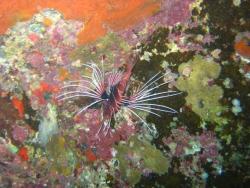
Poking around the Chicken Wreck off Jeddah Lionfish off Jeddah

pictures courtesy of Marja-Leena Lehtola

I’ve dived 50 times in a dozen countries, but I’ve never seen something quite like the Chicken Wreck. Yes, it’s a wreck, once laden with frozen chickens (hence the name) and not even particularly big as far as these things go, but on this dive everything just clicked: 30+ meter visibility, the great looming shape of the wreck encrusted with marine life, plenty of fish, corals bursting with color thanks to the sunshine above… about the only downside was that I was wearing just a 3mm shorty and was freezing my pansy tropicalized ass off towards the end. I switched to my own 1mm diveskin for the last dive (in part due to reports of jellyfish), and it seemed a better choice: better a slightly cooler torso than keeping your arms and legs entirely exposed.

The third dive, too, was through some of the most remarkable coral I’ve ever seen, but unfortunately there was a distraction: my buddy, a morbidly obese Indian guy, with such a pair of man-boobs resting on his pregnant belly that I actually initially thought he was female. Now, there are plenty of well-insulated diving walruses out there, but this guy, despite holding PADI Rescue Diver certification (the highest non-divemaster rating), was probably the most incompetent diver I’ve ever had the mispleasure of partnering with. Yo-yoing wildly up and down with total lack of buoyancy control, smashing into and grabbing onto the corals, swimming way up ahead and ignoring the DM’s frantic banging on his tank, it appeared that the only skill he had mastered was mouth-breathing. I was rather relieved when he surfaced alive.

Fortunately, the other folks on the boat were rather better company, and I hit it off well enough with a blonde Finnish girl and a friendly Basque-Irish couple to arrange to meet them later in Riyadh (about which more later). Once back at the dive shop, a bit of surprise awaited though: I’d paid SR 250 (~US$65) for two dives, which was reasonable, but the shop charged SR 150 for the return transfer from the hotel; not entirely out of line, given that it’s a good 50 km away, but it would’ve been nice to mention this a little earlier. A quick meal of shwarma and Saudi champagne (soda and apple juice) later I crashed and slept until morning.

My second day in Jeddah was a Friday, which in retrospect was a little unfortunate, as nothing in the country stirs until the noon prayers are over. The Marriott obligingly gave me a late checkout, so I whiled away the heat of the day by the rather nice pool until driven out by a quadruplicate mosquecast of the noon sermon, and only headed out to al-Balad, the old town, around 4 PM when I figured the shops would be opening again.

Jeddah’s old town, or more specifically Souq al-Alawi, is the first place in Saudi where I felt like I could have been wandering in the souqs of Cairo, Tunis or East Jerusalem, if not quite as hectic or packed. Conical piles of colorful spices, the queasily intoxicating smells of Arab perfumes and incense, tailors and cobblers with piles of shoes and clothes… but what makes Jeddah stand out is the local style of architecture, with towering buildings (often five or six stories) built from coral and framed in wood painted brown or green. With the lanes rather too narrow to get about by car, they’d been spared from razing, but aside from a few beaten-up “Historic District” signs and a duly ignored English-language sign requiring visitors to register for photography permits, precious little had been done to maintain them. Nearly all were in an appalling state of disrepair, and quite a few were uninhabited and literally falling apart.

The al-Alawi Restaurant was closed (not unexpected; Saudis like to eat late), and I realized I’d better get a move on if I wanted to eat something before the first evening prayer, so I hotfooted out through the gold souq and into the modern part of al-Balad, where not a few shaven-headed US Marines were walking around souvenir shopping — the only other foreigners I’d seen in the area. Picking a large shopping mall at random, I headed to the top floor to find a deserted-looking foodcourt and a packed Filipino restaurant with the delightful name of Barrio Fiesta. Today, the fiesta was being celebrated not only with a string of Christm…err…secular tree lights, but strobe lights above the sign as well, so I decided to give the Pinoys a chance to tickle my tastebuds.

I asked the waiter what was the most popular item on the menu among locals, and after pondering a bit and confirming that I really did want their food as opposed to, say, a nice plate of fried rice, he suggested kare-kare. Having not the slightest idea of what it was, I readily agreed and awaited something different for a change. I wasn’t disappointed in that respect at least: kare-kare turned out to mean a peanut-based stew of oxtail, banana flower, bitter eggplant and string beans, a rather peculiar and, to me, rather unpalatable mix. Fortunately, I was also given a little pot of bagoong alamang (fermented shrimp paste) to go with it, and while Wikipedia notes that “to many Westerners unfamiliar with this condiment, the smell can be extremely repulsive“, I’ve spent long enough in South-East Asia to positively relish the salty-spicy kick it added. I wonder how this stuff would taste with kebabs and hummus?

EY 315 AUH-RUH Y B777-300W seat 19C

Again a short hop and an almost unnecessarily luxurious plane, but while similar to the A346 in appearance, the seat pitch was an inch or two more generous. This was a relief: I’ll be flying back to SIN in one of these (or at least am scheduled to), and that inch will make all the difference. Today the usual complement of Filipinas was joined by the lovely Kyeong-Soo from Korea, who pacified us with a tasty chicken or veg sandwich and a small bottle of juice before leaving us to giggle at the inane antics of Juste pour rire, Montreal’s ripoff of Candid Camera that seems to have a remarkable hold on transport operators the world around, ranging from business class on Garuda Indonesia to the buses of SBS Transit in Singapore.  The plane was equipped with the same IFE system as the A346; it was just turned off, and no headphones were passed out.

My stomach was still bubbling discontentedly, and it was approaching 6 AM Singapore time, so I did my best to zonk out — not entirely successfully, but soon enough the 80-minute flight was over and we landed at King Khalid International, quiet as ever in the middle of the night. Having purposely booked a seat towards the front of the plane, I reached Immigration well before the queues formed. My suitcase was out almost surprisingly fast, and the irritatingly persistent taxi tout waiting for me outside Customs turned out to be the first guy in line at the official taxi rank. I negotiated his ridiculous initial offer of SR160 to a somewhat more reasonable SR80 (still a good 25% premium on the official fare), and we zoomed off down the desert highway to Riyadh.

Wahhabalinese Adventures 2: Abu Dhabi

Abu Dhabi is not one of the world’s great airports by any measure, but its quirky terminal seemed downright snazzy after the swirling chaos of DEL. Midnight is rush hour at AUH, but I had no problems snagging a seat from where I could contemplate the utterly bizarre mushroom-shaped spout of lime green and blue tiling that dominates the terminal, although any notions of Zen serenity were blasted out of the water by the endless loop of really, really loud trilingual announcements about vol eh-ygrec trois-trois-cinq a Casablanca or whereever. We’d rolled past Etihad’s future home Terminal 3 on the way in, but despite a few planes parked up to it’s still several months away from completion and Abu Dhabi has, inevitably, already started designing an entirely new airport expressly designed to put those young whippersnappers in Dubai in their place.

Etihad’s slogan is “The Airline of Abu Dhabi”, which left me ruminating. Sure, that’s an undeniable fact, but what do they mean by it? If they mean that Etihad is good because it’s associated with Abu Dhabi, I don’t think that line of argument will quite fly, as for most people “Abu Dhabi” is the faintly ridiculous-sounding place in the middle of nowhere (see also: Timbuktu, Ouagadougou) where Garfield regularly mails obnoxiously cute kittens. Alternatively, they might mean that Abu Dhabi is good because its airline is Etihad, but this has pretty much the same problem — when I told a colleague that I was flying Etihad via Abu Dhabi, her genuine reaction was “Where the heck is Abu Dhabi, and what on earth is an Etihad?” (Etihad, for the record, is Arabic for “United”, and with Air Arabia and Emirates completes the trio of large airlines using all components of the name United Arab Emirates.) Either way, it’ll take another good ten years until these guys get over their name recognition problem…

At any rate, the booze selection in AUH Tax Free was pretty good, although obviously for this leg of the trip I had to limit myself to window-shopping. An hour before my flight the gae number popped up and I headed down to Gate 22, which turned out to be a bus lounge, dominated by a colorful but orderly procession of Indonesian ladies going to work in Saudi. In the bus on the way to the plane, one of the younger women knelt on the floor and wordlessly pressed her head into the lap of a motherly older veteran. For one, the terrors of the unknown; for the other, resignation to the known.

EY 211 DEL-AUH Y A340-600 seat 43A

On my last day, the trip from Noida to the airport was (much to my surprise) over in barely an hour, leaving me with a rather too-generous four hours to kill at DEL. The Departures floor is under such heavy construction that I could barely recognize it, one of the check-in desk rows (Row 1) already reworked into the 21st century, the others still falling apart. I’d arrived so early that Etihad hadn’t even started checking in, but after I’d completed one circuit of the terminal looking for them, I spotted a bunch of unlabeled checkin desks with their monitors turned off… and a stack of Etihad luggage tags. Bingo. They’d just opened, and I got sequence number 002 for DEL-AUH, with sequence number 270 for AUH-RUH. How does that work?

Construction prevailed at the immigration desks (over in a jiffy) and the airside had been transformed to such an extent that I could only gape. Gone were the plastic bucket chairs, gone was the Flamingo duty free shop where I used to buy my Indian wines (better than you’d think), gone was the ITC lounge downstairs, even the security queue had transmogrified into something new. In their place were lots of construction hoardings and drilling noises, and I shuddered at the thought of having to spend four hours here. But there was a sign pointing to the Clipper lounge upstairs, and having done my research on FlyerTalk’s India forum I headed up with my Mastercard in hand. Now, in America gold Mastercards are included in boxes of cereal, and even in Singapore the income requirements for one aren’t too lofty, but in India they’re apparently still beyond the means of the hoi polloi — which is why Mastercard graciously offers free use of the Clipper Lounge for every holder of a Gold, Platinum, Titanium or World mastercard. It was still before the evening rush, and aside from a few JAL pax I had the blessedly peaceful lounge (and its fridge full of Kingfisher beer) to myself.

An hour before departure I headed out, and back in the less rarified realms of the terminal the security lines were as bad as ever, with powertripping jawans doing their best to harass the poor bunch of workers heading to the Gulf, barking at them for not waiting at the yellow line (as if they could read the signs) and emptying out every last slip of paper from their pockets. Once they were finally done with them, white sahibs like me were promptly passed through and I headed to Gate 3 to board my first Etihad plane.

The good news was that it was, indeed, the promised Airbus 340-600; why they’re operating a smallish long-haul plane on a low-yield short-haul route like DEL-AUH, though, is beyond me. The plane looked nice, all muted tones of desert tan (shades of Emirates), but the seat pitch was surprisingly cramped, with sharp bits of the seatback poking into my knees no matter how I moved my legs. Fine for this three hour flight, but I’d definitely steer clear of this plane for a real long-haul. The IFE screen was big and the headphones were unusually high-quality, but the interface was kinda slow and clunky, although there was a largeish (if dull) movie selection and an immense library of music — minus, alas, any ghazals. And no sign of the rumored in-seat power plug.

The bad news was that the plane was packed to hilt and 95% of the passengers in economy were workers headed to the Gulf, who aren’t exactly a frequent-flying bunch. Sitting as I was in the back, there was a constant jingle of “bong! bong! bong!” tones as people fiddling with remote controls unwittingly punched at the stewardess call buttons and little lights blinked on and off above the seats. Etihad also certainly didn’t bend over to serve this constituency of its passengers: all announcements and printed matter were in Arabic and English alone, with not a word of Hindi, and only one harried flight attendant appeared to speak the language. At least remarkably creepy safety video, which turned those 70s-style safety card cartoons into 3D computer animations of corpselike ghostly figures stoically enduring oxygen loss, crashes and evacuations, was probably equally incomprehensible in any language…

Meal service started soon after takeoff, and at least this was Indian style: Goan fish curry, curried peas and carrot, pulao, parantha and two balls of rasgulla. Reasonably tasty if unremarkable, and the carrots were red, so you could tell it was made in India. Drink service was a little odd: we received cups of water before takeoff, nothing immediately with the meal, a juice run after it was served, and then tea, coffee and hard liquors on demand while clearing the trays. Alas, the carbonation in the beer I’d drunk earlier has started disagreeing with the reduced air pressure and my stomach by this point, and while eating dinner helped — oddly, it usually does — I wasn’t quite in a position to appreciate the meal, or the flight, to its fullest. The workers, on the other hand, were enjoying the novel experience, with the jolly fellow in the row in front happily popping powdered coffee creamer into his mouth, like a Western version of paan masala, and chomping away.

The lights stayed on, but I pulled on my shades and attempted to rest a bit. Three hours into the flight we crossed over the coast at Oman and started coasting down to a descent in Abu Dhabi.

Wahhabalinese Adventures 2: Delhi

It’s been a good nine months since I was last in Dilli, and I was quite amazed by the speed at which (some) things have progressed. The Metro extensions to Noida and Gurgaon, a few tentative rebar poking out from the ground in fall 2007, had sprouted into an almost unbroken row of lofty concrete pillars with viaduct cranes connecting the tops and station boxes starting to take shape — they just might make the 2010 deadline. The Great India Place in Noida and the MGF Metropolitan in Saket had both opened and finally given Delhi malls that wouldn’t look too much out of the place in Singapore. The amazingly banged-up super-high-floor city buses slaughering pedestrians on Delhi’s roads have been joined by a growing fleet of slick green low-floor buses, and the Bus Rapid Transit line from Moolchand to Ambedkar Nagar is set to open in a few months. NH-8 from Delhi to Gurgaon has finally opened and the slick swooping curves of the grade-separated intersections around Mahipalpur and the airport are an infinite improvement on the previous jams. Last but not least, the airport’s tentative renovations are now in full swing: the entire five kilometers from NH-8 to the current terminal is now one giant construction site with worker ants scurrying about building the new terminal, the third runway and the Airport Express line. What’s this place going to look like two years down the line when everything is complete for the 2010 Commonwealth Games?

On the flip side of the coin, nine months away from India was enough to tune my eye again to the daily weirdnesses of life in India. Zooming on an on-ramp to the DND Flyway, one of Delhi’s still regrettably few expressways, a wandering swami had decided that the side of the road, ten meters up in the air and inches away from speeding cars, would be a good place to build a bonfire and warm himself. Going to lunch at the Shipra Mall in Noida, a ridiculously pompous palace of consumerism decked out with statues and Romanesque pillars and consequently rather resembling a cross between a Las Vegas hotel and Bangkok massage parlor, had one of the lanes on its entry way under repair — so they’d thrown up a strand of barbed wire across the road, with somebody’s pants hanging in the middle so drivers would see it. On the way out, an empty field between the glass offices of the call centers and outsourcing labs was covered from end to end in cow patties, drying in the sun. Under the flyovers lurk Delhi’s underworld of dirty street kids and destitute beggars, naked toddlers with dust-caked hair running about the median between the roads.

And in the sterile comfort of the bland Sheraton, where a week’s stay costs about the same as a Tata Nano microcar, I flipped my TV to state broadcaster Doordarshan’s Sports channel in prime time and was treated to a rerun of the 2000 World Chess Championship, long ago live from Tehran — another vaguely funny reminder of how India’s well-meaning government continues to cripple the country through misguided initiatives. The week’s talk of the town was the LPG shortage, caused by government fixed rates making it unprofitable to supply, and the limited supplies thus being diverted to commercial use at Rs.600 each or the black market at as much as Rs.1000 a pop, instead of the heavily loss-making consumer rate of Rs.300. The government’s reaction? Raids against retailers to make sure they aren’t selling them on the black market or “hoarding”. Sigh.