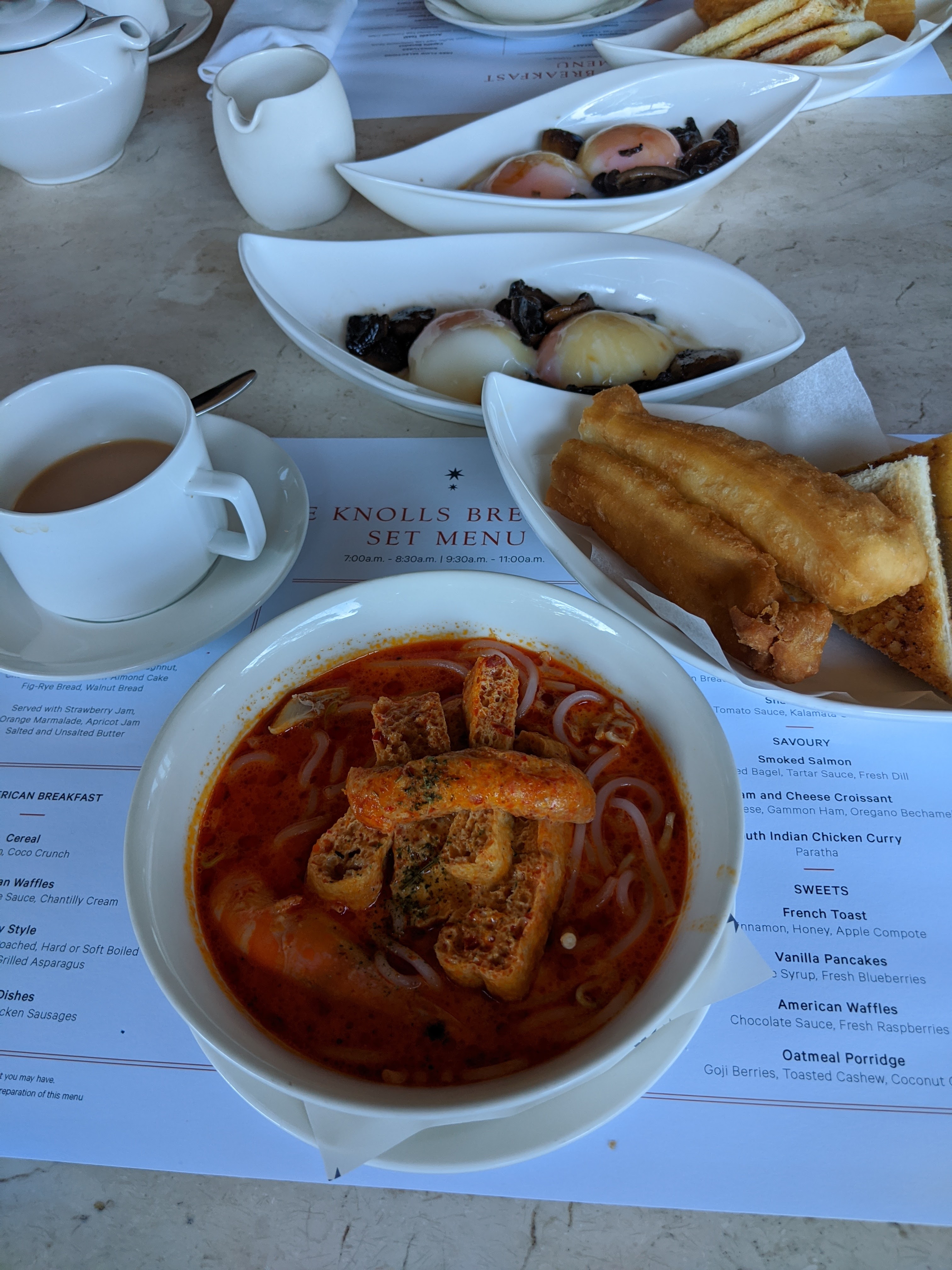
34 Province Project: Gansu 甘肃

Of all the provinces in China, the one I’d like to visit the most is Gansu. I suspect this is a rather rare sentiment, as in China the name was until recently is a byword for poverty, with peasants eking out a marginal existence at the drought-prone edge of the desert and dying in droves when the frequent earthquakes collapsed their yaodong cave homes, dug into the brittle loess of the plateau. In the fading days of the Qing dynasty, the area was wracked by rapacious warlords, while after the Revolution, Gansu became a base for heavy industry.

So why go? Gansu’s odd bone-like shape hints at its deep history. Sandwiched between the Qilian Mountains to the south and the Gobi Desert to the north, the Gansu (Hexi) Corridor is the first stretch of the northern Silk Road, running from Xi’an in Shaanxi to the east via the oasis town of Dunhuang, home to the fabulous Mogao Caves, to Xinjiang and Central Asia to the west. The Great Wall of China runs along its length, protecting the northern flank from Mongol invasion and ending at Jiayuguan, where those exiled from the country were cast out into the wilderness and where, oddly, China’s space program is now based. At the eastern end, the Yellow River (Huang He) passes through capital Lanzhou, and if you’re looking for a rollicking account of life in these parts in the late 1930s I warmly recommend In the Footsteps of Genghis Khan by John DeFrancis. Back in kindergarten in Finland, we used to sing a catchy ditty about wanting to row on the Huang He river, and after crossing the Gobi by camel John did just that, sailing 1200 miles on a sheepskin raft from Lanzhou to Baotou in Inner Mongolia. You can still go rafting in on the Huang He today, but try not to sing the song, since it has recently been cancelled.

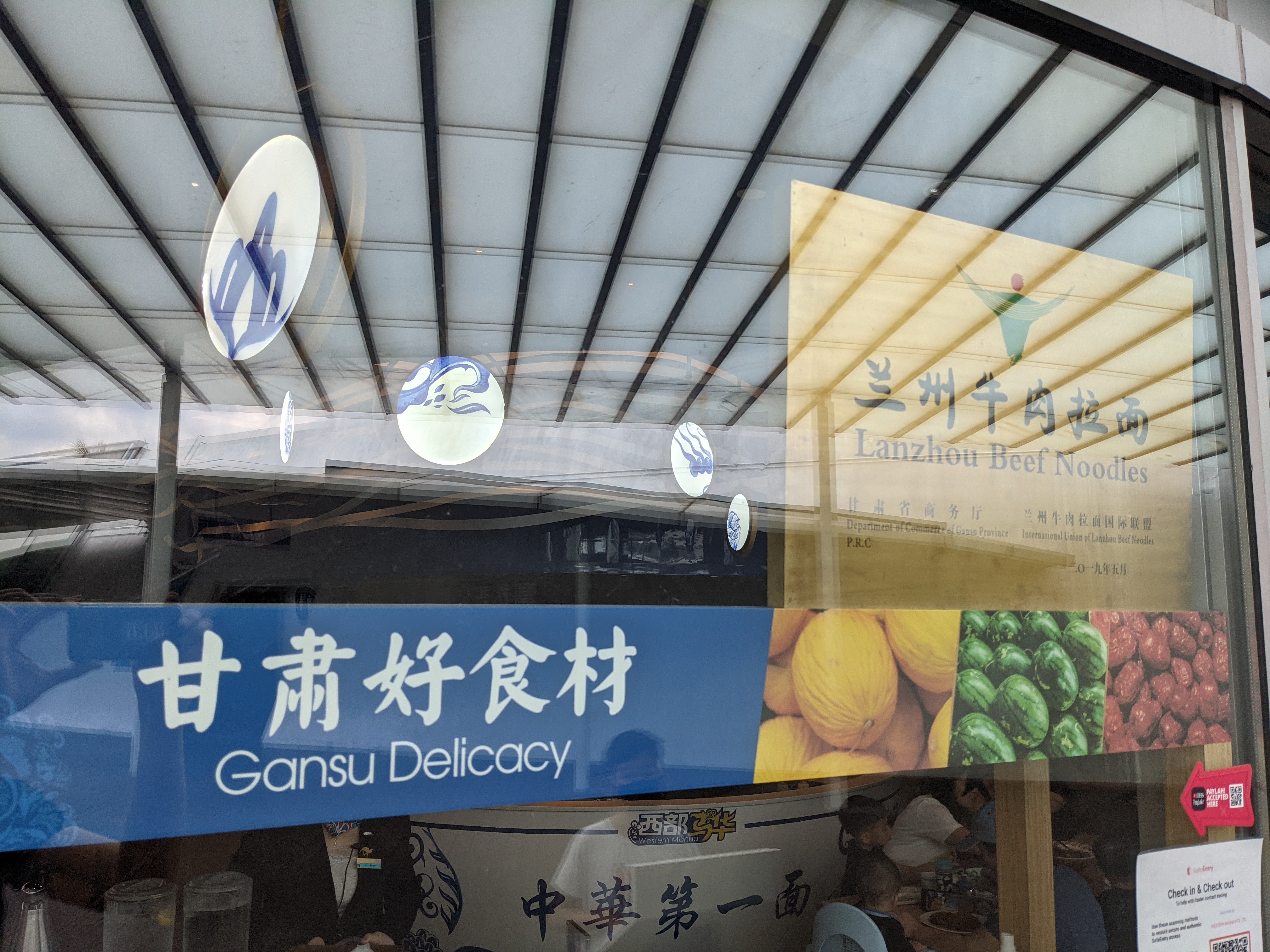
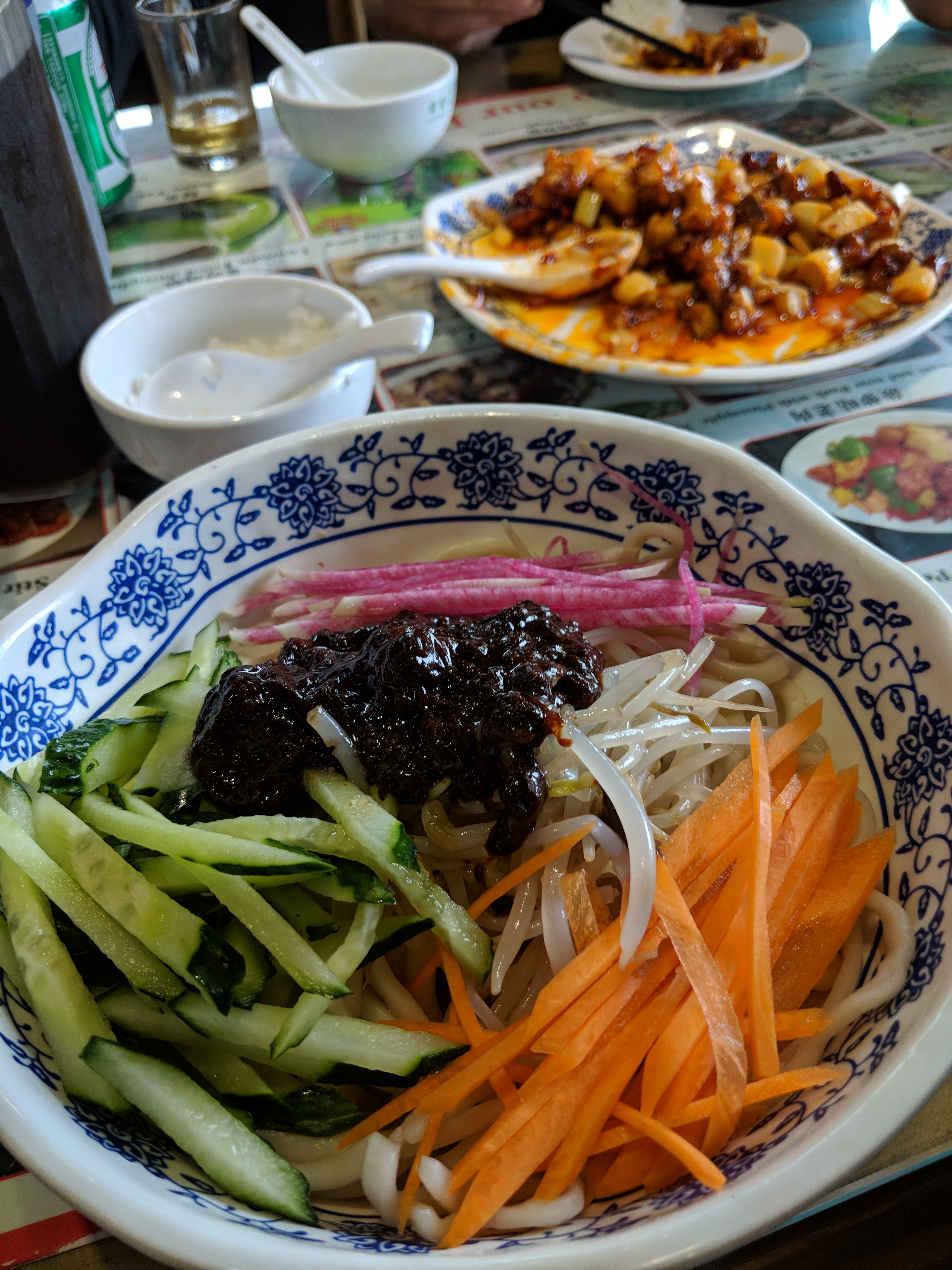
These days Gansu is famous for exactly one dish, hand-pulled Lanzhou beef noodles (蘭州牛肉拉面 Lánzhōu niúròu lāmiàn), the self-proclaimed “First Noodles in China” now ubiquitous not just throughout the country, but arguably the entire world, since the Japanese ramen descends from this. A canonical bowl is described by the mantra “One Clear, Two White, Three Red, Four Green, Five Yellow” (一清二白三红四绿五黄; Yī qīng, èr bái, sān hóng, sì lǜ, wǔ huáng), meaning that it must have clear soup, white radish, red chilli oil, green leeks and yellow wheat noodles.
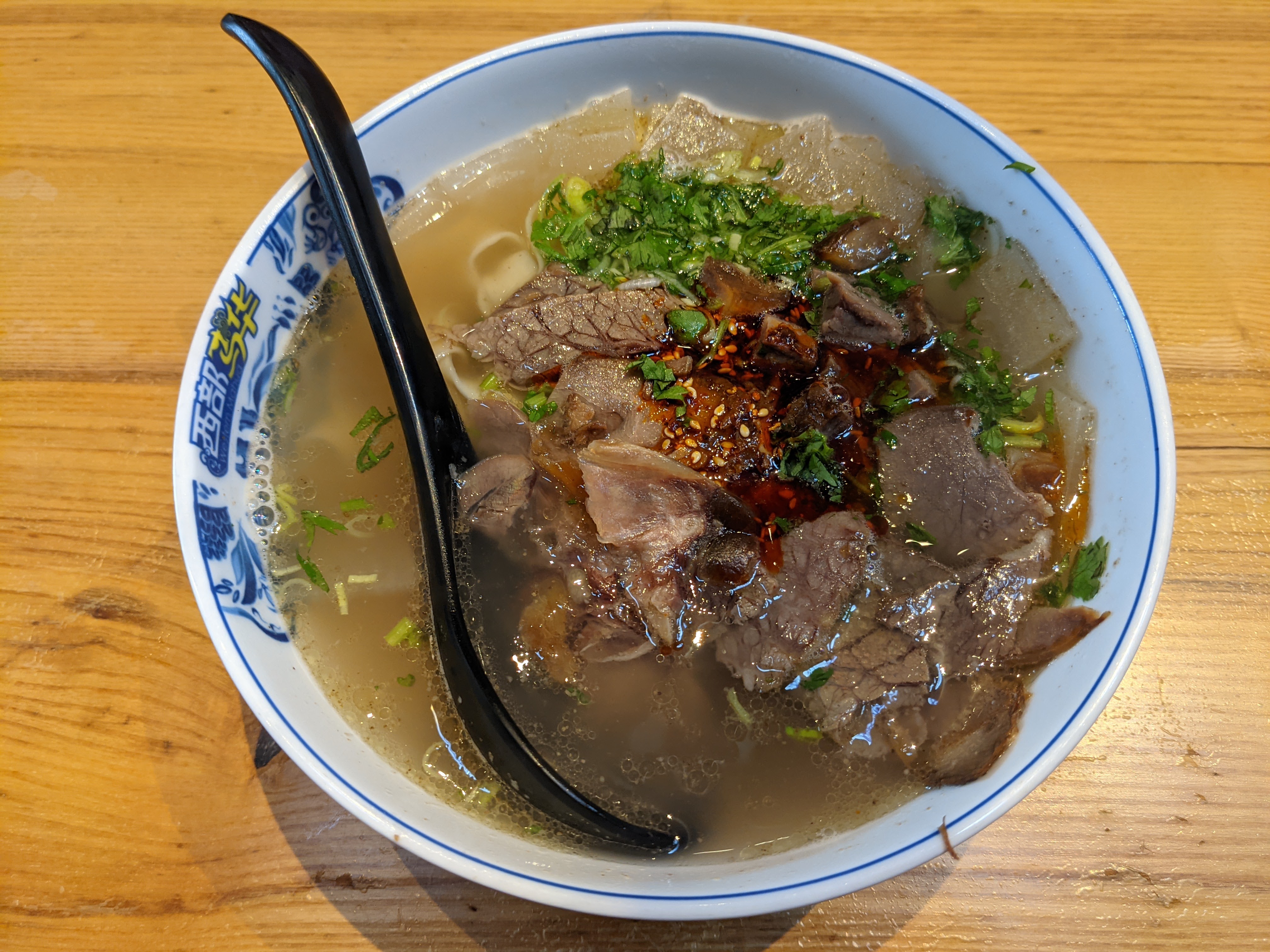
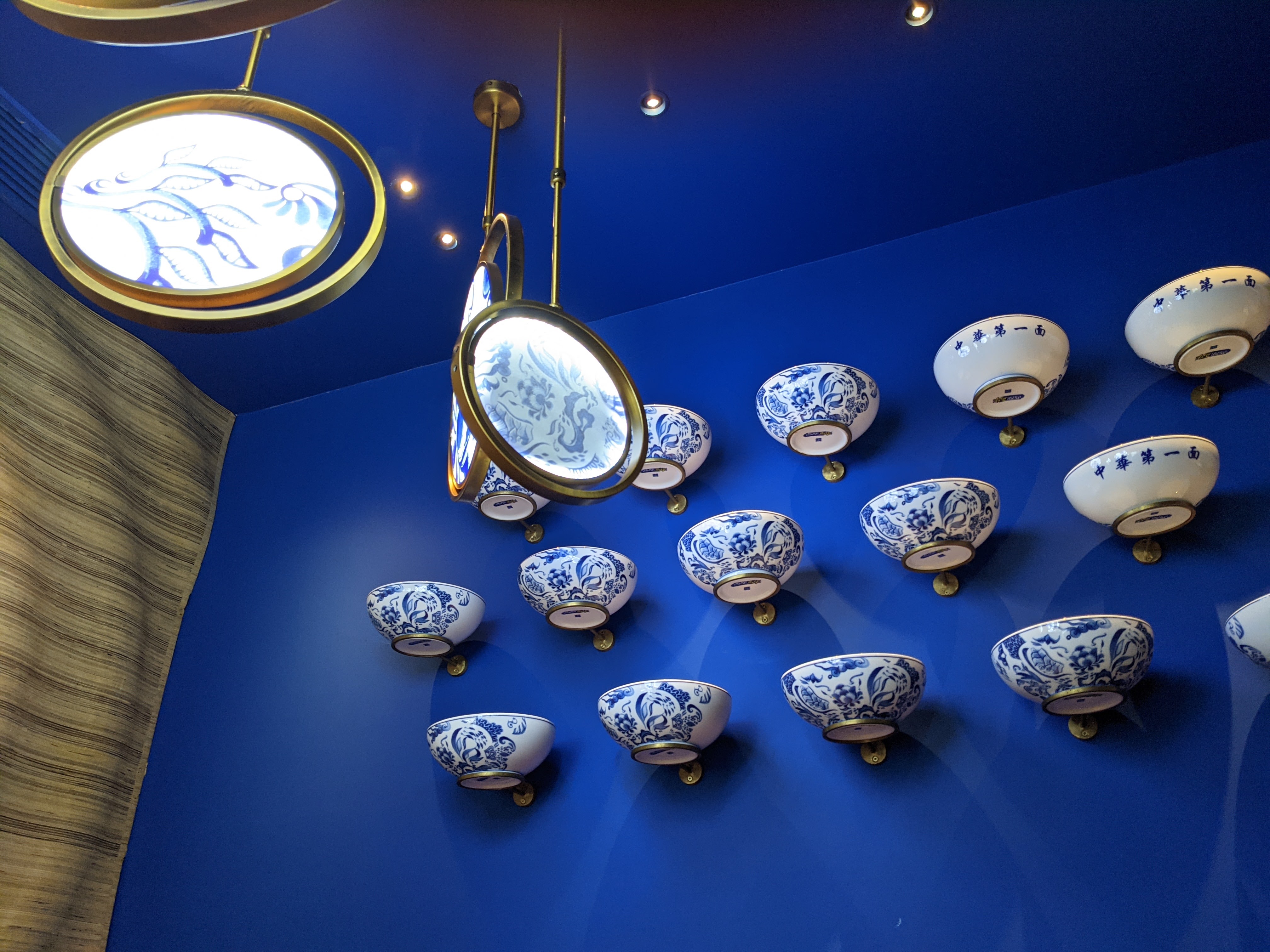
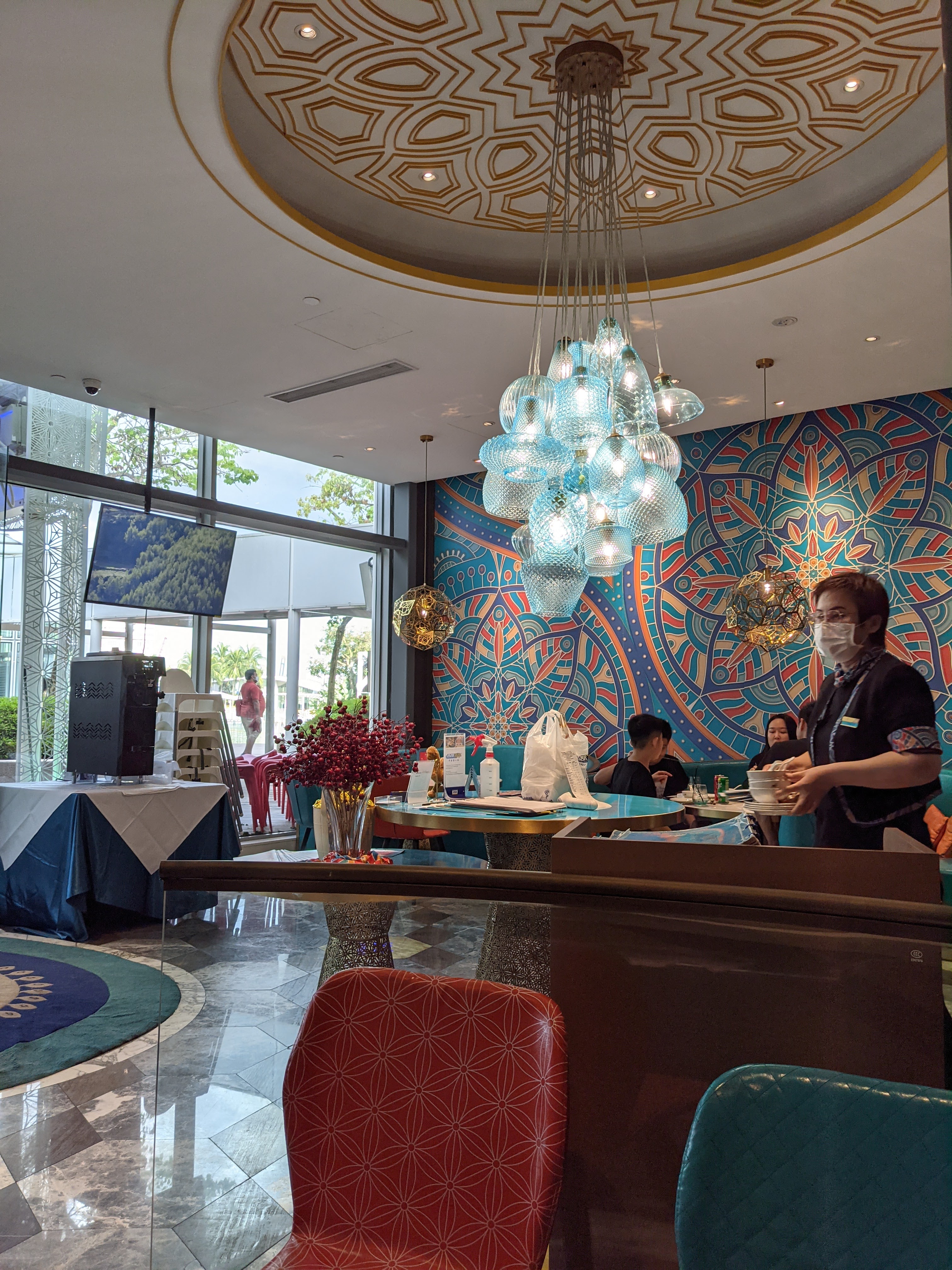
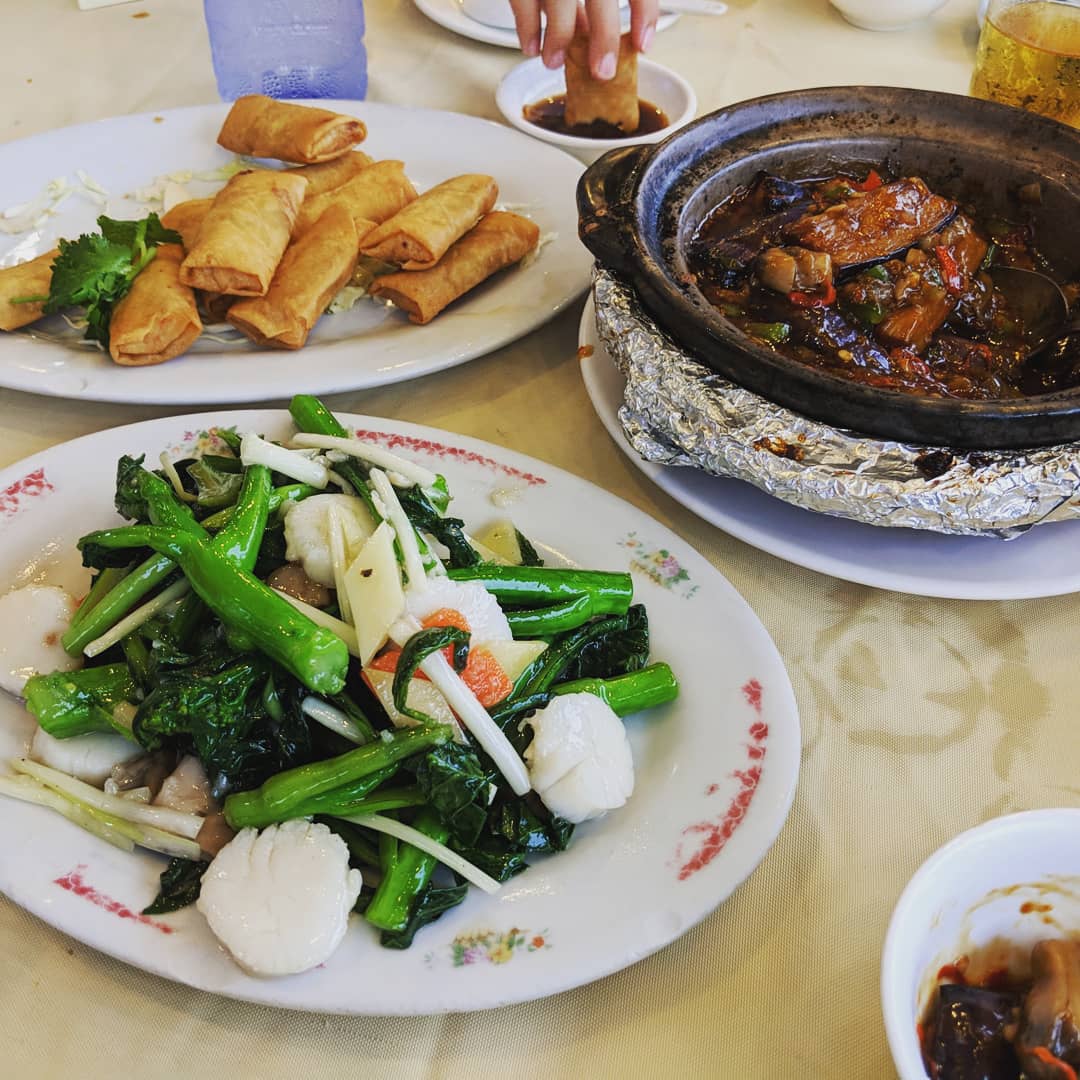
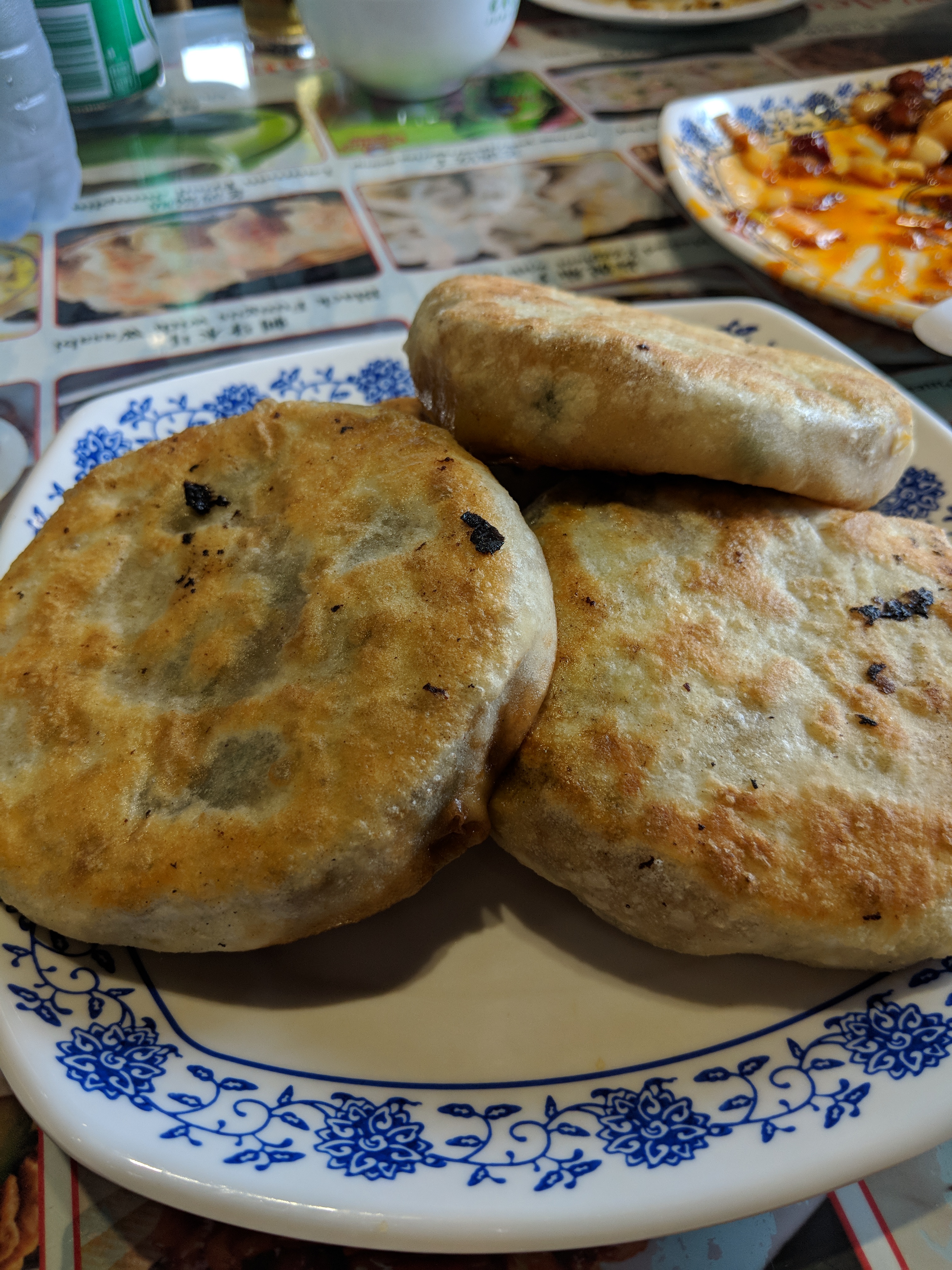
Lanzhou beef noodles are widely available in Singapore, and there are even a number of dedicated restaurants. My first stop was Western Mahua (西部马华 Xībù Mǎhuá), the sister restaurant of Alijiang from the Xinjiang post and in fact sharing the same premises in Vivocity, only more fast food than fine dining with a funky modern vibe, including a distinctly Chinese cover version of Despacito playing in the background. Musical atrocities aside, the noodles here are as good as it gets, and you don’t need to take my word for it, since the Deputy Secretary of the Gansu Party Committee has certified them as authentic. You can watch them made to order by hand, using that near-magical Chinese technique to tease apart a ball of dough into noodles using nothing but your fingers. The whole generously sized bowl is composed of one giant uncut noodle, made to any of 8 sizes, which even encode some social signalling: ladies and intellectuals are supposed to order thinner noodles down to sub-millimeter “hair width” (毛细 máoxì), while workers and peasants should go for wider ones, which range all the way up to the 50mm “big belt” (大宽 dà kuān). I tried the default size (普通细) of 2mm, while my wife sampled the waitress’s recommended 5mm, and they were both great, although the bigger sizes are definitely harder to eat. All five canonical ingredients were present, with a mild chilli-mala kick but nothing over the top, and the 6th (beef) was well-stewed and tasty as well. The kids chickened out with a chicken broth, but ended up preferring ours, although they lavished the most praise on what the English menu calls Braised Beef in Pita (精品煨牛肉夹馍 jīngpǐn wēiniú ròujiāmó), a Chinese “burger” I’ll talk more about when we get to Shaanxi. A regular bowl of noodles goes for $9.80, and total damage for 4 was just $44. Two thumbs up.
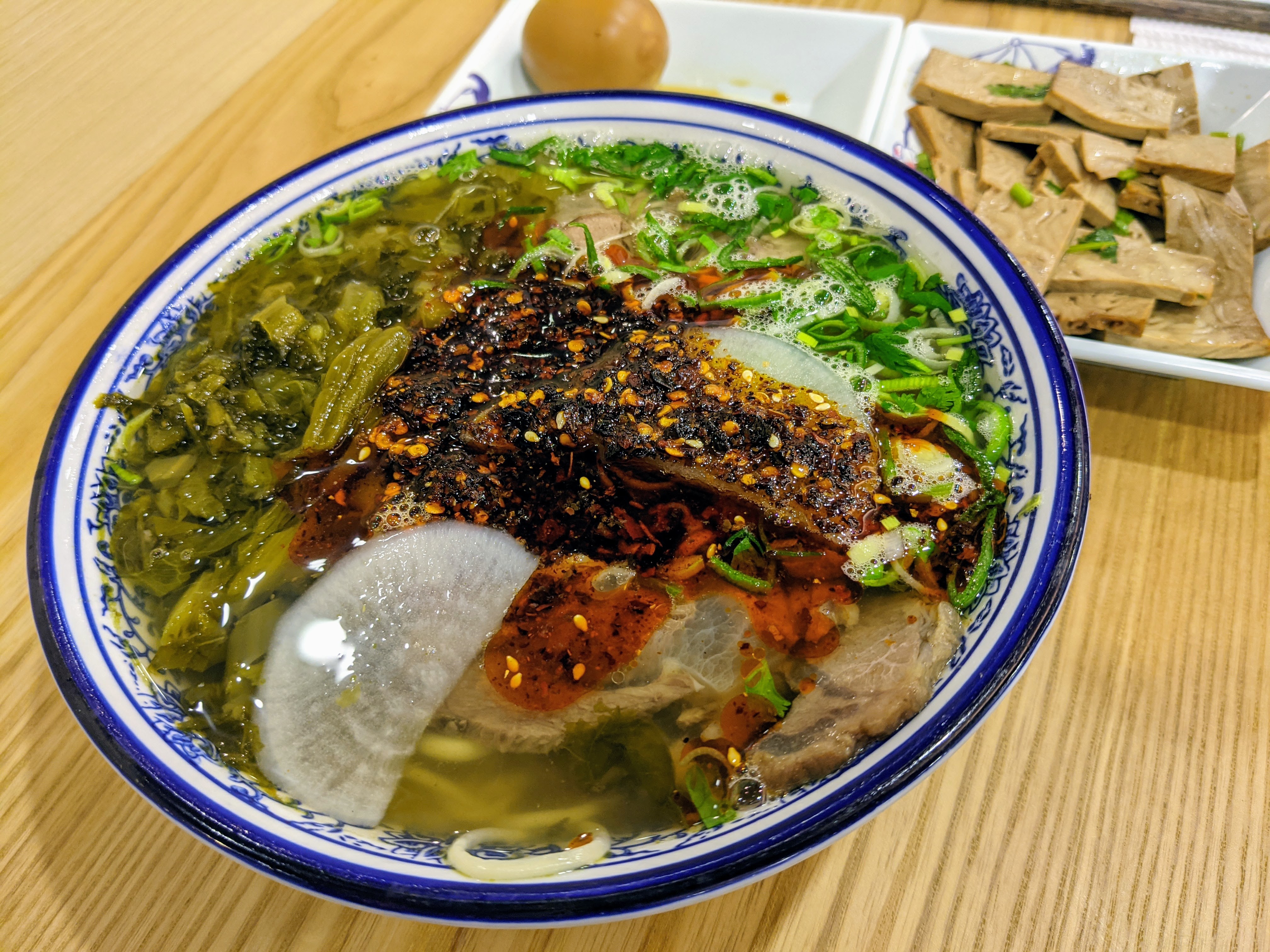
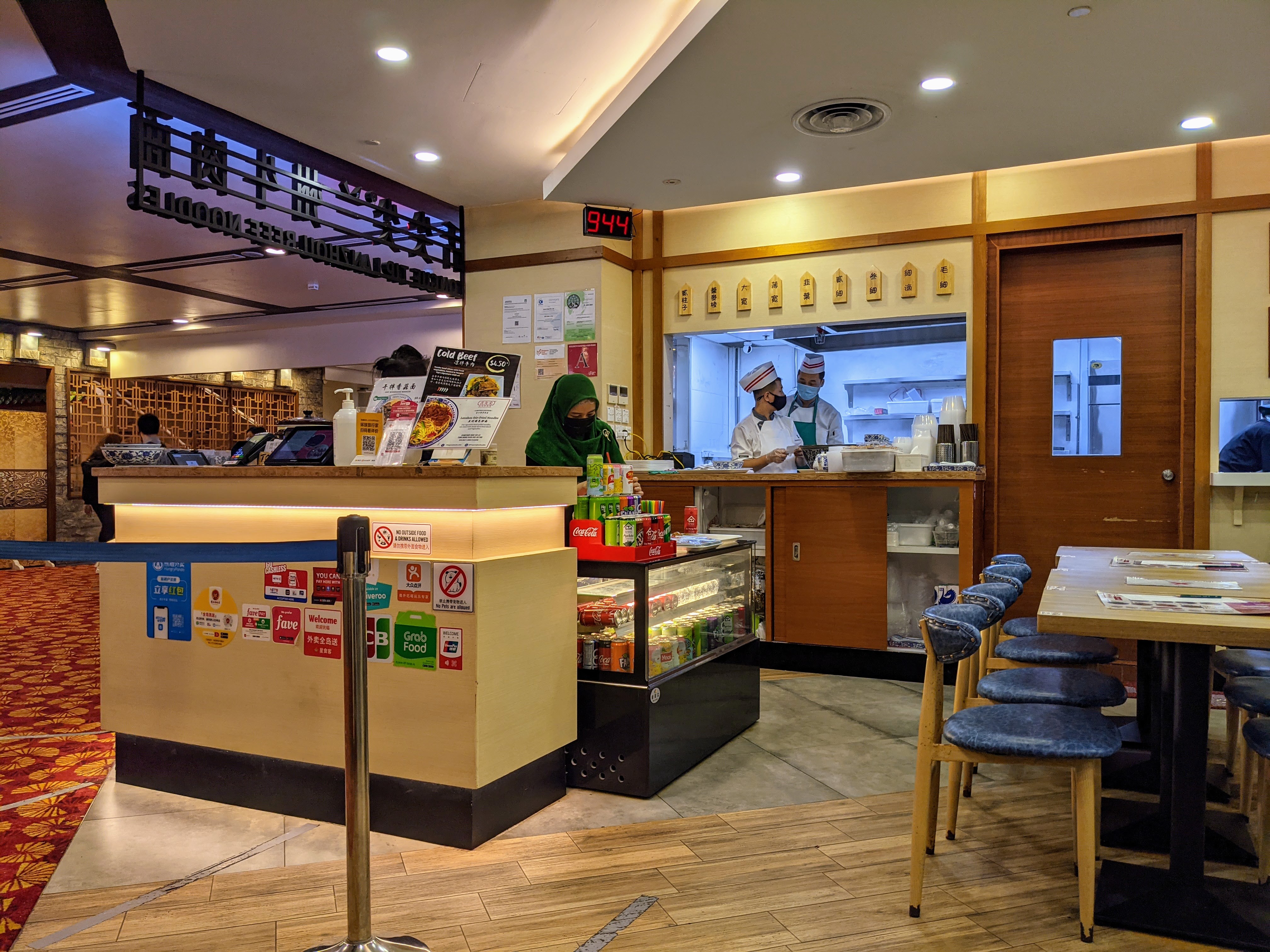
For balance, I went to test out the competition, Tongue Tip Lanzhou Beef Noodles (舌尖尖兰州牛肉面 Shéjiānjiān Lánzhōu niúròumiàn). A franchise of the Chinese chain of the same name, they have 4 outlets in Singapore, so I tried the one at Chinatown Point, which is also bedecked with the same certificates of authenticity as Western Mahua and has two behatted noodle masters doing their thing in a glass box.

This time, I tried the Sauerkraut Beef Noodles (酸菜牛肉面), but it was a sad disappointment in all respects. I have only myself to blame for ordering the suan cai variation with vinegary pickled cabbage, but there was also way too much chilli sauce, and the combo completely overpowered the broth. The “normal” sized noodles were thin and mushy, with none of the chewy bite I expected (were these really made to order?), and the beef slices were small, thin and mostly buried at the bottom of the bowl. I had paid an extra $4 for a set, which consisted of a cold braised egg whose yolk had long since turned green, a dish of rubbery “vegetarian chicken” (素鸡 sùjī, made from beancurd) straight from the fridge, and a can of soft drink. Neither the side dishes nor the noodles were worth it; not recommended.

<<< Xinjiang | Index | Macau >>>

34 Province Project: Xinjiang 新疆

Xinjiang, literally “New Territory”, is the largest and westernmost of China’s provinces. A significant fraction of its inhabitants, primarily the Uyghurs who until recently made up the majority of its population, is rather unhappy with this state of affairs and would much prefer that it be called East Turkestan in recognition of its cultural and linguistic roots with fellow Turkic peoples further to the west. The Chinese Communist Party, in turn, is rather unhappy with this state of affairs and has spent the past half century trying to assimilate them by hook or crook.

I’ve dreamed of the markets of Kashgar, the oases of Turfan and the deserts of Taklamakan ever since I watched The Silk Road in the 1980s, but I’ve never actually been to Xinjiang. I first encountered their food in Australia, where some 5,000 Uyghur refugees have settled and not a few have opened restaurants, like the daggy but iconic, uncompromising and rather tasty Kiroran in the heart of Sydney’s Chinatown. Uyghur cuisine features many Central Asian staples like rice pilaf (polu, in Chinese 抓飯 zhuāfàn); mutton kebabs (羊肉串 yángròu chuàn); flat, wide handmade laghman noodles (手拉麵 shǒu lāmiàn); and nan (饢 náng) bread, the last of these not referring to the soft, pillowy nan of India, but crisp, perfectly round discs often studden with sesame seeds or spices.

Here in aggressively apolitical Singapore, no restaurant dares utter the U-word, but there are two restaurants that claim to feature Xinjiang cuisine — so of course I had to go visit both.

Aisyah (西北香 Xibeixiang “Northwest Fragrance”) is a surprisingly hip & happening pint-size joint on Telok Ayer St, right next to Thian Hock Keng temple. Figuring the CBD would be deserted on Sunday, we rocked up at lunchtime with no reservation and were lucky to snag the last table.

The menu is short, and the name of the game here is kebabs and hand-pulled noodles (laghman) served with a variety of toppings, ranging from braised mutton (黄焖羊 huángmènyáng) to the more-Sichuanese-than-Uyghur “saliva” chicken (口水鸡 kǒushuǐjī), so called because it makes your mouth water. Both kebabs and the stewed mutton were excellent, with the meat soft and falling off the bone/skewer, and you can choose to have your noodles with spicy soup, mild soup or “dry” with soup on the side.

An unexpected new acquaintance was Hankow Factory #2 (汉口二厂 Hànkǒu èrchǎng) soda, hailing from a city better known these days as Wuhan. Selling their fruity Mystery Factor X soda overseas may be a bit of branding challenge these days, so I tip my hat to their marketing team, but at least the product was good: it was probably the closest thing I’ve had to Pommac outside Finland!

Total damage for 4 people: $80. Recommended.

I had my doubts about Alijiang (阿里疆), the lavishly decorated local outpost of a Chinese chain that claims to offer “Silk Road cuisine”, perched atop Singapore’s largest shopping mall Vivocity to boot. Not only are technicolor camels outside a restaurant usually a bad sign, but the menu veers way the hell off the Silk Road and onto completely the wrong continent: lobster noodles or avocado salad with cherry tomatoes, anyone?

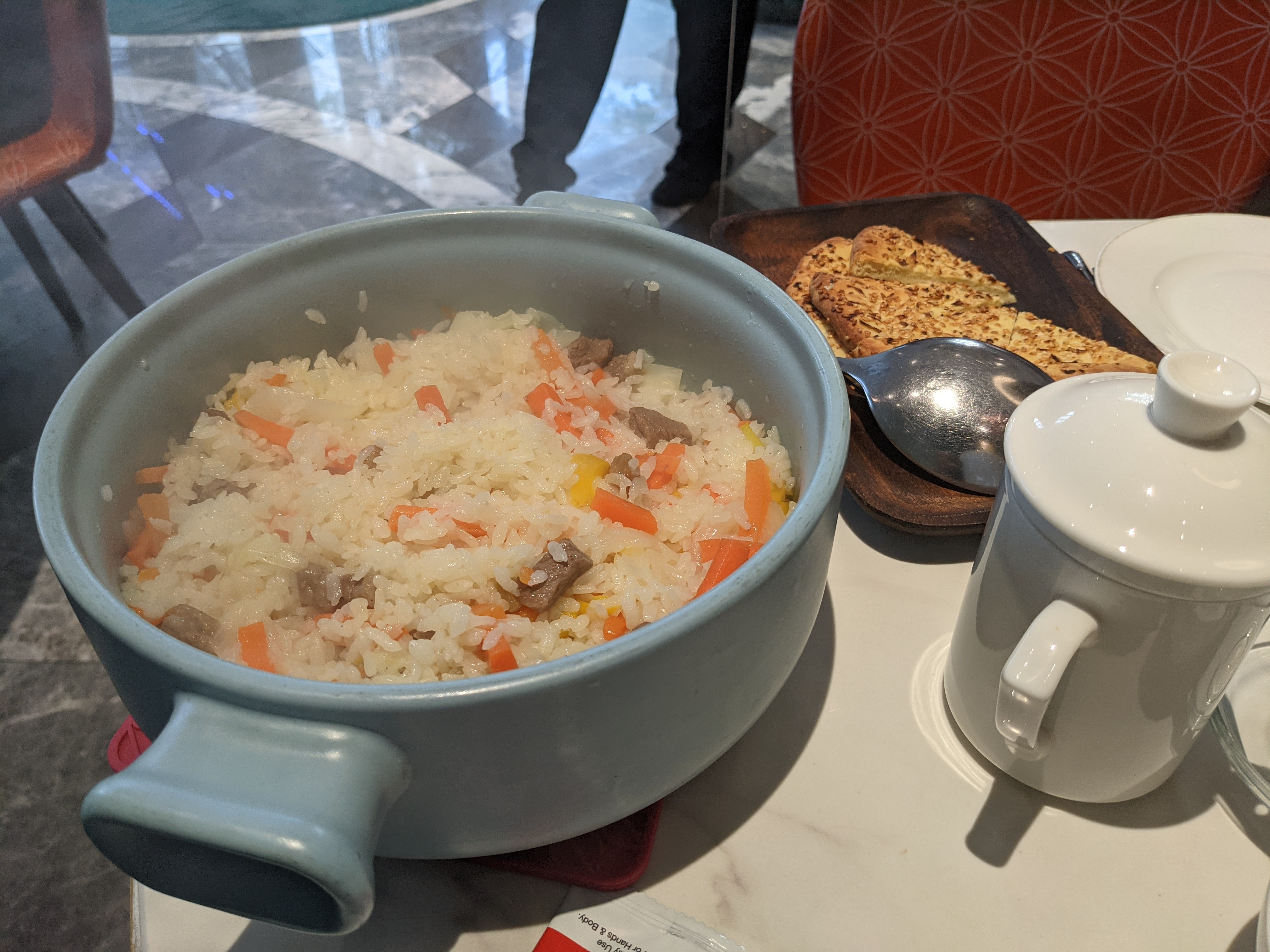
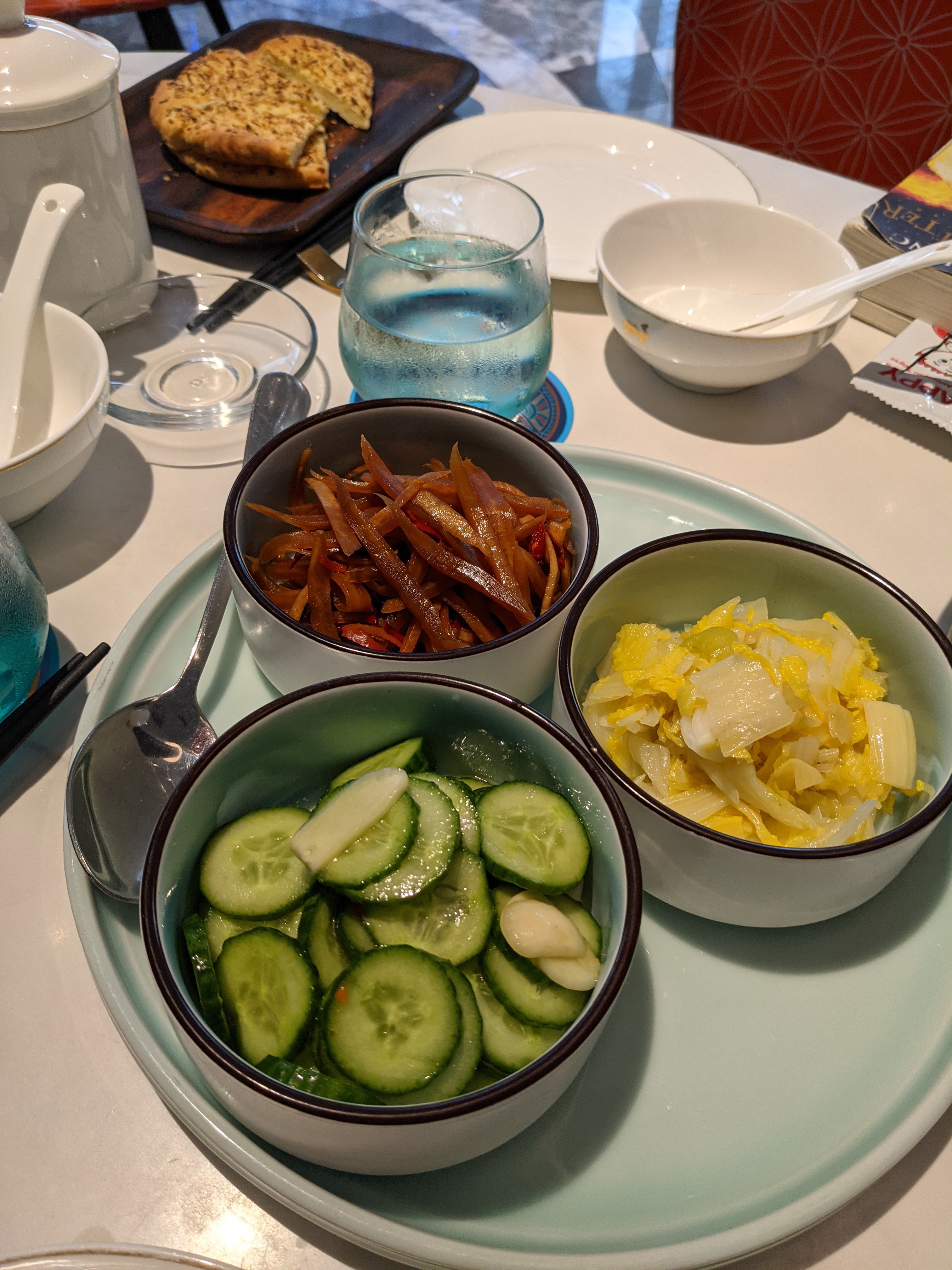
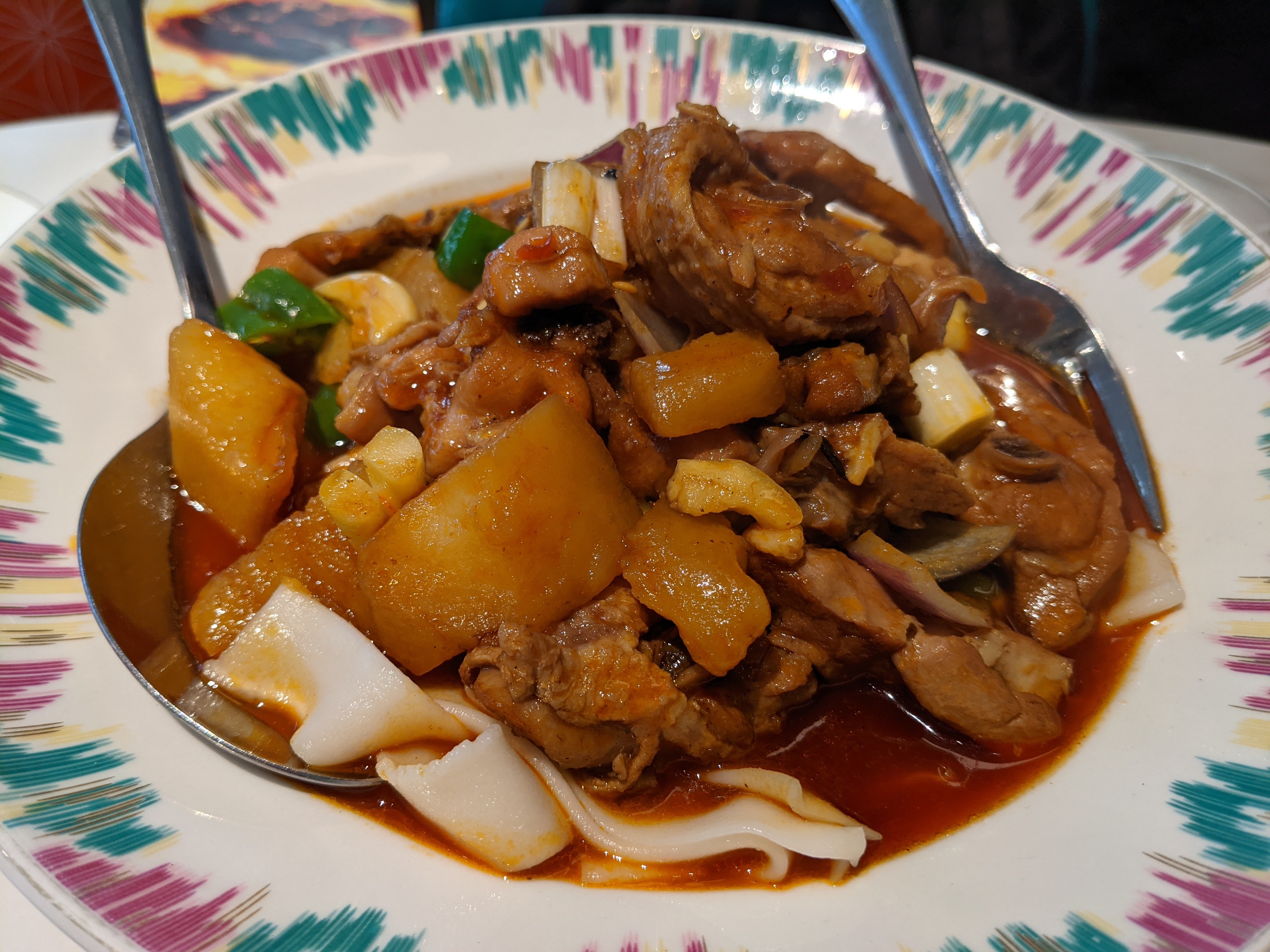
However, we struck to their self-proclaimed Xinjiang specialties and were pleasantly surprised. The mutton-laden polu cooked to order in a clay pot was oily and yummy, the nan was made fresh, the pickles were zingy and crunchy, and the kids devoured the kebabs and asked for more. All agreed the star of the show was the one Xinjiang dish the Uyghurs don’t usually get credit for, namely “big plate chicken” (大盘鸡 dàpánjī), a hearty stew of chicken, potatoes, and laghman noodles all slathered in oil and spicy-numbing mala sauce, reputedly invented by Sichuanese truckers to keep them going during the tedious 4,000-km drive from Beijing to Kashgar.

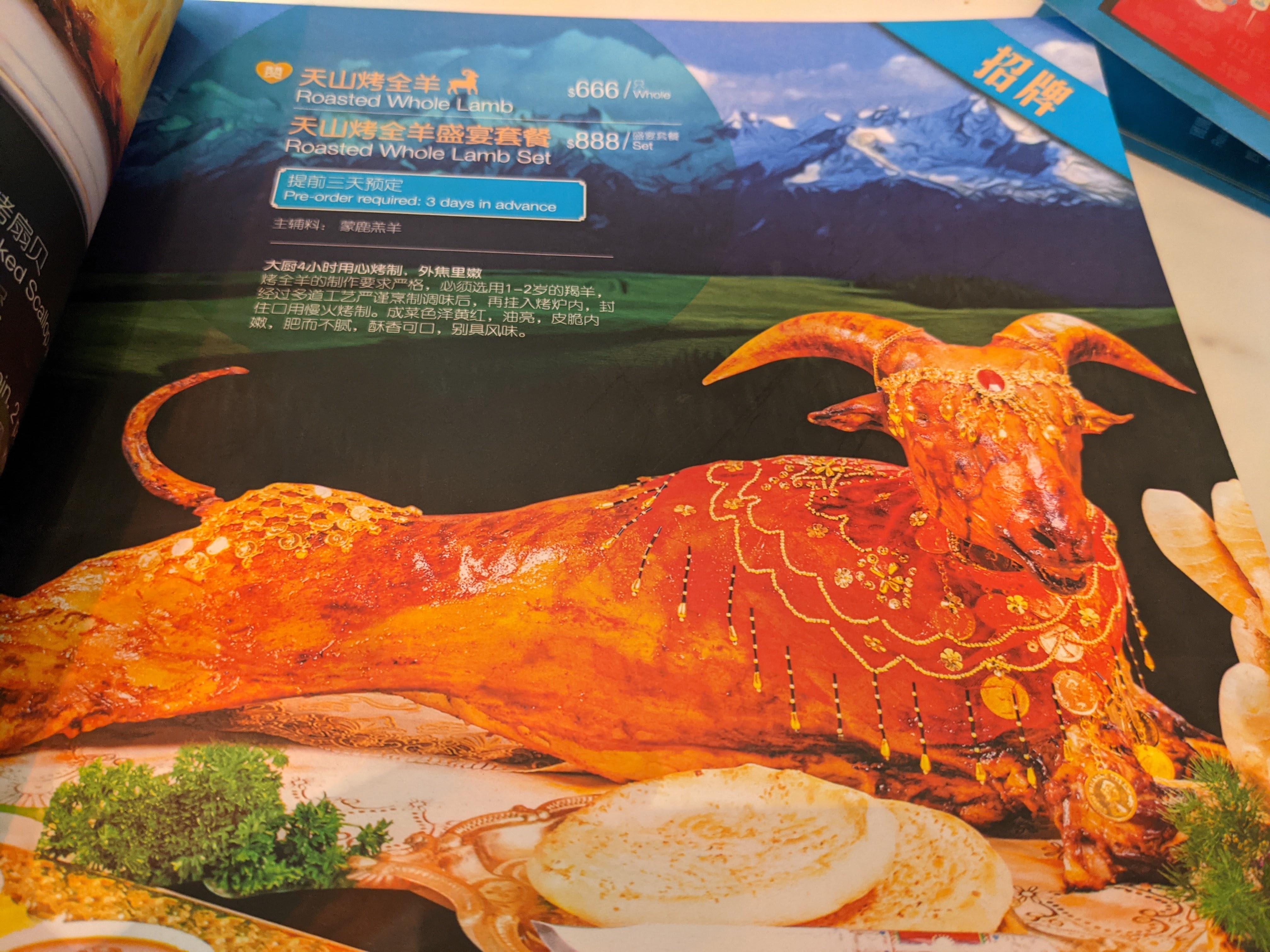
One dish we didn’t try was the roasted whole lamb, available for auspicious price of $888, but probably not selling that well in these COVID-constrained times of groups up to 8. I wonder if they actually dress it up with gold jewelry as shown in the brochure?

Two bonuses came at the end: the kids got free soft-serve ice cream, and I realized a bit too late that I got somebody else’s bill and consequently saved a fair chunk on what would otherwise have been a $120-ish tab. Oops: guess we’ll have to go back to atone, or check out the Gansu-style Lanzhou beef noodles at their sister outlet next door.

<<< Index | Gansu >>>

34 Province Project: Eating my way through regional China in Singapore

Coming back to Singapore after almost 10 years away, one thing that struck me is the proliferation of regional Chinese food. Mala is the most visible manifestation, but the southern Chinese dishes we all know and love have been supplemented by restaurants serving up more or less unadulterated dishes from northern, northeastern, western and central parts of China. Yet since they cater mostly to recent immigrants, many of them are nearly invisible on the English-speaking Internet: they’re rarely covered by local bloggers, mostly missing from the usual delivery services and often not even listed on Google Maps.

With my business travel plans to China scotched by COVID-19 for the foreseeable feature, I figured I’d set a goal for myself: trot out my 非常不好 Mandarin and try to explore the food of every one of China’s 34 provinces right here in Singapore. Easy enough for Shanghai or Hong Kong; a bit more challenging for Guizhou or Anhui.

The 34 provinces as we know them today were only set up in the 1950s, with tweaks continuing up to the 1990s, so Chinese culinary traditions don’t map them to them all that neatly either. So here’s a listing of China’s regions, their culinary traditions (the Eight Great highlighted in bold) and, roughly, how the provinces slot under them.

Region 地区CuisineProvince
Northwest 西北 XīběiXibei 西北菜Qinghai
Gansu
Ningxia
Xinjiang
Qin 秦菜Shaanxi
Northeast 东北 DōngběiDongbei 东北菜Heilongjiang
Jilin
Liaoning
North 华北 HuáběiInner Mongolia
Jing 京菜
Imperial/Yushan 御膳
Beijing
Jin 津菜Tianjin
Ji 冀菜Hebei
Jin 晋菜Shanxi
East 华东 HuádōngLu 鲁菜Shandong
Hu 沪菜Shanghai
Su 蘇菜
Huaiyang 淮扬菜
Jiangsu
Zhe 浙菜Zhejiang
Hui 徽菜Anhui
Gan 赣菜Jiangxi
Min/Hokkien 闽菜
Fuzhou/Foochow 福州菜
Putian/Henghua 莆田/兴化菜
Fujian
Taiwan
Southwest 西南 XīnánChuan 川菜Sichuan
Chongqing
Dian 滇菜Yunnan
Gui 黔菜Guizhou
Tibet
Central 中南 ZhōngnánYue 粤菜
Chaozhou/Teochew 潮州菜
Kejia/Hakka 客家菜
Guangdong
Hong Kong
Macau
Hainan
Chu 楚菜Hubei
Xiang 湘菜Hunan
Yu 豫菜Henan
Guangxi

Here’s my current plan of action, noting dishes & drinks to try and places to try them, and the map version of the same.  All things considered, I’d prefer to eat everyday/street/”real” food instead of fancy 5-star hotel restaurant stuff, but I’m open to everything.  If you have suggestions or would like to you’d like to offer your services as tour guide/translator/culinary consultant, please comment directly on the doc, join the 34 Province Project mailing list or Telegram group or drop me a line!

Pick an link from the table above, or start your journey here: Xinjiang >>>

Lady Jennifer Windsor: the hoax that fooled Singapore for over 11 years

Many Singaporeans will have heard of the tragic story of Lady Jennifer Windsor, wife of Lord Windsor. One of many British residents in the colony, she and her wealthy family lived on a huge estate in Upper Thomson in the 1920s.
Yet this idyllic existence was shattered on one cruel day in 1923.  Lady Jennifer’s three young children, Harry, Paul and little Angela, were playing at a nearby bridge when out of nowhere, a flash flood suddenly swept them all away to her deaths. The bodies of the two little boys were found downriver, but Angela’s body was never found.

Soon people started to hear what sounded like the cries of a little girl near the bridge, and the desperate Lady Jennifer went there to comfort her lost child’s soul.  She ended up spending the rest of her life in mourning near the bridge, and that is how the Singaporean neighbourhood of Ang Mo Kio, or Caucasian Bridge, got its name.


It’s a tragic tale, retold in many places like New York Times journalist Cheryl Tan’s book A Tiger in the Kitchen, a Singaporean TV documentary, the Wikipedia page for Ang Mo Kio and too many blogs and tourist guides to count. There’s only one tiny flaw in the story: it’s unadulterated horseshit.

The story seems off even on casual inspection. “Jenny from the block“, the Cornish version of Guinevere, seems an unlikely choice of name for an aristocrat born in the late 1800s. The Windsors are nothing less than the British royal family, so what happened to that estate, and why are there no other traces of them in Singapore? If they had lived here, would they really let their young children play on a road completely unsupervised? And even if they did, are flash floods large enough to wipe out bridges but not accompanied by massive storms really a thing in Singapore?

Once this thread of suspicion had been pulled, the entire fabric of the hoax unraveled within days. A Google Books search revealed both precisely zero hits for the fair Lady before 2009, and that there were historical references to the name Ang Mo Kio as early as 1855, decades before her supposed birth.  Soon a Wikipedia sleuth tracked down the apparent original source, namely this shitpost by a “Michaelzhang68” in the Chit Chat room of the late sgforums.com on November 21, 2008. Nobody bought it there either, as the improbable tale was promptly torn to shreds and one reply even lampooned it by suggesting that Ah Hood Road was named when Robin Hood decided to swap Nottinghamshire for Singapore.

Nevertheless, the original creator seems to have persisted, since mere hours later, a verbatim copy of the post was added to Wikipedia’s “Ang Mo Kio” page by a “Paulchen68”, and that’s all it took for the legend to sprout seed. For 11 long years and 8 months until July 2020, the story sat there, occasionally embellished or reformatted, but essentially unquestioned until this ang moh happened to move next to Ang Mo Kio and started wondering where that name came from.

So where did the name come from? I subscribe to the least sexy possible theory: a bridge (桥 kio in Hokkien) was built from concrete (红毛灰 ang mo he “Western ash”), which then became Ang Mo Kio. But maybe you shouldn’t trust the claims of a random stranger on the Internet on this point either…

Picture of a suitably skeptical-looking “Lady Jennifer” from the Mardi Gras Museum at Arnaud’s, an execrable tourist trap in New Orleans.


Staycation in the time of plague: a night at Capella Singapore

After months of lockdown, Singapore opened up some hotels to staycations by local visitors in early July. It had been 6 months since we’d gotten out of the house, the kids were on school holiday, and Capella Singapore of Trump-Kim summit fame had a pretty decent deal (20% off, free breakfast, late checkout and a $100 dining credit), so we decided to try it out. Make no mistake, this was still not a cheap stay, but we did also “save” on the cost of return flights for four people, or at least that’s how we justified it to ourselves!

This is not going to be a review of Capella: the place has been around for over ten years, so that’s been done to death. Instead, I’m going to focus on what staycations in Phase 2 Singapore are like when COVID-19 still stalks the streets.

Arrival

Luxury hotels put a lot of effort into making check-in as smooth as possible. COVID bureaucracy, unfortunately, does not. On arrival, every adult needs to do the SafeEntry QR scan before entering, get their temperature measured, fill out a lengthy health declaration form that requests everything from your reason of stay to your employer’s contact details, and only then to you get the to the normal hotel registration with NRICs, credit cards etc. No big deal in the grand scheme of things, but it did take a good 20 minutes and it’s always tedious to repeat the same info over and over — would it be hard to, say, extend SafeEntry to hotel stays?

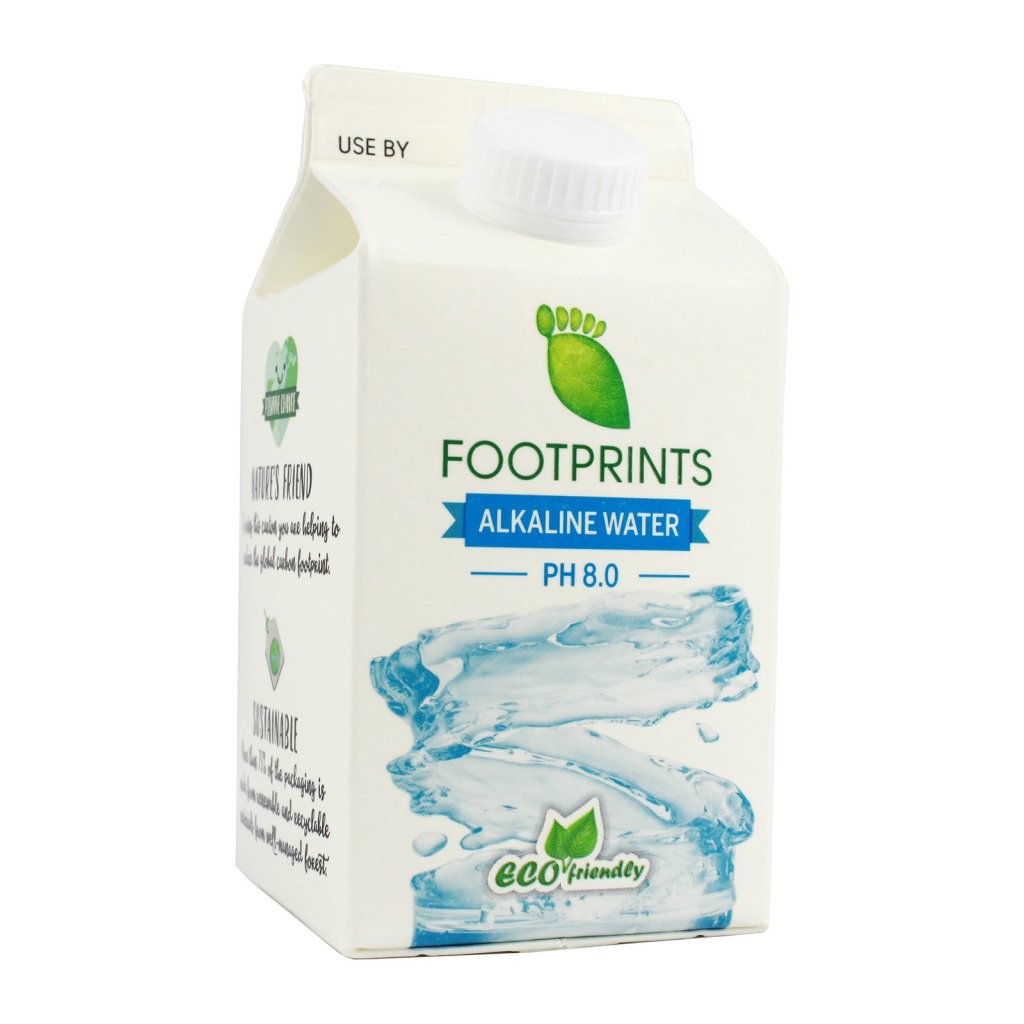
In normal times, Capella serves its guests iced tea on arrival. These are not normal times, so we got sealed tetrapaks of “ecofriendly” water instead. The kids were less than impressed, and entertained themselves by watching a cockroach crawl up the wall.

Room

Our room was otherwise refreshingly normal, and the kids were relieved to hear you don’t even need to wear masks inside. However, all in-room snacks and alcohol had disappeared. The minibar was still stocked, but only with 4 cans of Coke and some fruit juice. I’m not sure if this is because of COVID, regular Capella policy, or just some reopening glitch. A welcome gift in the form of shrink-wrapped cookies was delivered, but there was no sign of the usual fruit basket.

Facilities

All pools were open, but with capacity controls: for example, 16 guests max in the family pool, with 2-hour stays. Enforcement appeared to be mostly on an honour basis, and in any case we only saw one other family using it during our stay. The gym was open, but access was gated via the (also open) spa. The business centre was unsurprisingly closed. Elevators, the front desk, and other places with even a remote possibility of crowding were annotated with big social distancing stickers on the floor.

Capella’s complimentary lounge, the Living Room, was open but again with capacity controls, so we had to call ahead to book. On arrival, heads were counted to make sure they were within limits (yes, barely), then we were guided to a table and presented with a fixed set of snacks, plus coffee/tea/soft drinks made to order.

Interestingly enough, while most guests were couples or families like us, there were a few Mandarin-speaking solo travellers in business wear. The Singapore-China Green Lane in action, perhaps?

Dining

Capella has two restaurants and a bar, all of which were open. However, since in-house dining charges like a wounded bull ($38++ for nasi goreng, anyone?), we opted to eat our meals on the Sentosa beachfront, which isn’t cheap either, but there are many 1-for-1 deals to dull the pain. (Pro tip: with the 1:1 pizzas at Trapizza Mon-Fri, you can feed a family of four for $22++.)

For the breakfast, we had to make an advance reservation for one of two time slots (7-8:30, 9-10:30 AM), which prevented table use and allowed a half-hour deep clean between guests. Instead of a regular buffet, which isn’t allowed under COVID rules, we had a choice of one of three set meals and/or a selection of “free flow” made to order items on the side, all brought to your table. The net effect was a bit like eating dim sum/yum cha, with trays of pastries and trolleys of juice floating past. At a fairly small and intimate place like Capella this worked very nicely, but I do wonder how large hotels with their massive champagne brunch spreads will convert to this new format. One more plus for Capella’s The Knolls: there’s plenty of spaced-out, airy and shady outdoor seating. Your average city hotel will struggle with this too.

Activities

Capella offers a wide-range of free “cultural” activities like Peranakan painting and brown sugar bubble tea making. These operated normally, except that everybody involved — including us — was masked up. Mmm, just look at that frothy mug of diabetes in a cup!

Crowding & staffing

We visited on a regular non-school-holiday weekday, and both the hotel and Sentosa were pretty quiet. Apparently this is set to change once the holidays start, and Capella is already booked full (!) on July 23rd, although I imagine they’re also operating at reduced capacity.

One thing which soon became clear is that the hotel appeared to be somewhat understaffed. The front desk promised to call regarding an activity booking but didn’t, it was 9 PM by the time turndown service was offered, a late night snack attack room service order never showed up, we were asked for our newspaper selection but it wasn’t delivered, etc — none of these big deals, but not what you’d expect at this price point. Did they underestimate the demand, or do they have staff stuck overseas? If it’s like this during a quiet weekday, next week is going to be a mess.

Overall verdict

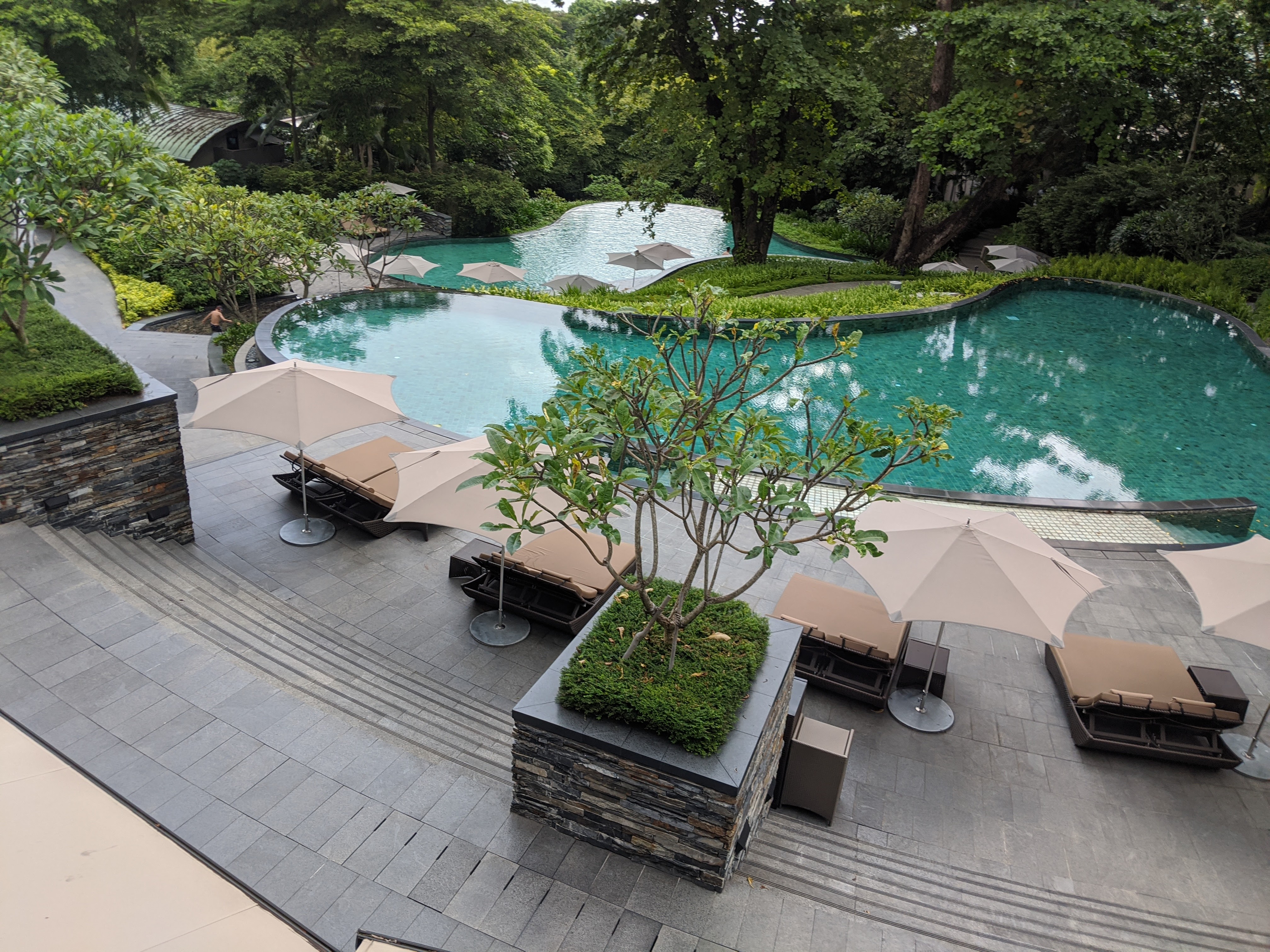
Definitely worth it. Capella’s terraced pools are the closest you’re going to get to Bali in Singapore (just try to ignore the oil refinery flares in the background), and it’s closer to our home than Changi Airport. The COVID limits were reasonable and the adaptations well thought out. We also try to avoid busy indoor spaces (19x risk compared to the outdoors!), so Sentosa is definitely the place to be: it’s much nicer now without the usual crowds, and we really appreciated the chance to see some greenery, wide open beaches and lots of airy outdoor eating options.

It was not so nice to see some groups on the beach with way more than 5 people and not a mask in sight. There was enough space that we could steer clear, but here’s hoping these troglodytes don’t ruin it for everybody else again.

Serpent Across the Mekong: Flight of the Thai Airways TG404 Airbus A330 seat 40A

Haiku time:

Tee gee four oh four
Seat pitch twenty eight inches
No one hears your screams

TG404 from Singapore to Bangkok is scheduled smack dab in the post-meridiem, which means it’s pretty much worthless for business travel. This has two consequences: as fares are cheap and availability is good, I seem to end up on it whenever I’m connecting out of Bangkok to somewhere else; and because the flight’s passengers tend to be the very definition of “low yield”, TG doesn’t hesitate to field its crappiest aircraft on it. Today, at least, they’ve replaced their previously ubiquitous Airbus A300, held together with baling wire, duct tape and chewing gum imported into Singapore with special permission from the Dutiable, Controlled & Prohibited Goods department of Singapore Customs, with a somewhat less antiquated A330. While I kind of miss the A300’s Commodore 64-vintage sickly beige interior and rotary audio channel selector, which always brought back fond memories of childhood flights when my knees were not necessarily jammed into the seat in front of me, in all other respects this plane is a mild improvement.

Despite Thailand’s generally stunning genetics and the same trowelful of makeup as that used to much success by Singapore Girls, Thai Airways flight attendants are generally not very attractive, doubtless because they received their positions through family connections in the vast, corrupt bowels of this state-owned airline. (A phenomenon easily observed elsewhere in the region, compare Garuda vs Lion or Malaysian vs Air Asia.) The plane is packed to the brim, and while waiting for Porn the trolley dolly(*) to fetch me my inevitable coconutty curry — as they say in Japan: Atsumono ni korite, namasu wo fuku, or “Learn from the stew, blow on the raw fish”, and ’tis a foolish man indeed who eats the “Western” meal selection on TG more than once — I hammer away at my Japanese kanji drills on my laptop like a crack-addled chimpanzee.

(*) Yes, really. It’s Thai for “blessing”.
​​​​​​​

Serpent Across the Mekong: Day of the Sign Banning Durians on Public Transport

My molded plastic seat hurtles sideways at 50 miles an hour. What passes for countryside in Singapore — carefully tended simulacra of jungles, housing blocks painted vaguely sinister shades of pastel with posters proclaiming “RACIAL HARMONY FOR TOTAL DEFENSE” (this being Singaporean code for “BE HAPPY OR I’LL KILL YOU“) — pass behind the head of the youngish Chinese office lady tapping away SMSes opposite me on her Hello Kitty-encrusted mobile, perfectly round glasses (but, not, thankfully, the moustache) robbed from General Tojo’s grave, complexion of a peach that ought to have been thrown out a few days ago and bouffant Kimjongilesque haircut enhanced by a constellation of expensive prohibitions, from flammable materials to stinky fruit, plastered on the wall beside her. A hypnotic spray of dots near the ceiling (1 center hole, 4 around it at the compass points, multiply by three to 12, shift and repeat 12, shift and repeat 12, shift and repeat 12, end) audibly advises us in English, Mandarin, Malay and Tamil to press the Emergency Communication Button if we see anything suspicious.

Imagine Changi Airport as a cluster of fire engine red water-filled balloons, quivering in the tropical heat, pressurized dihydrogen monoxide squirming for release from its plastic confines. Shortly after station CG1 “Expo”, the Kawasaki Heavy Industries/Nippon Sharyo C751B segmented steel bullet punches its way underground with a WHUMPP, first heading due north, then curving 90 degrees to pass under runway 02L/20R and then — we enter Matrix bullet-time here — squarely impacting into Terminal 3, which implodes in slow motion with a PLOOSH, showering rain on all sides, as the train punches a hole on its way in and, within seconds, punches out. The train is now braking for CG2 “Changi Airport” (an eerily distorted “All passengers please disembark” announcement plays in the background), but it still retains enough motive power to poke about one carriage length (23 meters) into Terminal 2, which punctures with a less convincing PHLUMPP like punching a fat kid in the abdomen and, Newton’s laws being in effect, disgorges its load of water towards the offending object.

A last pitter-patter of drops and we return to real time. Only Terminal 1 and the pathetic shrunken little brown lump of the Budget Terminal, hanging from the deflated remains of T2 like a colostomy bag, remain intact, if wet. I have chosen my seat in carriage 5 of 6, which positions me next to the up escalator into T3, where I trek past the orchideous Crowne Plaza and board the Changi Airport Automated People Mover System. A Mitsubishi Crystal Mover on the PMS(*) North route B-C Landside beeps its way to Station B, and I board and take the front seat facing the Emergency Escape Hatch, staring ahead through the plexiglass at three parallel tracks diverging to lurk into and sneak around Terminal 1. (*) Yes, it really is called the “PMS” in bureaucratese.

In the interest of narrative continuity, Terminal 1 fails to implode on arrival at Station C. I obtain a near-rectangular piece of cardboard at check-in desk, insert a rounded piece of plastic and an opposable digit into the appropriate orifices of the Enhanced Immigration Automated Clearance System, take yet another escalator to the Commercially Important Passengers level (always a depressing reminder of why airlines value me) and enter.

Changi’s Thai Airways lounge has undergone a welcome refurbishment since my last visit here. It’s been afternoon for a while now, but they’re still serving breakfast, including specimens labeled “Smoked salmon butter lettuce sandwich” and “Chicken mayonnaise butter lettuce croissant”, and I sample both before realizing that “butter lettuce” is not a meltingly smooth cultivar of Lactuca sativa, but two separate ingredients.

Outside, T1 is being refurbished for the third time since 2003, wiry little Bangladeshis in dusty blue overalls nipping their heads out from partitions covered in meaningless slogans selling an Exciting, Vibrant and Enjoyable Changi Experience(tm). This time, they’re ripping out a perfectly functional ceiling and rebuilding it again a little higher up.

At gate. Boarding starts.
​​​​​​​

Reviews of a Gourmet Snob: Jaan, Singapore

A friend of mine recently came into possession of a stack of CapitaLand vouchers, and while looking for a place to dispose of them, we realized that the entire Equinox complex perched atop the Swissotel Stamford — not long ago the world’s tallest hotel — accepts them.  What better excuse for a birthday splurge at my near-namesake, the newly renovated Jaan?

Making reservations at Jaan is hard, not because it’s so popular, but because you have to go through the Swissotel’s centralized system and they usually just refuse to answer the phone.  But reserve we did, and I asked if I could bring along a nice bottle of Lebanese wine…  to which I was told that yes, certainly, but a token corkage fee of S$100 (about 5x the cost of the bottle) would be charged.   Yowza!  Scratch that then.

We showed up at 7 PM, along with two other groups of customers, only to find the entrance to the restaurant closed.   After five minutes of drumming our fingers and collectively wondering if we were in the right place, somebody finally showed up and let us in; not, perhaps, the best way to treat your customers.  The view from the floor-to-ceiling windows on the 70th floor is impressive, although I was mildly disappointed to find us facing towards the endless housing block jumble of eastern Singapore, instead of the rather more dramatic Singapore River, banking district and Chinatown area.

Jaan offers 5/8 course tasting/degustation menus for $180/250 (plus around $100 extra for wine pairings), but we decided to go for a la carte.  The a la carte menu was fairly stripped down: half a dozen appetizers, three Poissons et crustaces, three Viandes, and half a dozen desserts, all listed in French and English.

Amuse-bouche

Prawn and mango ceviche with kaffir lime froth, served in a shot glass.  This was just terrible, a pretentious attempt at fusion that didn’t work on any level at all.

Super-skinny breadsticks (crostini?) with squid ink-parmesan puree and butter.  A work of art in appearance — if not for the waitress’s explanation, I would’ve thought what appeared like a bunch of twigs in a glass was a table decoration — and very tasty too, especially the subtle sea flavors of the squid ink dip.

Appetizer

His: Tartar of Hokkaido sea scallop with dabs of oscietra caviar and a spray of random vegetables ($68).  The one whole grilled scallop was mindblowingly tasty; the tartar paste was just generically fishy (and I usually love raw scallop).  The grudgingly dribbled caviar came atop halves of baby potatoes, and the veggie side dishes included artichoke, asparagus and peas, carefully boiled and laid out into a strip not unlike a Japanese garden.  A little uneven, but pretty good.

Hers: Foie gras ice cream (!) and a layeed foie gras pastry of sorts ($5x?).  This was really, really good, especially the pastry-thing: the pureed foie gras with a little crunch from the pastry with a little sweetness and spice from the sauce just hit all the right spots, and while the idea of mixing goose liver and ice cream sounds pretty disgusting, it worked quite nicely.  Best dish of the evening.

Main course

His: “Duo of Pigeon”, two halves grilled in red-wine-type sauce, plus a miniature salad with two pigeon legs served cold in a mild Chinese-style sauce and pats of apple-ginger(?) compote ($68).  The grilled pigeon was quite OK, if no match for the duck at Kafe Warisan; the teeny tiny little legs were very tasty, but, well, teeny tiny.  In all, competent but unextraordinary.

Hers: Pumpkin soup ravioli with popcorn and black cod a la plancha with bacon bits ($5x?).  Yes, bacon bits, and intensely salty ones at that, which pretty much obliterated any taste the cod (already plenty salty in itself) might have had.  I snagged one of the raviolis and kind of liked the intense sweet soup within, but she didn’t, at all.  Quite disappointing.

Dessert

I was somewhat intrigued by the offering of le bar “Snickers” with ice cream ($20), but in the end, we just shared some chocolate mousse with white chocolate vodka sorbet ($22).  The sorbet was quite good, although the vodka was hardly noticeable, but only a single spoonful was served and it melted pretty much immediately.  The mousse came wrapped in a unidentifiable and quite tasteless red jelly wrapper and was quite dense, so much so that it was hardly a mousse anymore, but hey, it was chocolatey.

And finally, the house plied us with little violet-colored lavender pastries (very sweet: I liked ’em, she didn’t), orange peel dipped in chocolate (usually a favorite of mine, but these were kind of blah), and a miniature Madeleine-type pastry flavored with almond (?), all served on a metal plate engraved with “Jaan by Andre”. Ooh.

Drinks

Jaan has an extensive wine menu, spanning the globe (albeit with an emphasis on French) and the gamut from $90 to $17,000 bottles (a Chateau Margaux), but they do not offer wine by the glass.  We (fine, she) opted for a Beni di Batasiolo Barbaresco 2003 ($160), which was a very good choice: a very light and drinkable red, which paired quite nicely with the fish dishes as well.

My eyeballs were set rolling, though, by their other drink menu: this is the first time I’ve seen a water menu in a restaurant, offering everything from artisanal Welsh well waters to bottles from Japanese mountain springs, all (needless to say) at ridiculous prices, some north of $20 for a 0.5L bottle.  Our pick of a very lightly carbonated Saint-Géron ($12.50/750mL) was OK — at least it’s better than Evian.

Overall

The damage done came to just over $500, easily my most expensive dinner in Singapore (or, on second thought, anywhere), and we didn’t even order from the expensive end of the menu, which had things like Kobe beef steak for $125.  The service was very good, the views were nice, the setting was OK, but I couldn’t help but feel that, at these prices, the food was a bit of a letdown.  I doubt I’ll be back.

A Querulous QR Quest to Q8: Singapore to Doha

Changi Terminal 3 at 3 AM in the morning is positively comatose. Qatar had four desks open and a supervisor watching over it all, but I was the only passenger. My iPod having done a disappearing act earlier in the week, I’d been planning to pick up a new one at Changi, but hadn’t expected all electronics shops in all three terminals to be closed. Lacking a lounge, I picked up a few snacks at the convenience store and attempted to sink into one of the plush-looking seats at the closed Il Lido cafe, only to find that they were actually rock-hard. Next time, I’m not showing up two hours before my flight…

QR639 SIN-DOH Y A330 seat 17K
QR638 DOH-SIN Y A330 seat 18A

I had high expectations for these flights, and due to that very fact was ever so slightly let down. Based on the scuttlebutt on FlyerTalk, the A330 is considered the bee’s knees of the QR fleet, but apparently this applies mostly to the pointy end of the plane: in the back of the bus, the seat pitch is less than generous (32″, says SeatGuru) and window seats on both sides of the plane turned out to have half their foot space eaten up by the AVOD box. The configuration is a rather odd 4-2-4, and while on the way in I had a free seat next to me and could catch a few Z’s, on the way back the plane was packed to the max. Based on quietness of Changi, I’d assumed the plane would be half empty, but no; this flight continues onward to/from Jakarta, and the rear half of the plane — on both flights — was packed with Indonesian aunties in hijabs on their way to work in the Gulf, with virtually no men to be seen. Obviously a more profitable strategy than Etihad’s AUH-SIN-BNE flights.

But what the seat lacked in pitch, it almost made up in AVOD. QR’s “Waves” is one of the best I’ve tried, with 120 movies on demand, another stack of TV shows, an eclectic set of music (mmm, ghazals) and a zoomable in-flight map. The screen is large and the controls very responsive.

Both flights were red-eyes, so the service followed the same pattern: “refreshment” (read: sandwich) after departure, then hot breakfast before arrival. QR doesn’t do hot towels, instead passing out those dinky little disinfectant wipes (boo), but they do give a nice amenity pack with shades, earplugs and even a tiny toothbrush, and even the bathroom amenities are by Aigner. The thing I missed the most compared to SQ, though, was the total lack of water runs: you had to page the crew to top up on your H20, which isn’t really excusable on an 8-hour flight, and unlike Etihad they don’t hand out water bottles either.

Last but not least, QR gets some brownie points for crew: especially on the return flight, the cabin crew were absurdly attractive, with Japanese and south Indian ladies who should be strutting on a catwalk in Paris instead of dishing out omelettes on a plane.

All in all, I would probably have been delighted with QR if only I’d had a little more space for my legs. On any future flights, I’m definitely steering clear of the windows, or better yet, angling for a way to get myself into C.

A Querulous QR Quest to Q8: Singapore to Kuwait on Qatar Airways

The Firm recently found itself with a customer in Iraq, but visiting Baghdad being presently contraindicated for unbelieving khawagas like myself, I was asked to visit the next best thing — Kuwait. Always ready to check another Gulf state off my list, I accepted the offer and set off figuring out how to get there on Singapore. There are no direct flights, and I first looked at Thai via BKK, but they only fly three times a week and the schedule didn’t fit. Going through DXB on SQ and/or Emirates would have required two long layovers on the return leg, although detouring via Sri Lanka did sound kind of interesting… but in the end, I decided to try out Qatar for the first time: the schedule was excellent, the price was right and it was time to see if they lived up to their “five-star airline” hype, especially in Y — there are plenty of trip reports about QR C/F on FT, but I couldn’t find any for economy.

http://openflights.org/trip/1

As I flew the same flights on (almost) the same planes in both directions, I’m going to condense the flights together: one report each for SIN-DOH-SIN and DOH-KWI-DOH. No pictures, alas, as my CF card did a disappearing trick on my very last day and took every last picture of Kuwait along with it.